
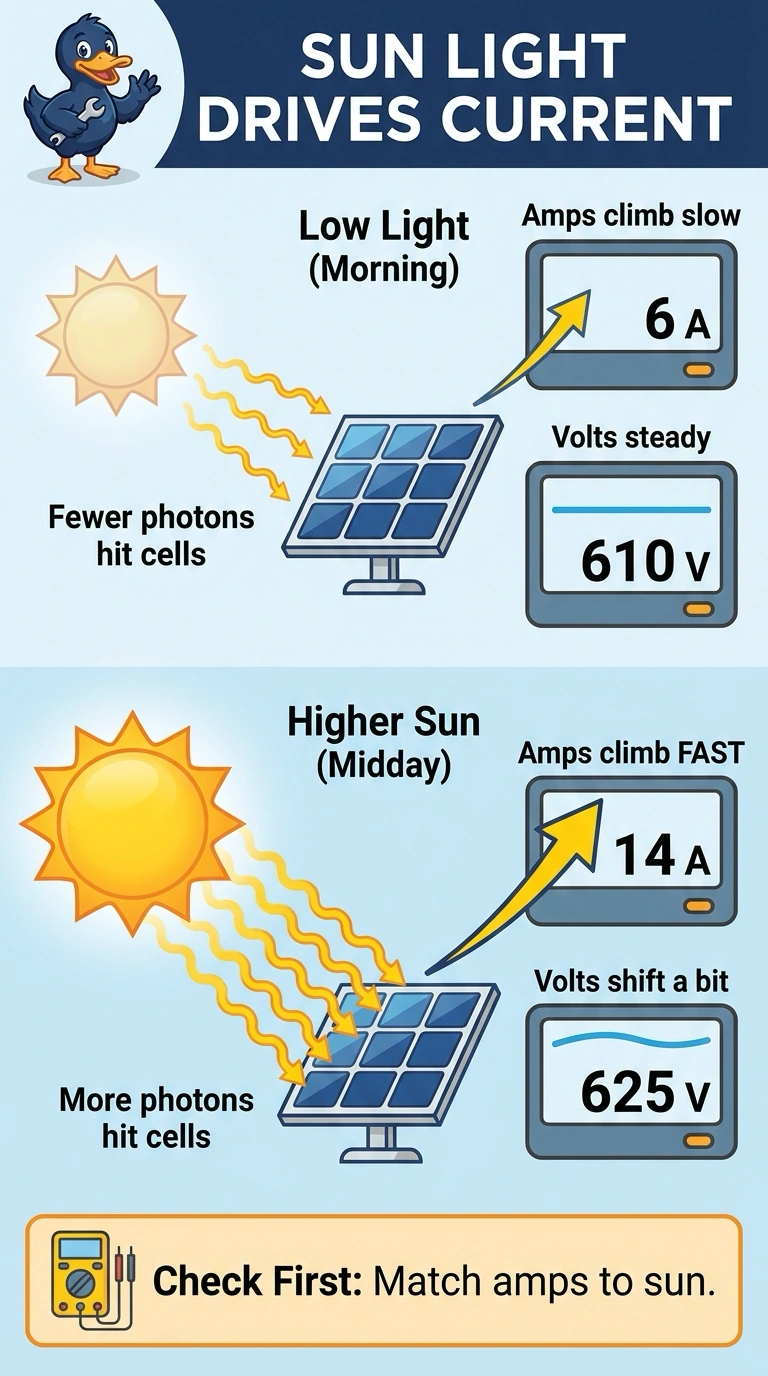
You maintain two identical 10-kW rooftop systems in Phoenix. At 9 a.m. under light haze both show 610 Vdc and 6 A, and at solar noon under clear sky both show 625 Vdc and 14 A. Your supervisor asks for a status note. Which statement correctly explains irradiance effects on performance parameters?
Select an answer to reveal the explanation.
Short Explanation
You nailed the core pattern here — current chases sunlight while voltage holds its ground. Daylight acts like a faucet for amps, not a pressure pump for volts. That small voltage rise versus big current jump is your clue.
Full Explanation
Array current is nearly proportional to plane-of-array irradiance because more photons create more charge carriers that can be collected as current, while cell voltage is set mainly by semiconductor junction properties and changes only logarithmically with light level, so clear midday sun produces a large current gain with only a small voltage gain. The reversed response attributing the large gain to voltage fails because voltage is relatively stiff across normal irradiance swings and temperature often offsets it. The equal-ratio rise fails because voltage and current follow different physical relationships and do not scale together with light. The voltage-drop description confuses irradiance effects with temperature effects, where heat lowers voltage, and misstates the magnitude of both changes. For the exam, remember that low current with normal voltage points toward low light or soiling rather than a failed module, and on site always compare readings to expected irradiance and cell temperature before flagging equipment.