
You maintain a 12-kW rooftop array with central monitoring. On a clear day the site pyranometer drops from 1000 to 400 W/m2 when thin clouds pass, cell temperature stays near 25C, and the inverter stays online with no faults. Output current falls sharply while DC voltage dips only slightly. Which performance statement best explains this irradiance effect?
Select an answer to reveal the explanation.
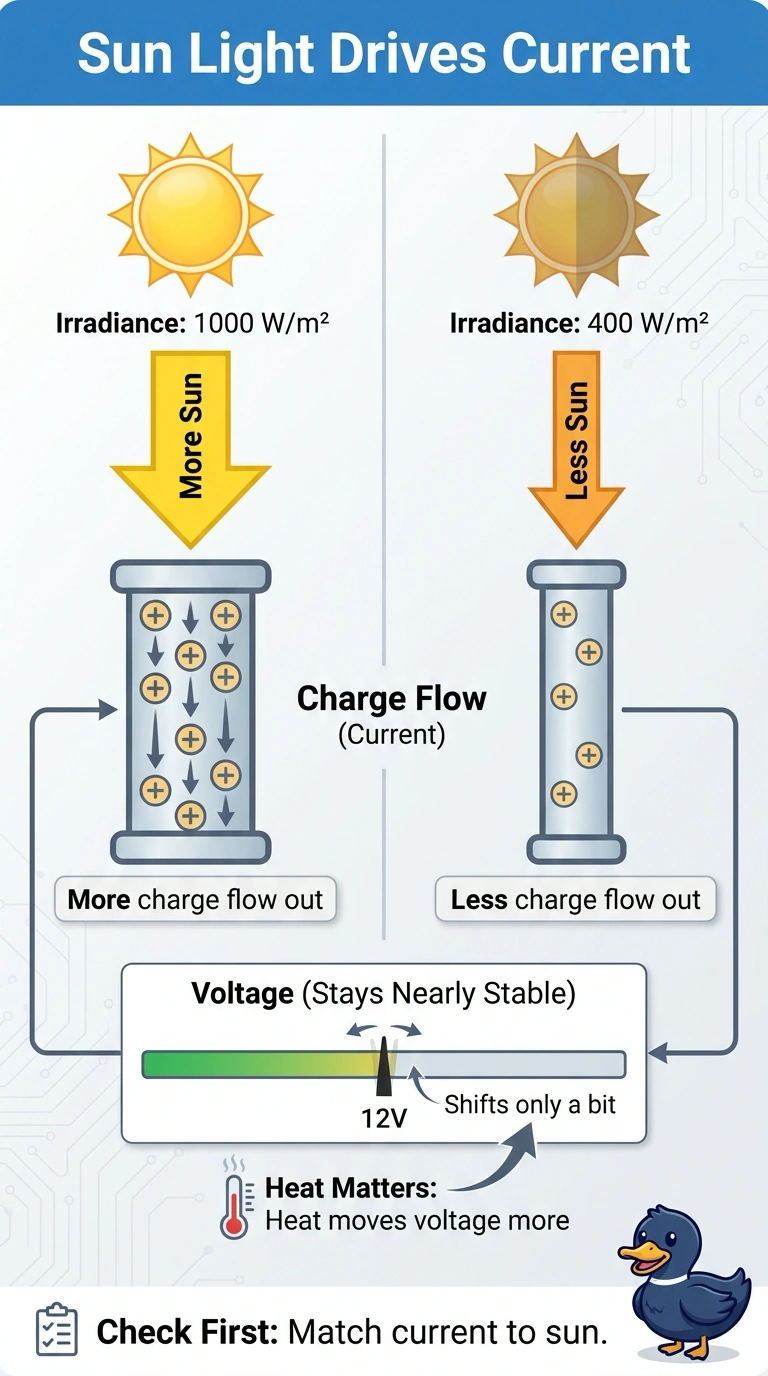
Short Explanation
You caught the classic sunny-day clue — current follows the sun. Proportional current is your bread-and-butter check, like dimmer lights mean less flow from the tap.
Full Explanation
Photocurrent is generated when photons free charge carriers, so short-circuit current and maximum-power current scale almost linearly with irradiance while open-circuit voltage varies with the log of irradiance and stays fairly stable when temperature is constant, which is why monitoring shows a sharp current drop and only a small voltage dip during a cloud event with a healthy inverter online. Describing voltage as proportional reverses the mechanism because voltage is set mainly by cell chemistry and temperature rather than photon count. Claiming equal proportional drops treats the array like a resistor and misses that light primarily controls charge flow, not electrical pressure. Claiming constant power through inverter boost confuses maximum power point tracking with energy creation, since tracking can optimize the operating point but cannot replace missing sunlight. For the exam, remember irradiance drives current and temperature drives voltage, and on site always compare normalized current against irradiance before suspecting soiling or faults.