
An O&M tech is chasing repeated ground-fault alarms on a 3-year-old rooftop string that reads low isolation resistance at the inverter. The array is de-energized, LOTO applied, and conductors are isolated for testing in dry daylight. Which insulation tester practice gives a valid leakage check that shows which conductor is leaking?
Select an answer to reveal the explanation.
Short Explanation
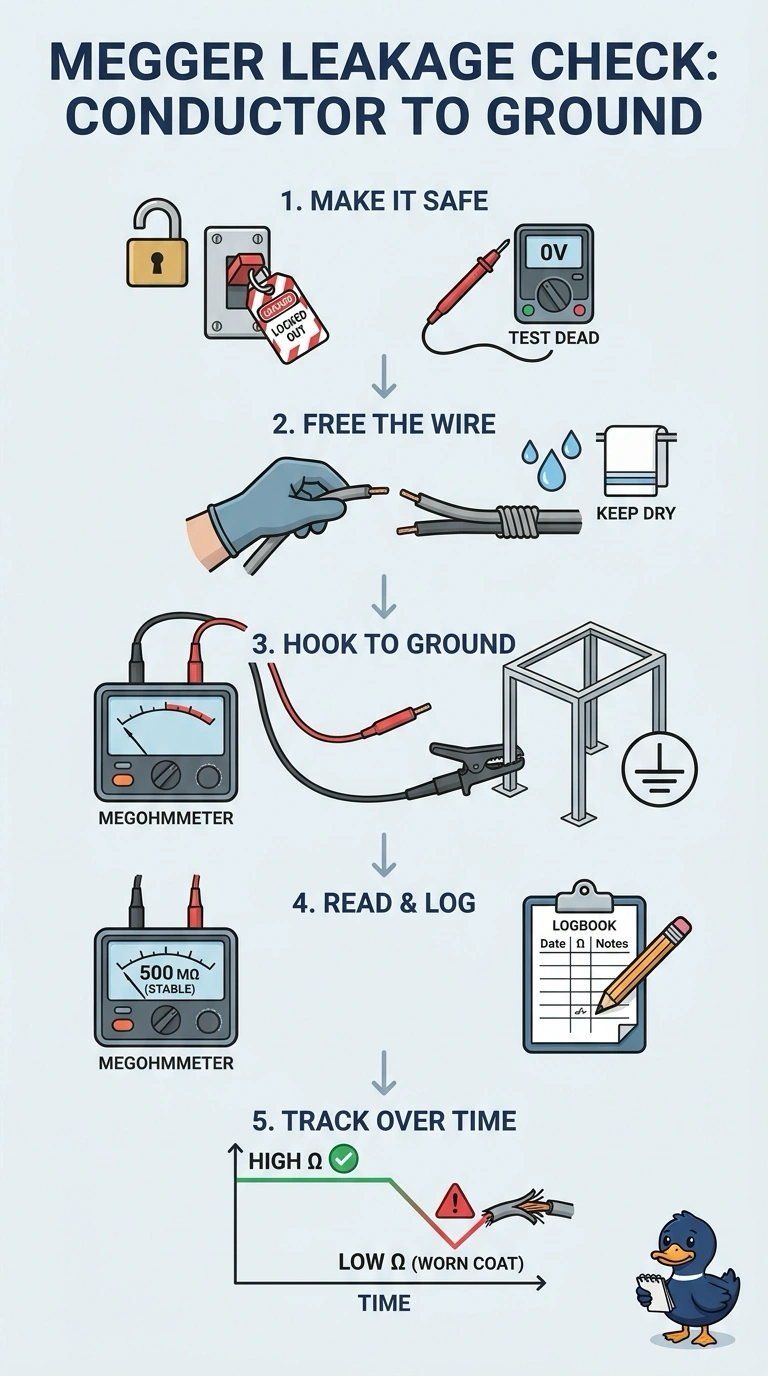
You've set up a clean test, so let the meter do its one job well. A megohmmeter applies high DC volts to reveal weak insulation the way a pressure test finds slow tire leaks. Stable readings to frame tell you if leakage is real.
Full Explanation
Testing each isolated conductor to the grounded frame with a megohmmeter directly checks insulation resistance from the conductors to ground, the leakage path implicated by the inverter alarm. Isolation and LOTO prevent connected equipment or energized circuits from affecting the measurement, while stable readings allow a meaningful comparison and record. A DMM resistance mode is useful for continuity and basic resistance checks, but its low test voltage may not reveal insulation weakness that appears under an insulation tester’s higher, controlled voltage. Bundling positive and negative conductors and testing the bundle to ground measures only the parallel combination of both insulation paths; it can screen for leakage but cannot show which conductor is degraded, so it does not meet the individual-conductor check. Deliberately wetting the modules may help investigate a weather-dependent fault, but it changes the stated dry test condition and can lower or destabilize readings; it is not the specified dry-condition leakage check. Exam caveat: use only the manufacturer-approved test voltage and procedure, and disconnect or protect sensitive electronics, including inverter inputs and surge devices, before applying the megohmmeter. Practical check: verify LOTO, confirm each conductor is actually separated from the inverter and other conductors, inspect leads and frame bonding, then log polarity, test voltage, conditions, and stable readings for comparison.