
A 120-kW rooftop system for a grocery store shows healthy irradiance and no faults, yet output flatlines at 50 kW on sunny afternoons per the utility interconnection agreement that caps export to protect the feeder. Which curtailment and export-limitation behavior best explains this deviation from expected performance?
Select an answer to reveal the explanation.
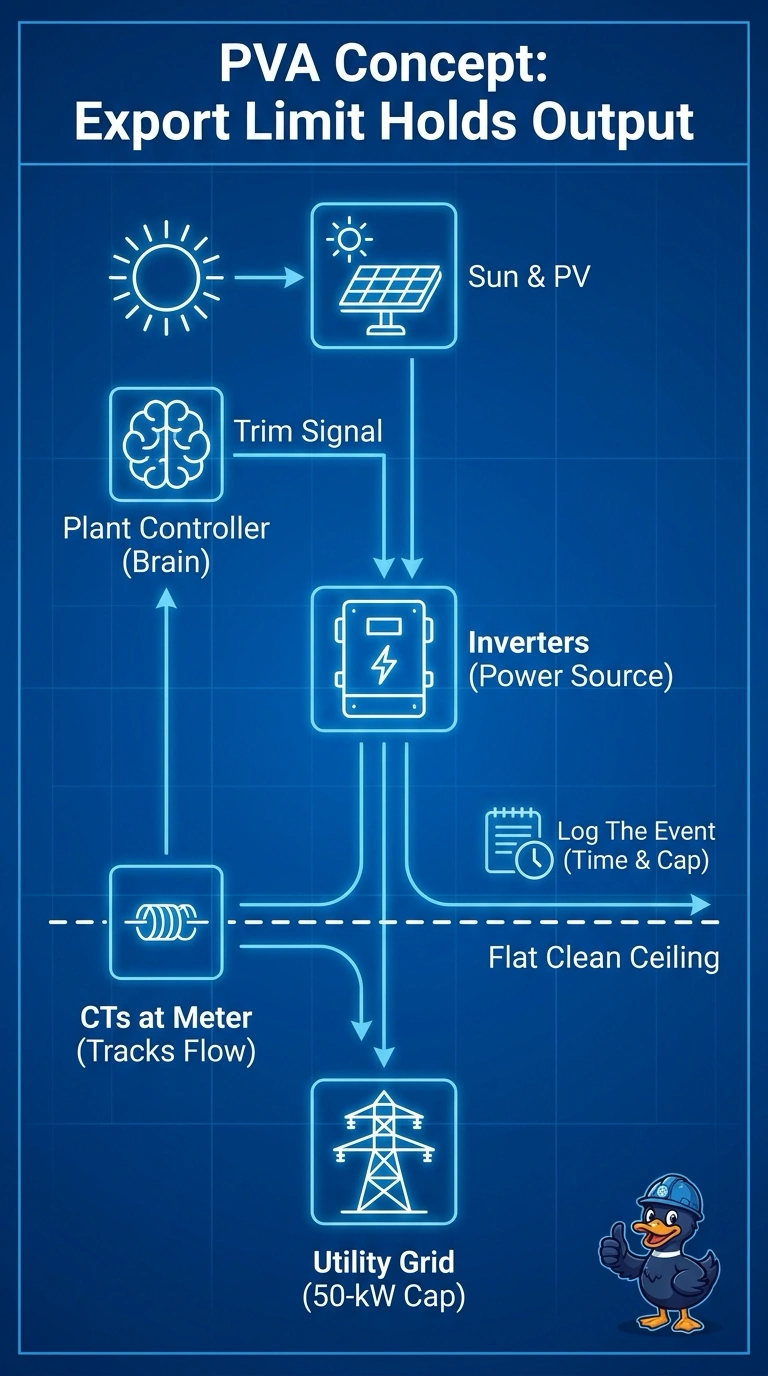
Short Explanation
You nailed a tricky one — grid rules can cap a healthy plant. Export limiting acts like a speed governor that holds output at the allowed cap even when sunshine begs for more.
Full Explanation
The plant controller’s export-limiting function best fits the stated cause: the interconnection agreement restricts power sent to the utility, so the controller uses metering and inverter commands to keep site export within the approved limit. Strong irradiance and fault-free operation are consistent with controlled curtailment rather than a loss of solar resource or equipment failure. Volt-Watt control is a legitimate grid-support function, but it responds to elevated service voltage; no voltage condition is given to explain this output plateau. Frequency-Watt control is also commonly used, but it requires grid frequency to cross a configured response threshold, and the scenario gives no such event. Fixed AC power clipping can flatten output when array capacity exceeds inverter capacity, but no inverter rating is provided to support a 50-kW ceiling, whereas the stated interconnection restriction directly accounts for the behavior. Exam caveat: a 50-kW plant output does not necessarily mean 50 kW is being exported, because the store may consume part of the generation onsite. In practice, compare revenue-grade meter export, site load, inverter power, controller setpoints, and event logs during the plateau to confirm the export-control response and distinguish it from voltage, frequency, or equipment limits.