
Commissioning a 60-kW rooftop array, you find string tags at the combiner box that do not match the tags on the module rows, and no crew member can confirm which set is right. The as-built drawing predates two late field changes, and owner sign-off is tomorrow morning. Which verification step should you run first to reconcile the string labeling?
Select an answer to reveal the explanation.
Short Explanation
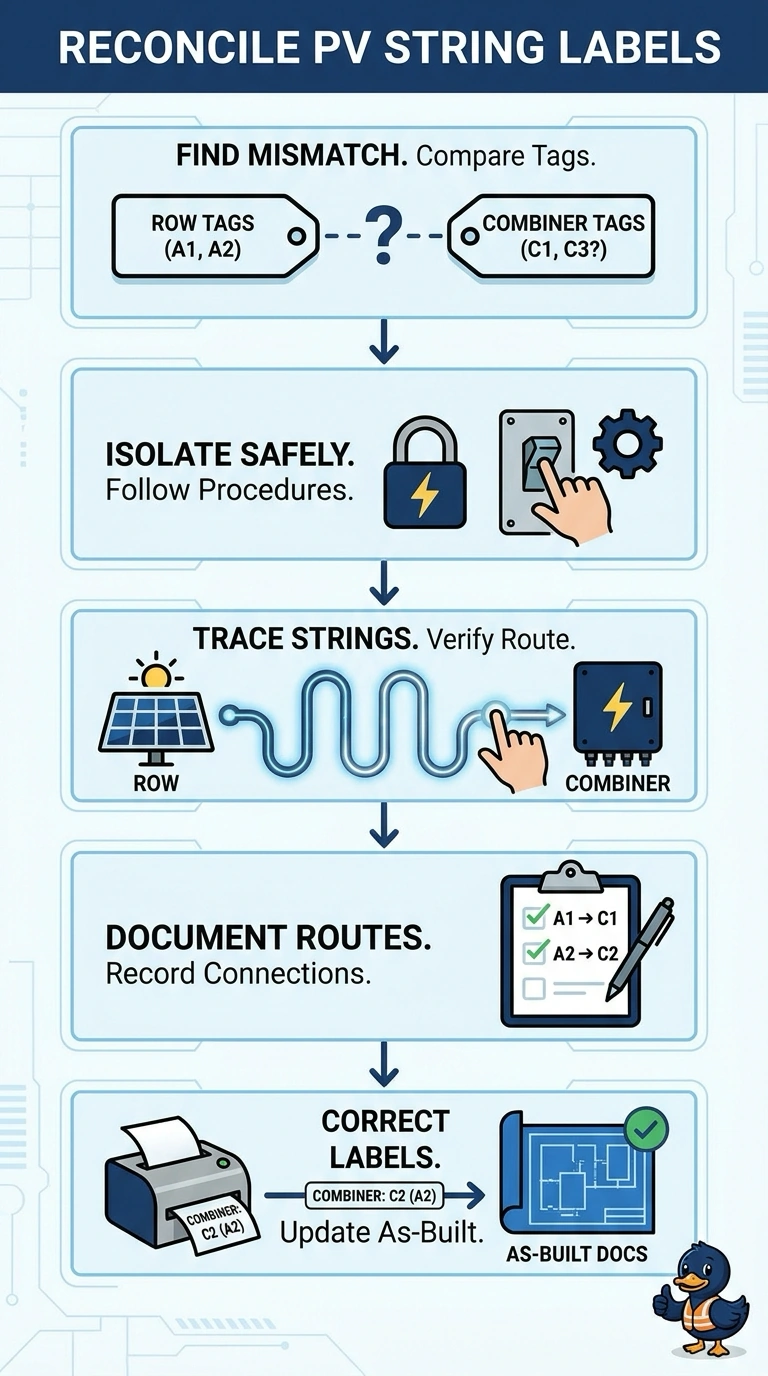
When tags conflict and the drawing is outdated, you need to verify the strings in the field first—like following a mislabeled trail back to its source. Safely isolate and trace each affected string, then correct its labels and document the verified routes.
Full Explanation
Safely isolating and physically tracing each affected string resolves the uncertainty at its source; you can then correct its labels to match the verified routes and document those routes. The as-built drawing cannot establish which tags are correct because it predates two field changes, and the imminent sign-off makes complete, traceable field verification especially important. Tracing and recording routes but postponing relabeling until after sign-off leaves the known mismatch unresolved for the owner’s review. Using the latest approved as-built as the basis for relabeling follows a normal drawing-led workflow, but the stated field changes mean that document is not reliable for resolving the discrepancies without field verification. Tracing one sample string per combiner may suit routine checks, but it cannot establish the identity of every affected run when the tag sets conflict and no crew member can confirm either set. Exam caveat: representative sampling can be appropriate when records and labels are reliable, but it cannot replace tracing each disputed circuit. Practical check: compare each corrected field identifier with the verified route record, and confirm continuity and isolation status before releasing the array for sign-off.