
A ground-mount crew is staking row spacing for a 60-module array. Sheet A-1, the site plan, dimensions the rows at 12 feet from a scaled dimension string, and its title block notes that enlarged layouts and details govern and that scaling from that sheet is prohibited. Sheet A-4 is labeled 'Enlarged array layout' and dimensions the rows at 14 feet with rows running east to west, while detail M-1 shows 15-foot spacing for rows running north to south. This job's rows run east to west. Which source should the crew stake for this job's row spacing?
Select an answer to reveal the explanation.
Short Explanation
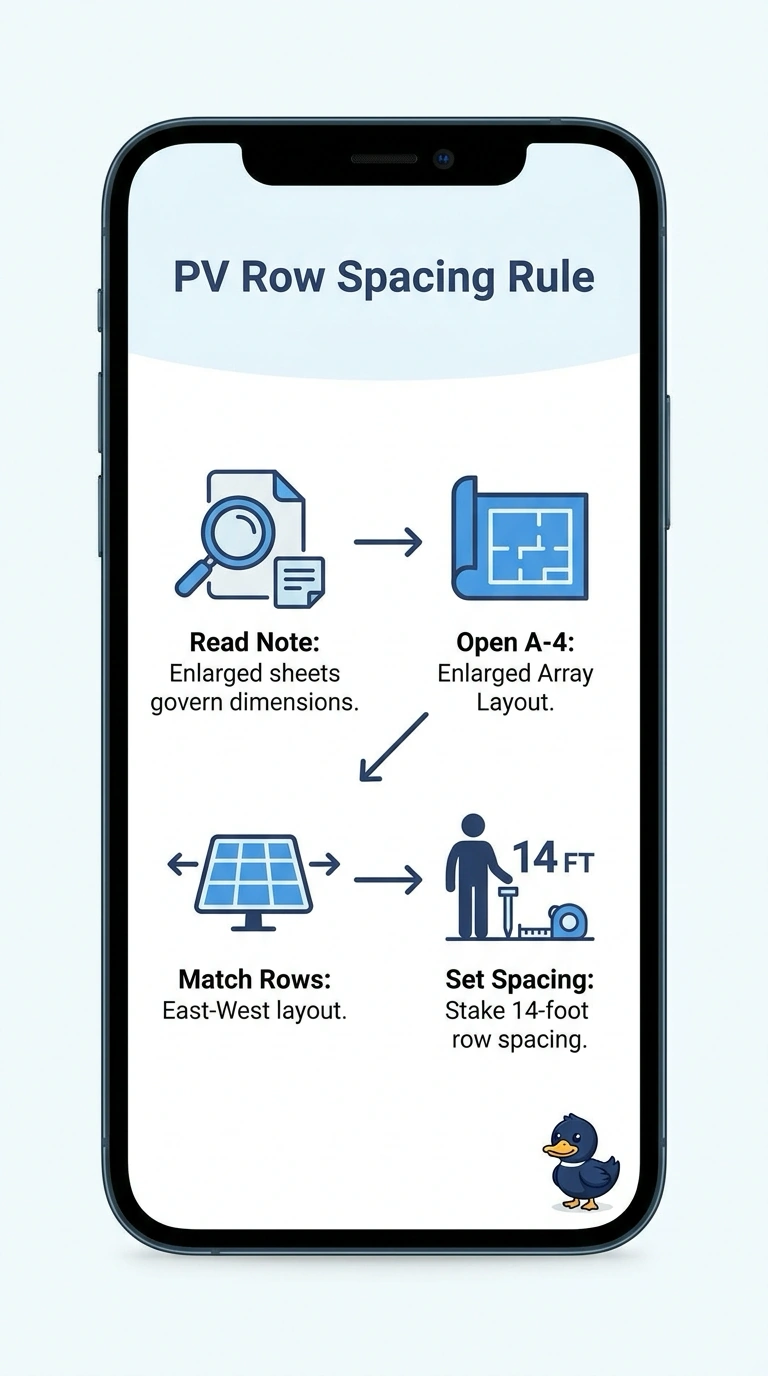
The title-block note gives you the tie-breaker, and A-4 is the enlarged layout for this job's east-west rows. M-1 shows a different row orientation, so its 15-foot spacing does not apply here. A-1's 12-foot dimension does not govern where A-4 provides the enlarged layout, and the note prohibits scaling from A-1.
Full Explanation
The crew should stake 14-foot spacing from A-4: it is explicitly the enlarged array layout, and A-1's title-block note says enlarged layouts and details govern. A-1's 12-foot figure comes from a scaled dimension string, so using it for staking disregards the explicit prohibition on scaling from that sheet; an overall plan's coordination role does not override its stated limitation. M-1 provides a legitimate detail dimension, but its 15-foot spacing is for rows running north to south, whereas the question identifies the array rows as east to west. Applying A-4's 14-foot dimension to every orientation also overextends its information: A-4 gives that spacing for east-to-west rows, while M-1 specifies a different spacing for north-to-south rows. The exam caveat is to read orientation and applicability notes alongside drawing hierarchy; a detail can govern where it applies without controlling every condition on the project. Before staking, the practical check is to confirm the row orientation and the applicable dimension on the issued enlarged layout, and resolve any conflicting or unclear scope with the design team rather than measuring from A-1.