
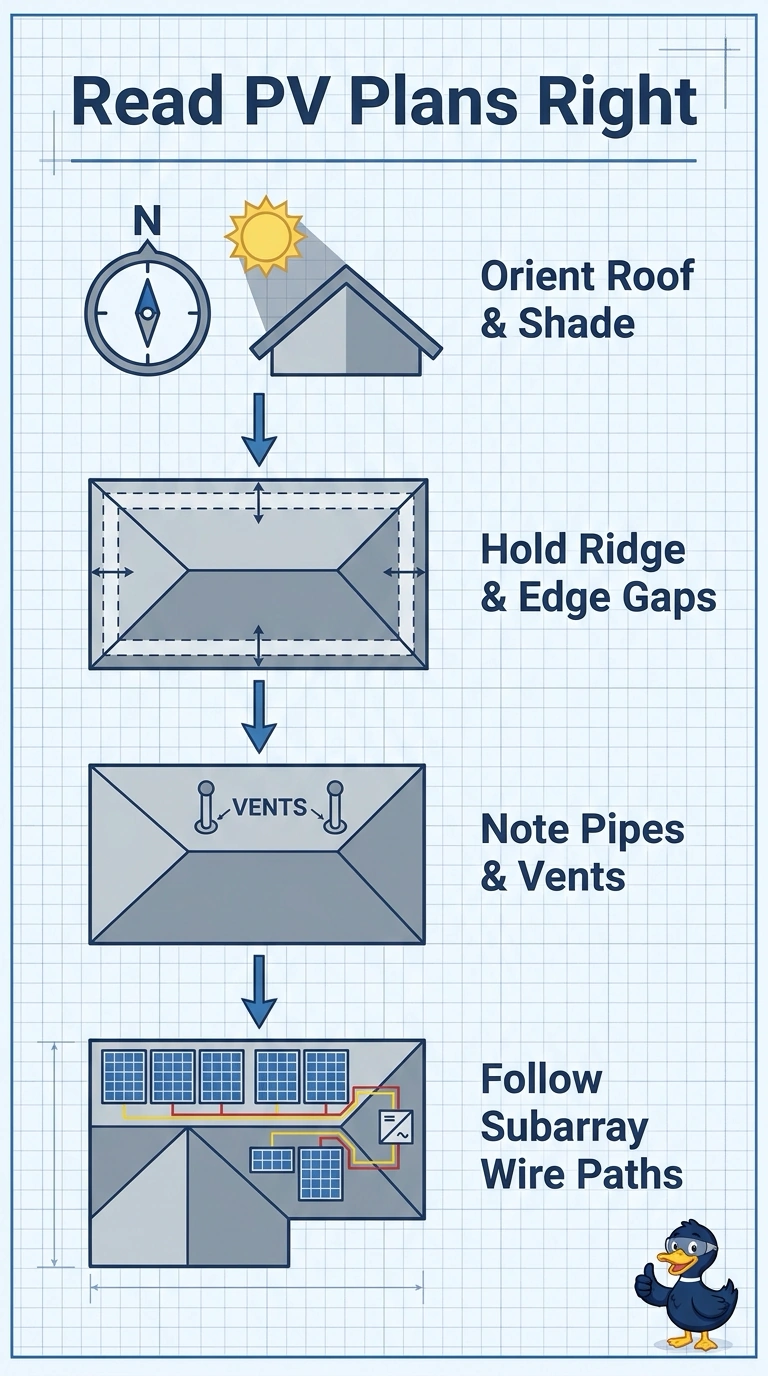
You get a permit set for a 9-kW home showing a north arrow, property lines, a 3-ft ridge setback, vent locations, and two subarrays with string labels. The foreman asks for rail spans and wire routing confirmation. Which plan-reading task extracts site plans and array layouts for the install?
Select an answer to reveal the explanation.
Short Explanation
You're reading a treasure map before you climb, not guessing on the roof. A sharp plan review turns lines and labels into rail and wire paths.
Full Explanation
The correct task is a layout review because it interprets the plan set as a coordinated site and array drawing: setbacks and vents constrain usable roof area, subarray positions show where modules are grouped, and string labels or routes help confirm wiring intent. Those details give the foreman the layout context needed to check installation planning. A structural review is an appropriate field task for checking framing, attachment locations, and rail spans, but it does not confirm the wire routing requested here. An electrical review is a standard way to trace strings and conduit or homerun paths, but it does not establish the rail spans, which depend on the roof and racking layout. A layout review that omits the north arrow can capture the other listed features yet still fail to orient the roof plan correctly to the site; direction matters when interpreting array placement. Exam caveat: permit drawings may show design intent rather than final field conditions, and not every sheet contains both structural and electrical details. Practical check: compare the site and roof plan with the structural and electrical sheets, then verify rail dimensions and proposed wire routes against the approved drawings and actual roof conditions before installation.