
A 50 kW ground array in a dusty farm area faces hot summers, winter snow, and seasonal pollen that coats modules and raises cell heat. The designer must adjust expected yield for climate losses. Which design allowance best accounts for weather and soiling effects?
Select an answer to reveal the explanation.
Short Explanation
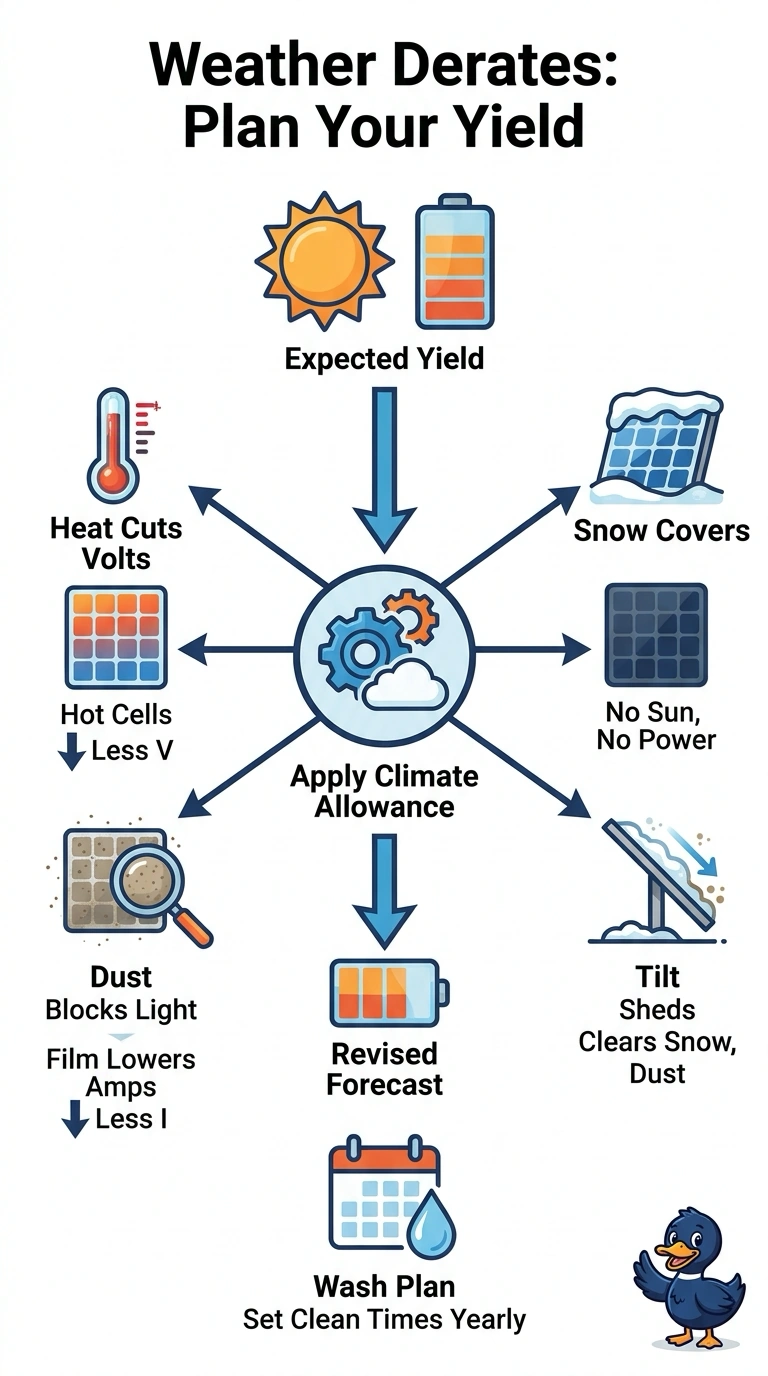
You’re planning for real weather, not lab conditions, so your yield estimate should reflect what your modules will actually face. A sound climate derate trims sunny-day expectations for heat, snow, dust, and seasonal pollen—like leaving extra time for traffic.
Full Explanation
A climate allowance that derates expected yield for heat, snow, dust, and seasonal soiling captures the full set of stated effects. High cell temperatures reduce module output, snow can block irradiance, and dust and pollen can reduce light reaching the cells. A site-specific model for heat, snow, and dust that omits pollen misses a recurring source of soiling; its impact is not automatically negligible. Modeling heat, snow, and pollen while assuming routine cleaning eliminates farm-dust losses is also incomplete: cleaning can limit accumulation, but it does not prove dust causes no production loss between cleanings. Using local records for snow, dust, and pollen while omitting temperature derating fails to account for reduced output at hot operating cell temperatures. Apply a suitable temperature coefficient to expected module temperatures rather than leaving temperature effects out. Exam caveat: avoid double-counting losses if the yield model already incorporates temperature, snow, or soiling assumptions. Practical check: compare the model’s weather inputs and loss settings with local temperature records, snow conditions, dust and pollen patterns, and the planned cleaning schedule.