
You must lift six modules and rails to a second-story roof over a narrow side yard with a fence, kids next door, and gusty wind. Crew have ropes, a gin pole, and tool lanyards. Which hoisting, rigging, and tool-tethering method keeps the lift controlled and the ground clear?
Select an answer to reveal the explanation.
Short Explanation
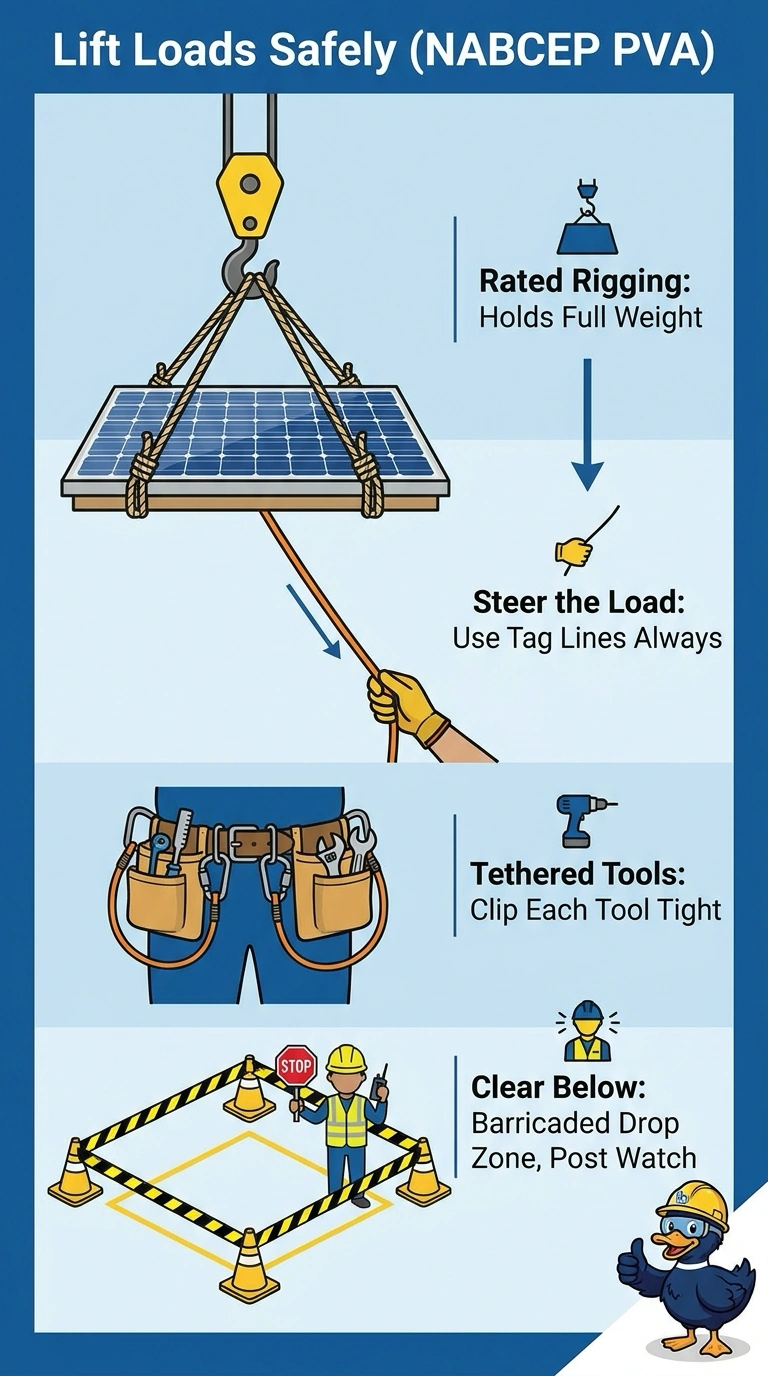
You keep the lift controlled by pairing rated rigging and tag lines with tethered tools and a barricaded drop zone monitored by a spotter. These layered controls help manage gusts, dropped objects, and access to the area below.
Full Explanation
The safe method combines controls for the suspended load, falling objects, and people below: rated rigging supports the lift, tag lines help guide the modules and rails in gusts, tool tethers reduce dropped-object hazards, and a barricaded drop zone keeps people out while a spotter monitors the operation. Using a gin pole with rated rigging, tethered tools, a barricade, and a spotter can provide a useful lifting point, but omitting tag lines leaves the load harder to control against rotation or wind-driven movement. Stowing tools in closed belt pouches can secure them during work, but it does not replace tool tethers; a tool could still fall if removed or dropped during the lift. Having a spotter monitor a marked drop zone adds oversight, but without a physical barricade the area is not as effectively kept clear. Exam caveat: a spotter or visual marking does not automatically replace a required exclusion barrier, and controls must suit the site and lift plan. Before lifting, verify rigging ratings and connections, confirm tag lines and tool lanyards are attached, and check that the barricade fully encloses the drop zone with access controlled.