
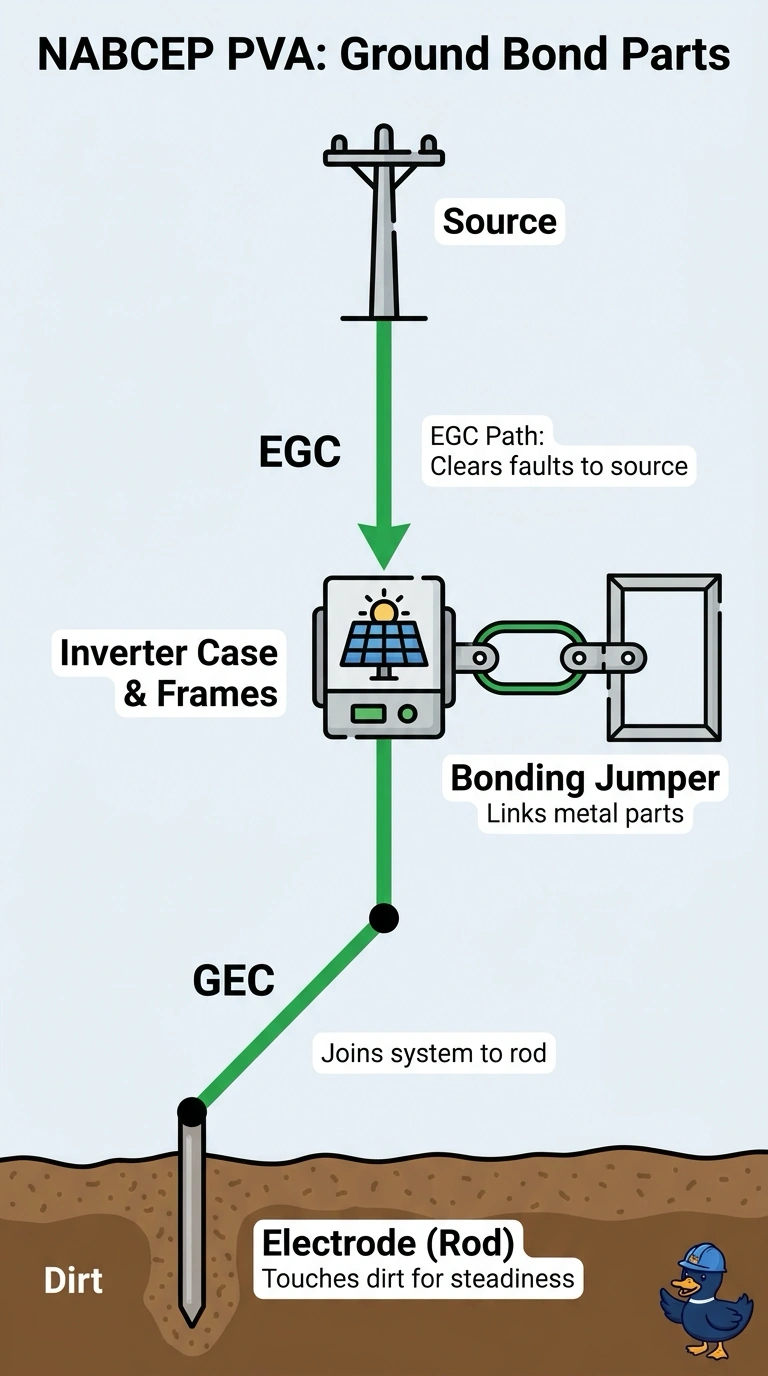
A trainee wires a residential rooftop system where module frames must link together, the inverter case needs fault protection, and a ground rod ties the system to earth through a continuous conductor with jumpers around lugs. Which grounding and bonding element choice correctly separates EGC, GEC, electrode and jumper?
Select an answer to reveal the explanation.
Short Explanation
You wire it right when every path has a clear purpose. The bonding network carries fault current, while the grounding conductor leads that network to earth.
Full Explanation
The correct choice gives each part its distinct function: the equipment grounding conductor (EGC) provides the fault-current path from exposed equipment, including the inverter case, and bonds the module frames; the grounding electrode conductor (GEC) connects the system grounding point to the electrode; the electrode connects to earth; and bonding jumpers preserve electrical continuity around lugs. The arrangement with jumpers between frame-to-frame joints assigns them the wrong task: it does not maintain continuity around the specified lugs. The arrangement with jumpers across conductor splices also fails because continuity at a splice does not substitute for the required lug bypass. The arrangement that assigns module-frame bonding to the GEC misplaces that function; frame bonding and equipment fault protection belong to the EGC, while the GEC connects the system grounding point to the electrode. Exam caveat: conductor sizing, permitted connections, and bonding details depend on the adopted code edition and equipment instructions. Practical check: trace the EGC from the bonded frames and inverter case, follow the GEC to the electrode, and inspect each lug for a correctly installed continuity jumper.