
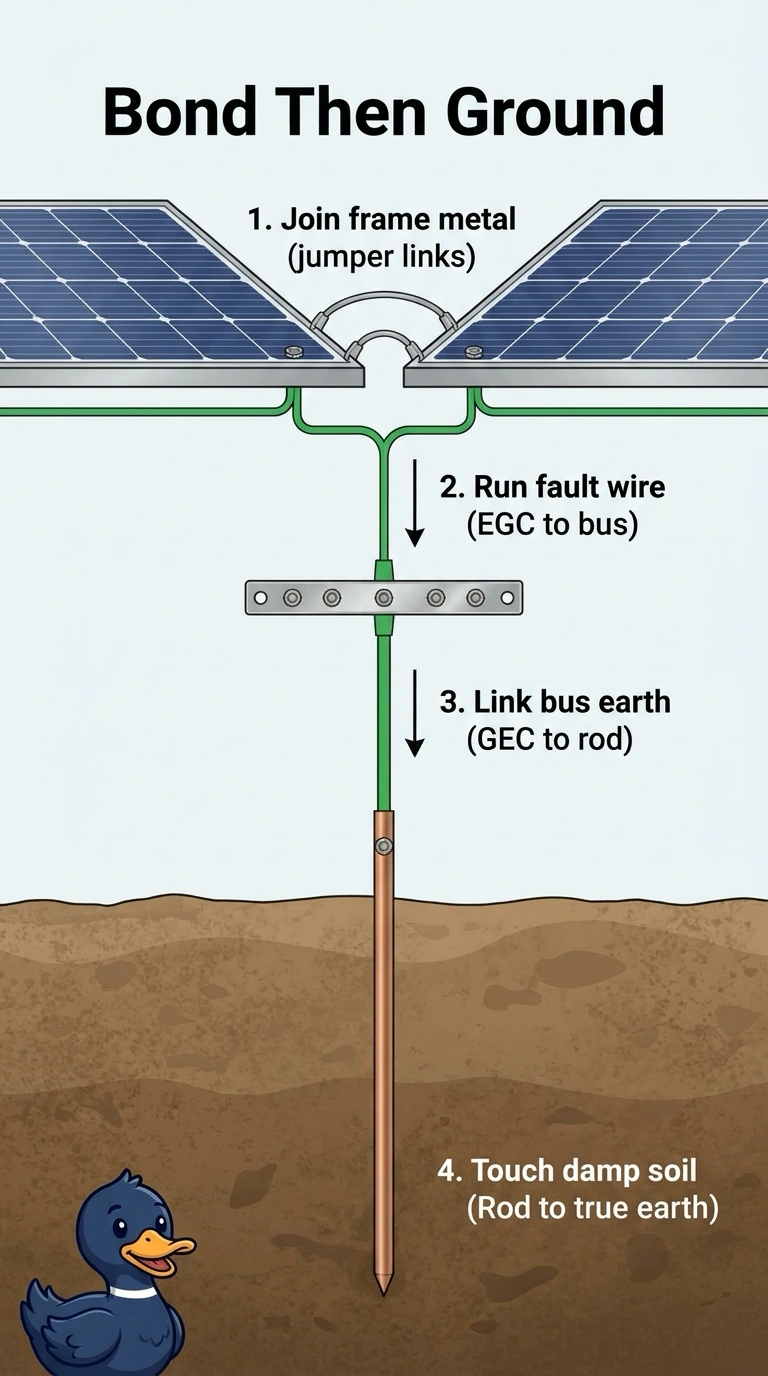
On a residential rooftop retrofit, the installer bonds module frames to rails and runs a wire from the rail to the main grounding bus, which ties to a ground rod. The lead confuses the rail wire with the rod wire. Which grounding and bonding distinction correctly names EGC, GEC, electrode, and bonding jumper for this system?
Select an answer to reveal the explanation.
Short Explanation
Sorting wires by job makes the whole system click, promise. Your EGC handles fault current while the GEC and rod handle earth tie.
Full Explanation
The correct description keeps the functions distinct: the equipment grounding conductor (EGC) bonds exposed module frames and associated metalwork into the equipment fault-current path; the grounding electrode conductor (GEC) connects the grounding bus or system to the grounding electrode; and a bonding jumper electrically joins conductive parts that need to be bonded. A ground rod is an electrode, not a substitute for the low-impedance metallic path that should carry a ground fault back to the source and support protective-device operation. Treating the electrode itself as the fault-clearing path therefore confuses grounding-electrode connection with equipment grounding. Calling the bus-to-rod conductor a bonding jumper misnames the GEC; the rod may still be correctly identified as the electrode. Reversing the EGC and GEC assignments also fails: the frame-bonding and electrode-connection functions are assigned to the wrong conductors, even though the jumper’s general role is stated correctly. Exam caveat: terminology and conductor routing can vary with system layout and applicable code, so do not infer a conductor’s function from color or physical proximity alone. Practical check: trace each conductor from endpoint to endpoint and verify that the frames have a continuous equipment-grounding path to the system, while the GEC runs from the grounding bus to the electrode.