
On a ground-mount service call, an apprentice sees bare copper to frames, a lug to a ground rod, and a jumper between metal boxes and asks what each part does for fault safety. The lead must clarify paths without quoting code text. Which answer best distinguishes grounding and bonding elements EGC, GEC, electrode, and jumper?
Select an answer to reveal the explanation.
Short Explanation
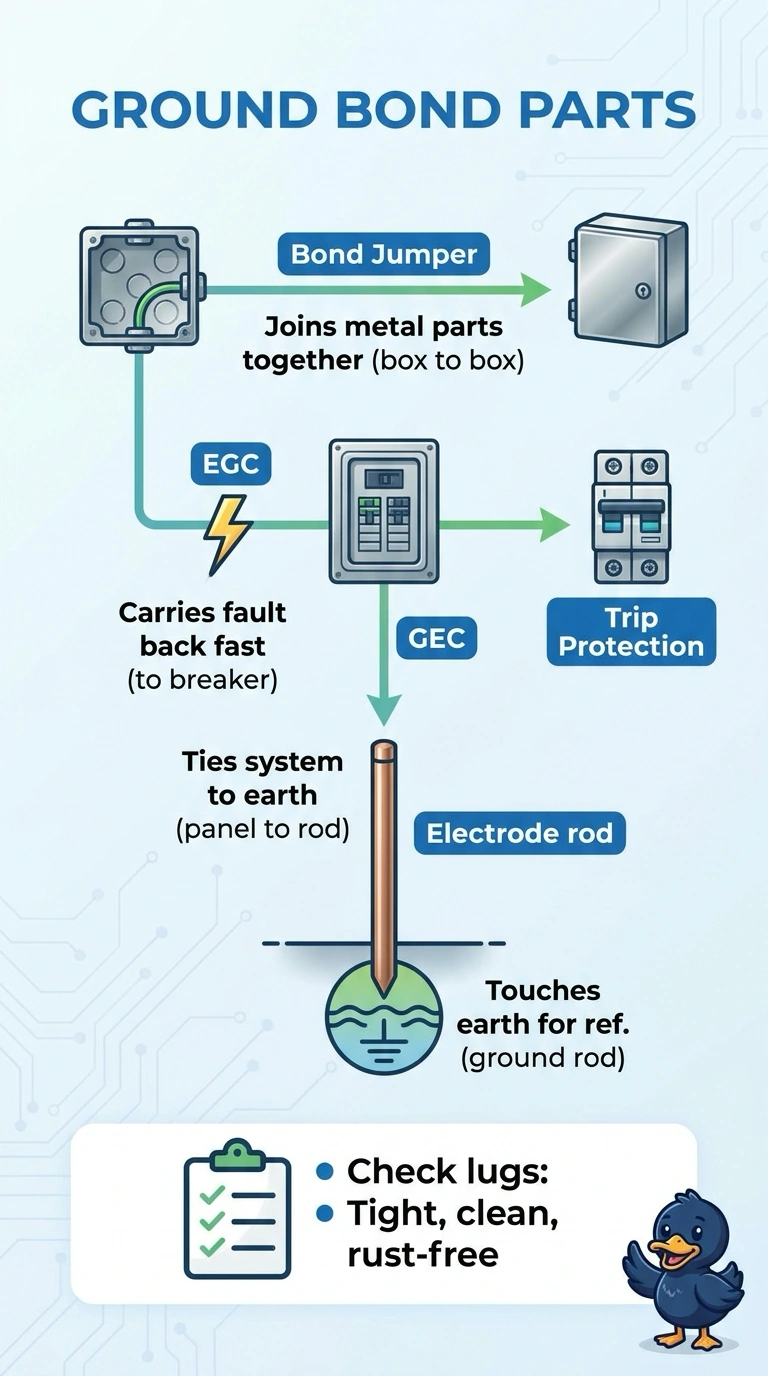
You can keep the paths straight by matching each part to its job. Bonding joins metal parts so a fault has a continuous path back to the source.
Full Explanation
The accurate distinction is that the equipment grounding conductor (EGC) provides a conductive fault-current path back to the source so overcurrent protection can operate; the grounding electrode conductor (GEC) connects the system to the grounding electrode; the electrode makes the connection to earth; and a bonding jumper electrically joins metal parts, such as boxes, to maintain continuity. Describing the EGC as bonding frames to the equipment ground path captures a connection it helps establish, but assigning the fault-current path that trips protection to the GEC confuses the GEC’s role with the EGC’s. Calling the electrode the low-impedance return path to trip protection is also incorrect: earth is not a substitute for the metallic fault-current path. Saying the jumper connects metal boxes to the grounding electrode misstates its job; it bonds the boxes to one another or to the relevant metal path, not to the electrode. Exam caveat: terminology and diagrams may vary by system, and an electrode connection to earth should not be assumed to clear a ground fault. Practical check: trace the intended fault path from exposed metal through the EGC and bonding connections back to the source, then verify that the GEC connects the system to the electrode.