
A service call finds a scorched combiner with melted insulation, a lingering burnt smell, and midday sun keeping the roof array live with no effective rapid-shutdown reset. The owner wants power back fast. Which assessment captures the risk of working on energized or faulty equipment including rapid shutdown?
Select an answer to reveal the explanation.
Short Explanation
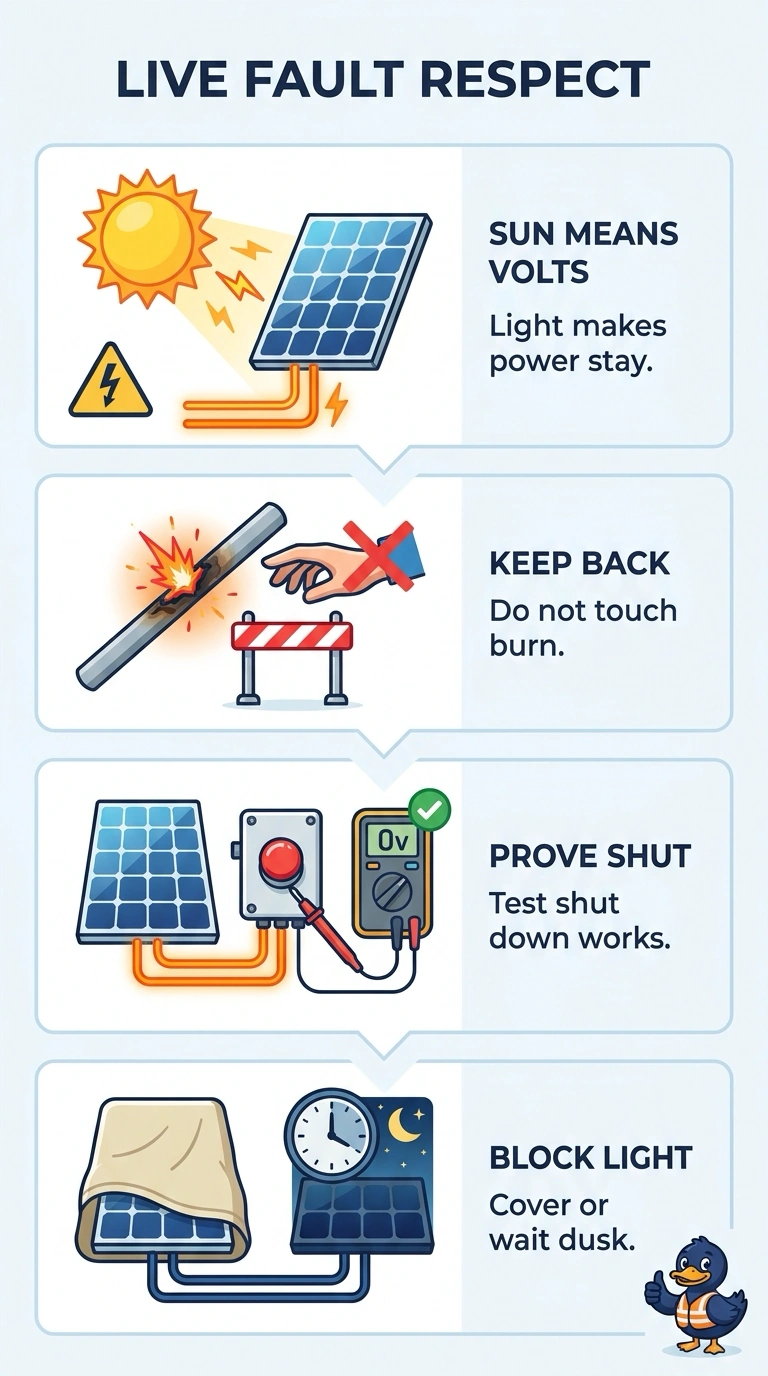
In daylight, treat the array conductors as live—even when switches are off—like a stove that stays hot after you turn the knob. Keep clear of the scorched equipment, verify rapid shutdown works before touching anything, and cover the array or wait until it is no longer energized; your safety comes first.
Full Explanation
PV modules can produce hazardous DC voltage in daylight even when an inverter or other switch is open. Scorched equipment and melted insulation signal a fault, and a rapid-shutdown system that has not reset effectively cannot be assumed to make the array safe. Keep clear of the damage, verify rapid-shutdown function before contact, and reduce generation by covering the array or waiting until it is no longer energized. Treating the array as live, cordoning off the damaged area, and isolating the inverter are prudent, but leaving without checking rapid-shutdown operation leaves its status unknown. Treating conductors as live and keeping clear are also prudent, but a status indicator alone does not prove shutdown worked, particularly when the reset is already ineffective. Treating the fault as an arc-flash hazard and establishing an exclusion zone are sensible, but inverter isolation does not stop modules generating in sunlight; that approach neither covers the array nor waits for daylight to fade. Exam caveat: shutdown behavior and voltage limits depend on system design and applicable code, so a switch position or indicator alone does not establish safety. Practical check: follow the manufacturer’s procedure and use properly rated test equipment at the intended work point to confirm the required voltage state before contact.