
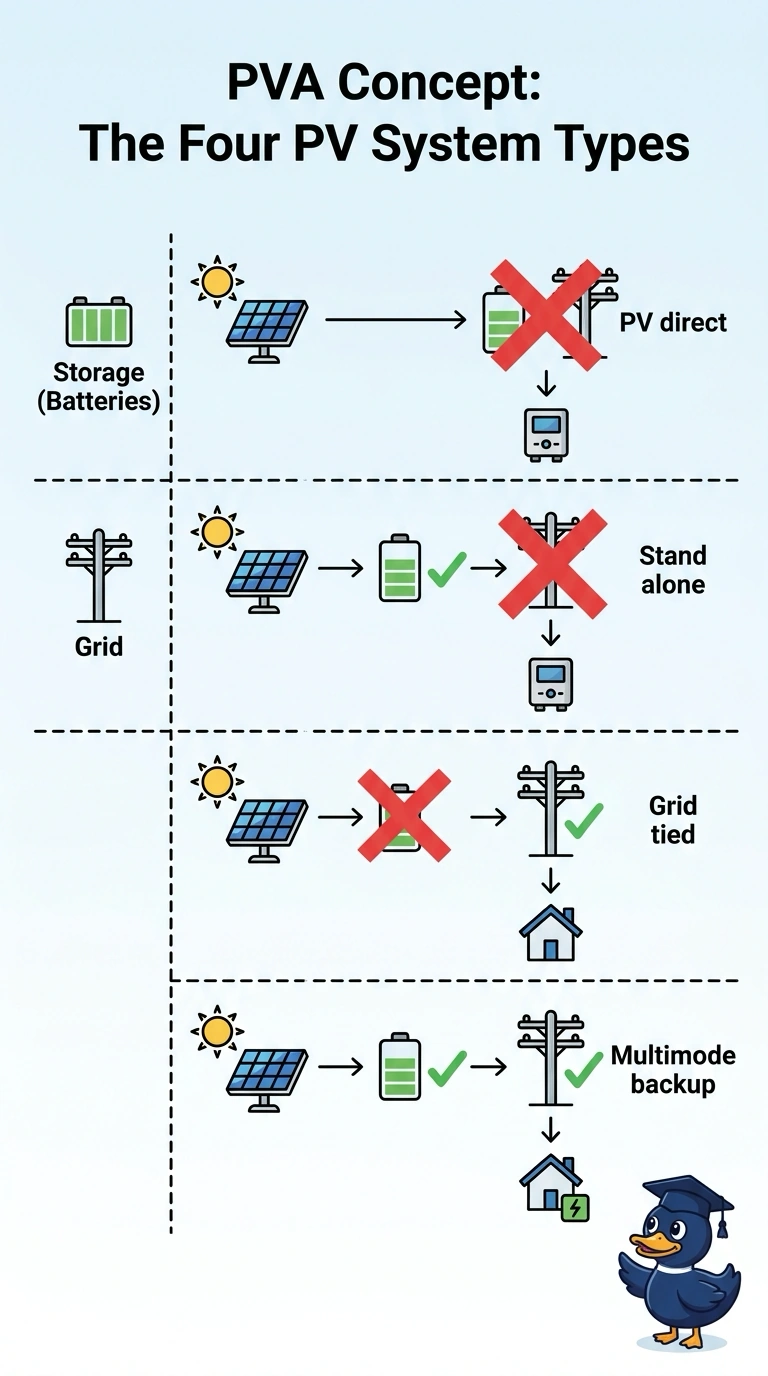
A trainee confuses a fan wired straight to a module, a cabin with batteries and no grid, a suburban net-metered roof, and a suburban roof with backup batteries. Which concept check distinguishes PV direct, stand-alone, grid-tied, and multimode systems by storage and grid ties?
Select an answer to reveal the explanation.
Short Explanation
You're sorting by two simple yes-or-no questions about grid and batteries. Your system type grid is like sorting cars by fuel and spare tire, quick and clear.
Full Explanation
Grid connection and energy storage are the defining checks because the four systems differ in whether they connect to the utility and whether they use storage. A direct PV system typically powers a load when sunlight is available, without batteries or a utility connection. A stand-alone system is not grid-connected and uses storage to serve loads beyond immediate PV production. A grid-tied system exports or imports energy through the utility connection and ordinarily has no storage. A multimode system combines a grid connection with storage and can supply designated loads during an outage, subject to its equipment and configuration. Inverter configuration is relevant to system operation, but it does not replace the missing grid-or-storage criterion: inverter features alone cannot reliably distinguish all four categories. Battery storage is likewise important, but inverter configuration cannot tell whether the system is grid-connected, so that approach conflates stand-alone and grid-connected arrangements. Grid connection is not enough either; battery capacity is a sizing value, not a yes/no indication of storage, and it cannot distinguish a grid-tied system from a multimode one. Exam caveat: a grid-connected system may include batteries, and backup operation depends on approved islanding controls rather than battery presence alone. Practical check: trace the one-line diagram for a utility interconnection and confirm whether batteries are installed and connected to the system.