
A two-person crew must clean dust from ground-mount modules reached by kneeling on a damp hillside near a pond, with slip and shock risks from hoses and cords. The foreman can reroute work to dry level carts. Which control choice applies the hierarchy of controls to this solar hazard?
Select an answer to reveal the explanation.
Short Explanation
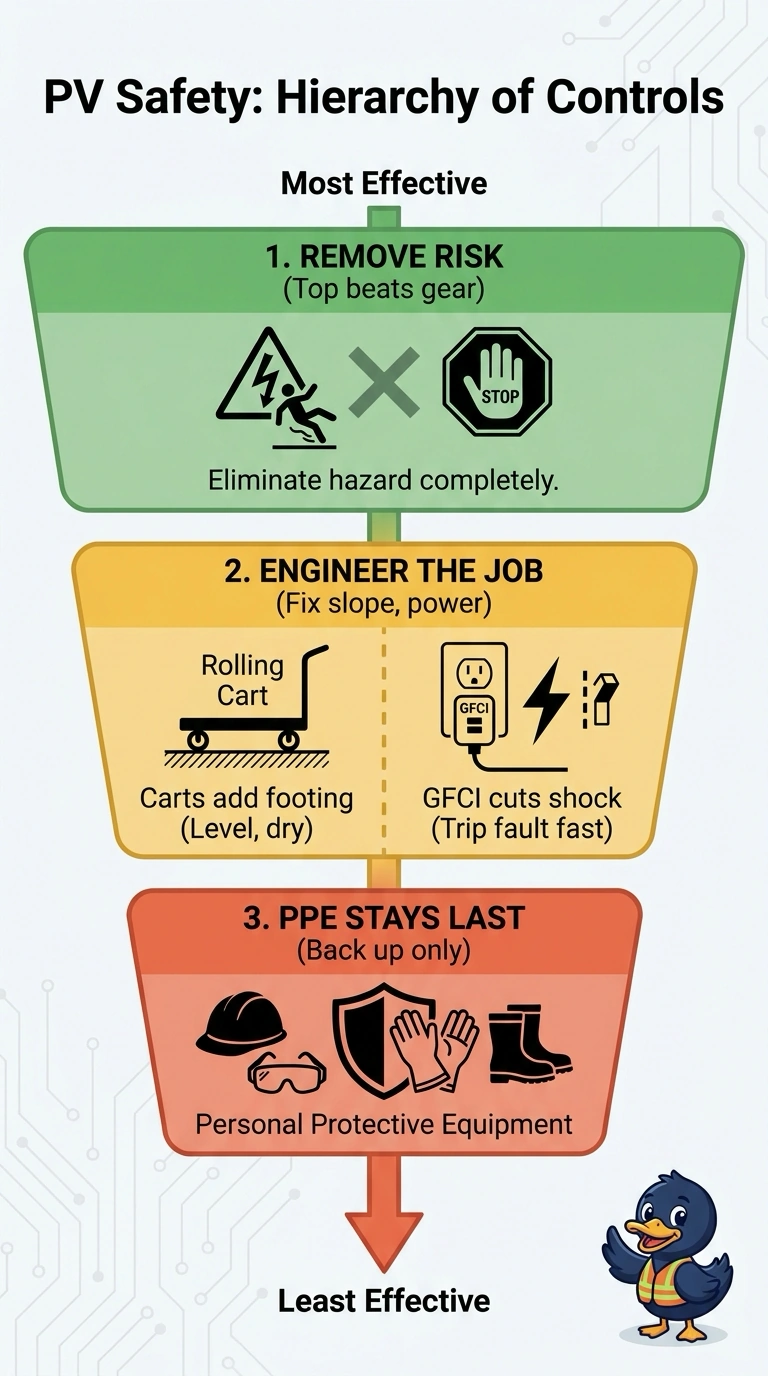
You're fixing the stage, not just suiting up the actors. Engineering changes the setup itself, like adding rails instead of shouting be careful.
Full Explanation
The correct choice applies engineering controls because stable rolling carts separate workers from the damp hillside kneeling position and pond-edge slip plane while GFCI power interrupts cord shock paths, controlling both stated risks without relying on behavior and using the foreman's ability to reroute to dry level carts. De-energizing and locking out array circuits before washing is a valid elimination step for shock that follows electrical safety practice but fails on scope because the crew still kneels on the damp slope with hose water near the pond, leaving slip and fall unaddressed. Substituting cord-powered washers with battery units is a legitimate substitution widely used to cut cord hazards but fails by incompleteness because it removes only one shock path while the wet-slope method and hose slip risk remain and the feasible dry-level isolation is unused. Enforcing a two-person buddy system with hose and cord procedures is sound administrative practice for awareness around water and electricity but fails by level because it depends on vigilance rather than removing the slip and shock paths when engineering is available. An exam caveat is that a higher label alone is not correct if it leaves a stated hazard uncontrolled while another feasible choice controls both hazards. A practical check is to verify carts are level, locked and on dry ground, test GFCI trip before washing, route hoses and cords clear of the pond, and stop work if conditions turn wet again.