
During commissioning of a 12 kW rooftop array, a tech uses a handheld tracer on one string at midday and records open-circuit, short-circuit, and peak-power values to compare with the datasheet. The crew leader asks for a clear field reading of curve points. Which reading best identifies Isc, Voc, and maximum power point?
Select an answer to reveal the explanation.
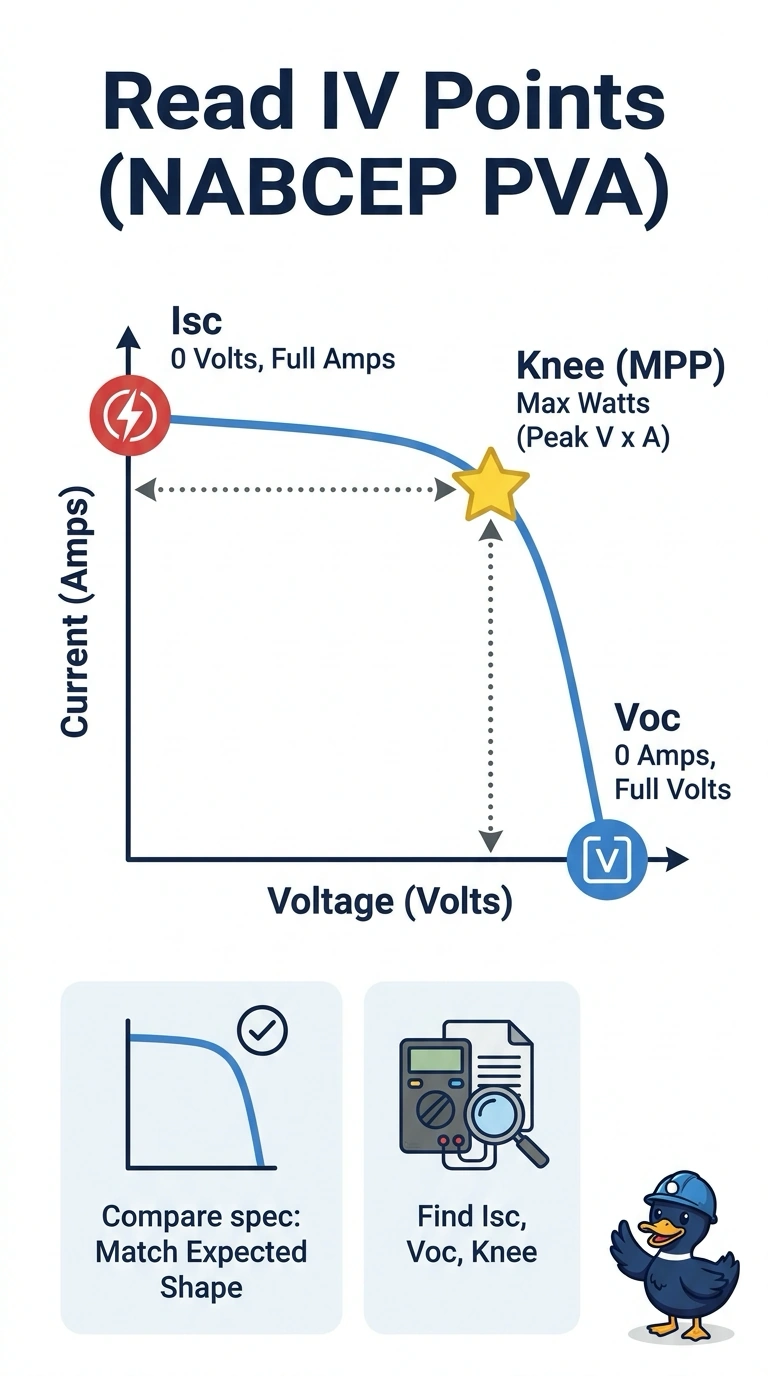
Short Explanation
You read the curve from its ends to its bend. The sharp knee marks where volts times amps peak, just like the sweet spot on a hose nozzle.
Full Explanation
The correct reading assigns each quantity to its defining point on the I–V curve: Isc is the current where voltage is zero, Voc is the voltage where current is zero, and maximum power occurs at the knee, where voltage multiplied by current is greatest. These definitions let the technician interpret the handheld tracer’s string-level curve directly. A whole-array sweep uses the right curve-point definitions, but it measures a different electrical scope from the requested single string; array-level values can conceal string-specific performance issues and do not satisfy the stated measurement. Comparing the midday trace directly with the datasheet’s STC curve is a familiar reference method, but it treats measurements taken under different irradiance and temperature conditions as directly comparable. STC values are standardized reference values, not expected midday field readings without suitable correction or normalization. Inverter MPPT telemetry can report the operating voltage and current at the tracker’s operating point and is useful for checking the MPP, but it does not provide the curve’s open-circuit and short-circuit endpoints; those require appropriate tracer measurements. Exam caveat: the knee is a visual shorthand for the maximum-power point, not a fixed voltage or current, and its location shifts with operating conditions. Practical check: confirm the tracer is connected to the intended isolated string, record irradiance and module temperature, and verify the trace shows both endpoints before comparing values with the datasheet.