
A garage retrofit adds a wall-mounted lithium battery, a hybrid inverter, and a critical-loads panel fed during outages. The crew has arc-flash, disconnect, and NEC-required placards ready. Which storage labeling and marking approach completes the install for first responders?
Select an answer to reveal the explanation.
Short Explanation
You’re leaving clues for crews who may arrive in smoke. Marking each box and path helps you guide them like street signs on a dark road.
Full Explanation
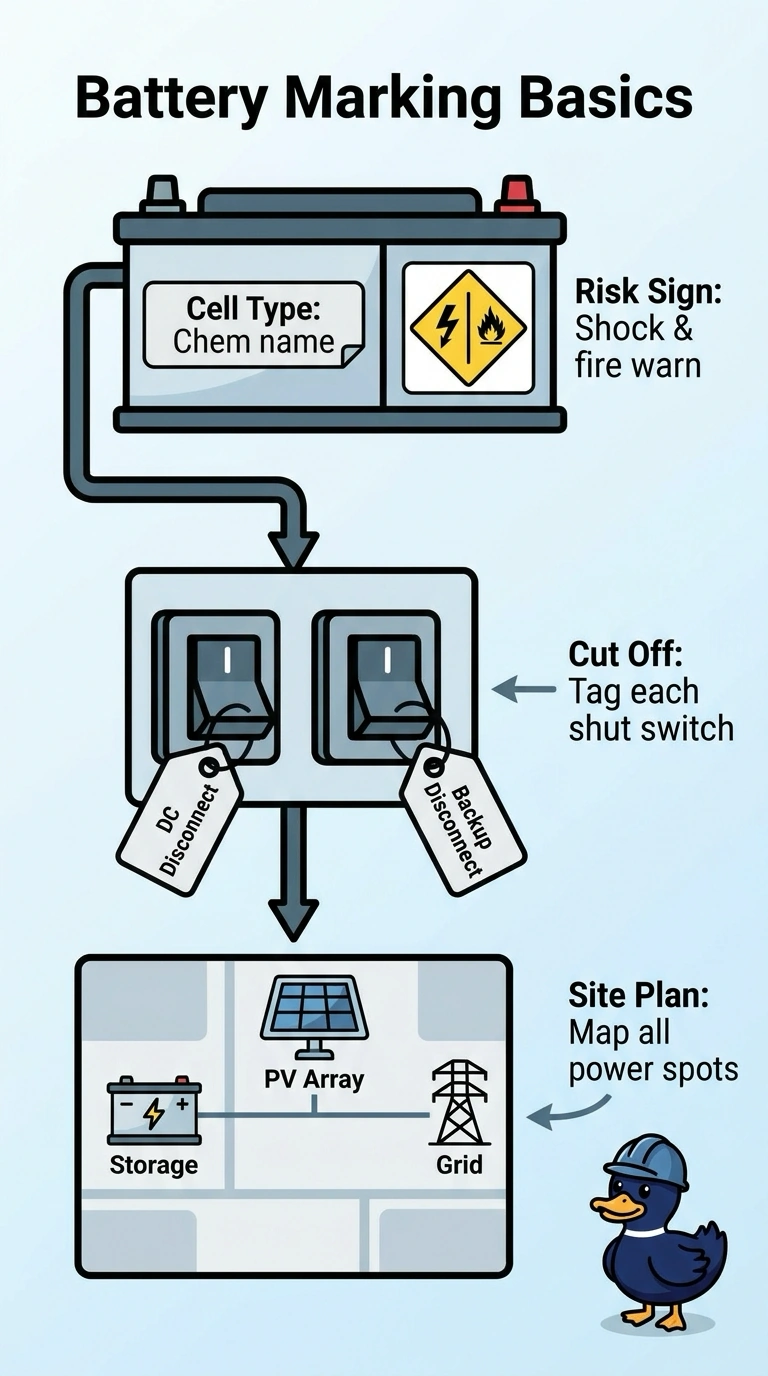
The complete approach gives responders the information they need both at the equipment and across the site: battery chemistry and hazard labels communicate the system’s identity and hazards, marked DC and backup disconnects help responders locate isolation points, and a site map shows the storage system and power sources. A map that identifies storage but not the other power sources leaves responders without an overview of how the site may remain energized. Chemistry labels, both disconnect markings, and a complete source map still leave battery-related hazards uncommunicated if hazard labels are omitted. Chemistry and hazard labels plus a complete map are not enough if only the DC disconnect is marked, because the backup disconnect may also matter during an outage. Each of these approaches misses a distinct part of the requested labeling and marking. The complete combination includes both label types, both disconnect markings, and a map showing storage and power sources. Exam caveat: an accurate map or label does not replace locally required wording, placement, or additional code-specific markings. Practical check: walk the installation as a responder would; confirm every required label and disconnect marking is visible at its equipment, and verify that the posted map identifies the storage system and every relevant power source.