
A solar firm is writing its site safety plan for a steep-slope residential install with ladder access, attic work, and panel handling near a 240V service. The manager must cite the right authorities for falls, ladders, and electrical hazards. Which safety-plan statement best identifies the applicable safety regulations?
Select an answer to reveal the explanation.
Short Explanation
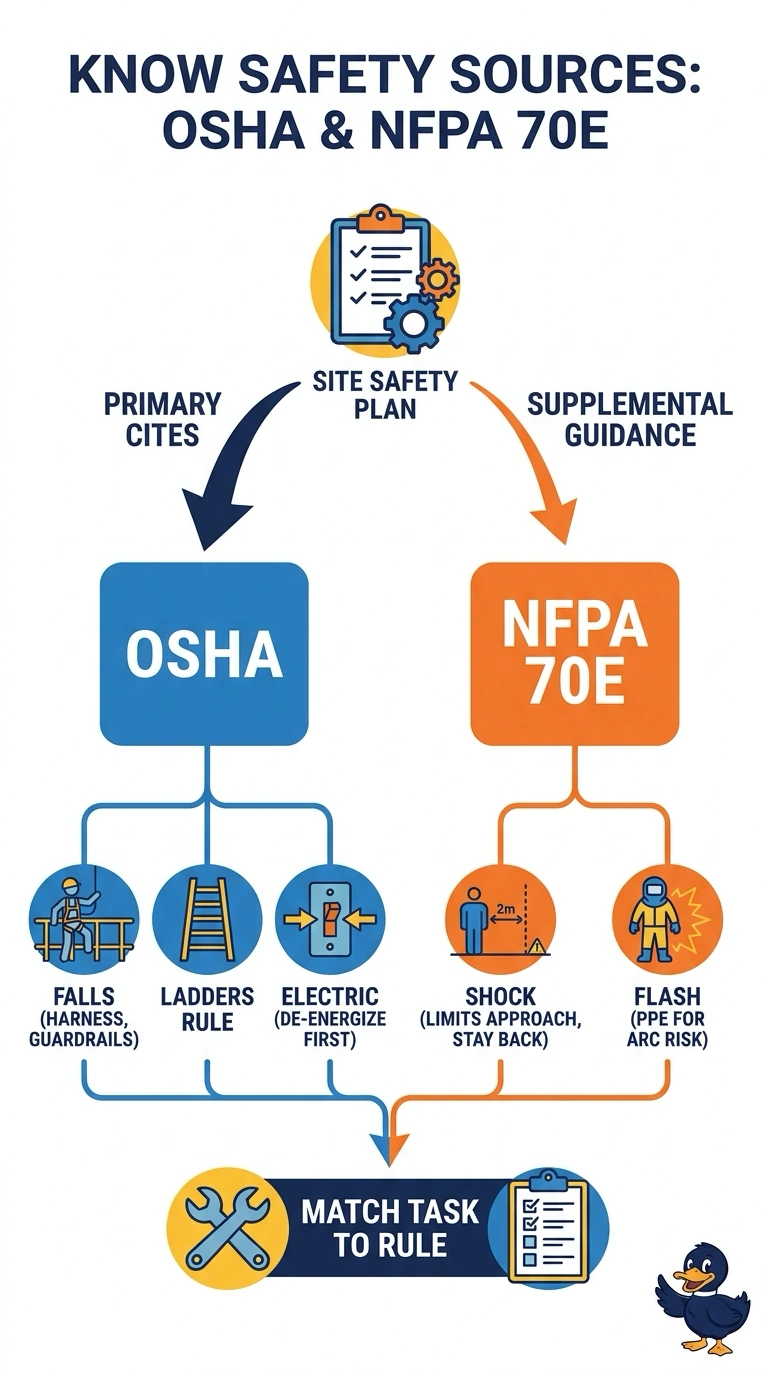
You can keep the authorities straight by treating OSHA as the source of workplace requirements for falls, ladders, and electrical hazards. Use NFPA 70E as supplemental guidance for electrical safe-work practices, not as a replacement for OSHA.
Full Explanation
The site safety plan should cite OSHA for applicable workplace requirements covering fall protection, ladder safety, and electrical hazards, and use NFPA 70E as supplemental guidance for electrical safe-work practices. A plan that cites OSHA for falls and electrical hazards but relies on ANSI A14 for ladder selection overlooks OSHA’s ladder-safety requirements for worksite use; an industry standard does not replace the regulatory citation. A plan that cites OSHA for falls and ladders but treats NFPA 70E as the governing authority for shock and arc-flash controls gives the consensus standard the role of a regulator: OSHA’s electrical standards remain the workplace requirements. A plan that cites OSHA for falls and ladders, the NEC for wiring hazards, and NFPA 70E for work practices distinguishes installation requirements from work methods, but misses OSHA’s role in regulating workers’ exposure to electrical hazards. Exam caveat: a consensus standard may be adopted by a jurisdiction, contract, or employer policy, but that does not automatically make it a federal OSHA regulation. Practical check: confirm current OSHA construction standards and applicable state-plan rules for the site, then verify that the plan separately addresses roof edges, ladder access, and electrical approach and de-energization procedures.