
During O&M on a 12-module string reading low power at midday, the inverter display reports only 380 V on the string while the tech expects about 480 V open-circuit, with intact wiring and no shade. The lead asks for a safe first electrical check. Which multimeter task isolates the voltage fault correctly?
Select an answer to reveal the explanation.
Short Explanation
You're hunting a missing chunk of volts without touching live guts first. Open-circuit voltage tells you the string's story before you break any links.
Full Explanation
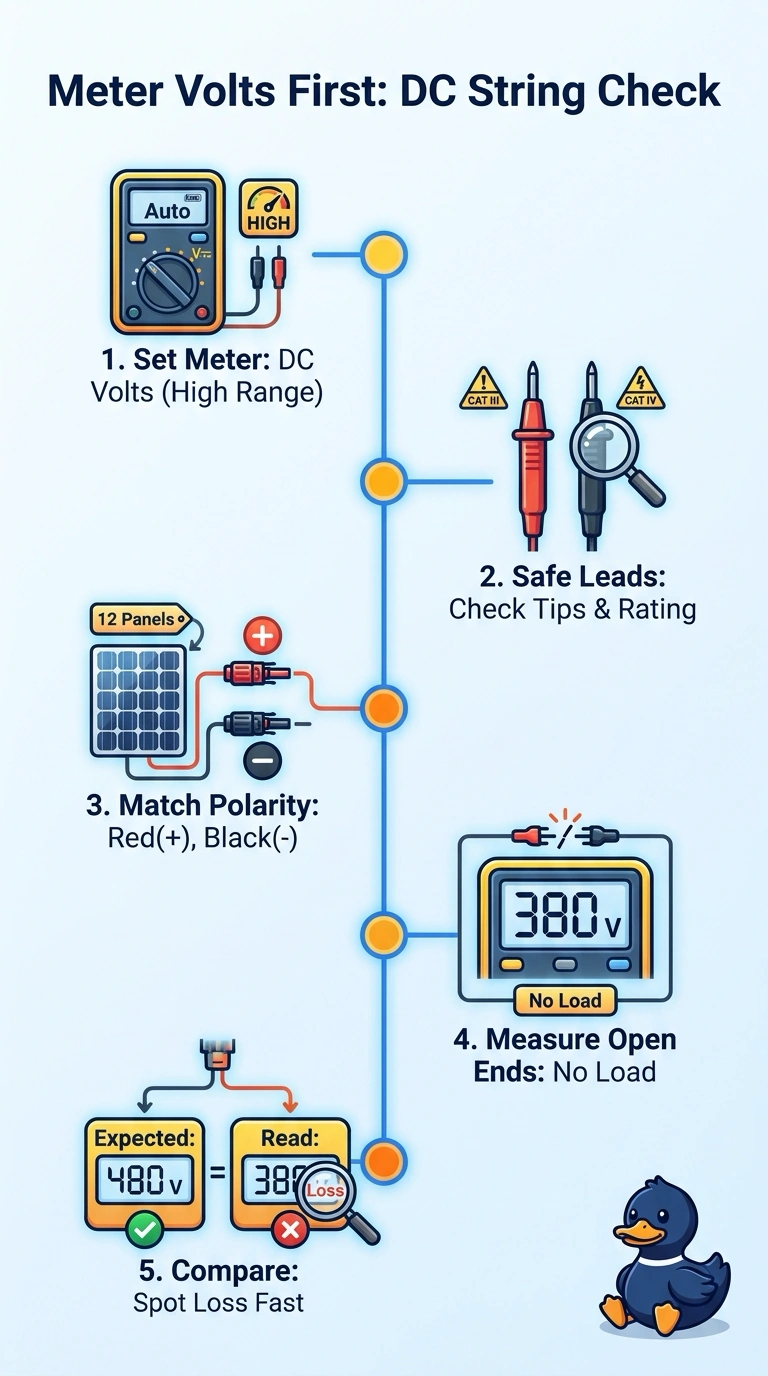
The correct task is right because a 12-module string with about 40 V per module should show near 480 V open-circuit, so a verified open-lead measurement with proper DC range, polarity and CAT-rated probes safely reconfirms the reported 380 V deficit and isolates the problem to string voltage magnitude before deeper work, which fits intact wiring and no shade that already rule out obvious external causes. Measuring operating voltage under load at the inverter fails by concept because Vmp is pulled down by MPPT tracking, irradiance and temperature and cannot be directly compared to a Voc expectation, so a low loaded reading would not prove missing module voltage. Measuring each individual module open-circuit in sequence fails by concept because module-level disassembly is a valid second-stage localization method but is inefficient and adds unnecessary exposure as a first check when a single string-level retest would confirm whether the deficit persists. Measuring short-circuit current fails by concept because Isc evaluates current collection and irradiance response rather than voltage addition, and a string short several modules or with activated bypass diodes can still pass near-normal current while Voc remains about 100 V low, so current data cannot isolate this voltage fault. Exam caveat is to carefully separate Voc open-circuit conditions from Vmp loaded conditions and to prioritize the least invasive safe confirmation before component isolation. Practical check is to open the disconnect, verify zero load, use rated PPE and fused leads, confirm meter operation on a known source, then remeasure string Voc and record ambient temperature for correction before proceeding to module-level tests.