
A café tenant has her landlord's written approval to install solar on the roof. She wants to keep her cash for a new oven, see a solar cost that stays steady through cloudy weeks, and end the term with no equipment left to own or maintain. Which financing option meets all three goals?
Select an answer to reveal the explanation.
Short Explanation
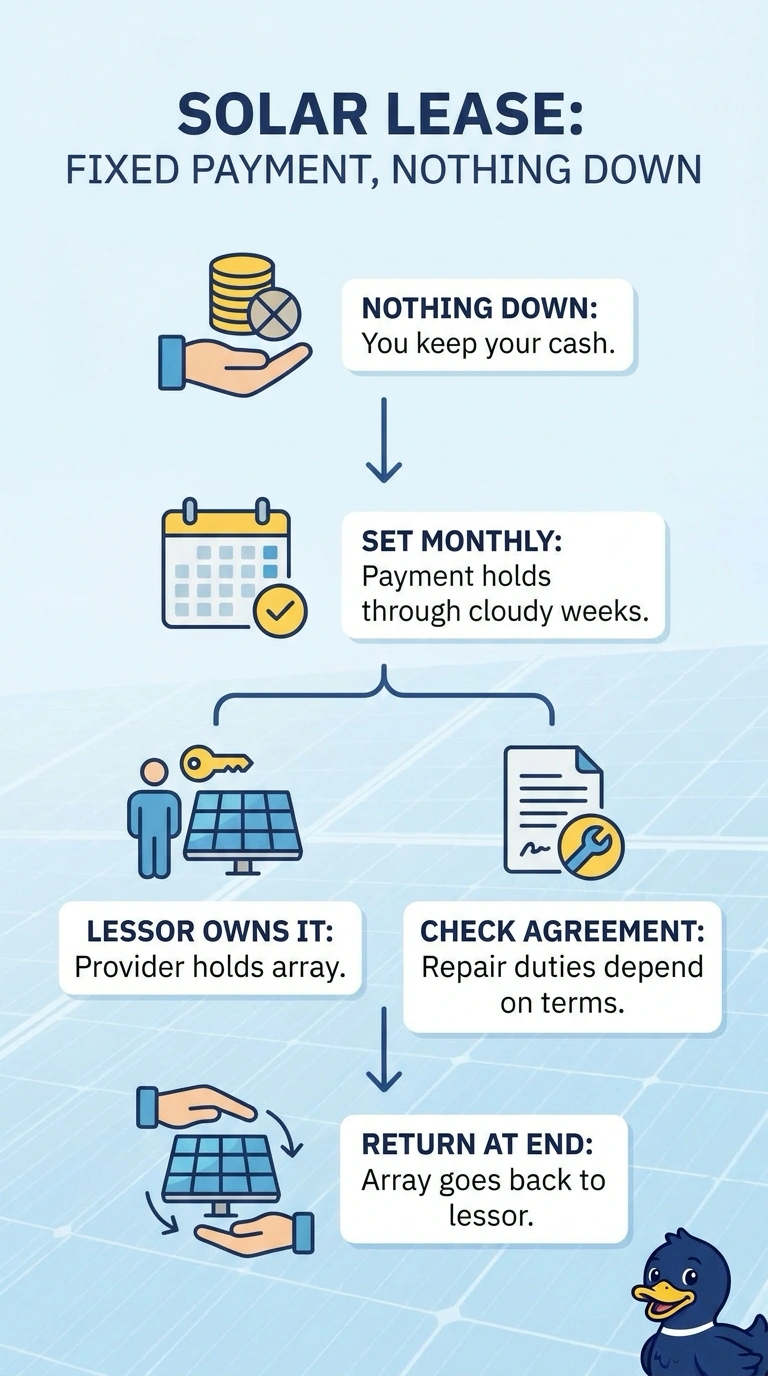
A lease with no money down and a fixed payment covers all three goals: no upfront payment, one flat payment, and the array goes back to the lessor when the term ends. Paying per kilowatt-hour looks tidy until a gray month bumps your bill up. It's really about who owns the system once the term closes.
Full Explanation
The no-money-down solar lease is the best fit because its fixed monthly payment gives the café a predictable bill even when cloudy weather reduces generation, while the lessor retains ownership and the array returns to it at the end of the term. With no initial payment, the tenant can preserve cash for the oven. A power purchase agreement can avoid an upfront payment and leave system ownership and maintenance with the provider, but its charges are based on energy produced; the bill therefore varies with generation rather than staying steady through cloudy weeks. A no-money-down loan with fixed payments can make financing costs predictable, but the café owns the equipment and remains responsible for it, contrary to the requirement to finish the term without equipment to own or maintain. A lease with a substantial upfront payment can still provide fixed monthly charges and return the array to the lessor, but it ties up cash the tenant wants to keep available for the oven. Exam caveat: check whether a quoted lease payment is truly fixed or includes an annual escalator, and distinguish that payment from any utility bill that may still vary. Practical check: review the agreement for payment terms, maintenance duties, and who removes or takes back the array at term end.