
An apprentice must verify 480-V AC disconnect voltage and 600-V DC string voltage on a bright rooftop with a digital multimeter rated for the task. Gloves, glasses, and a buddy are on site. Which safe use of electrical test equipment proves absence of voltage?
Select an answer to reveal the explanation.
Short Explanation
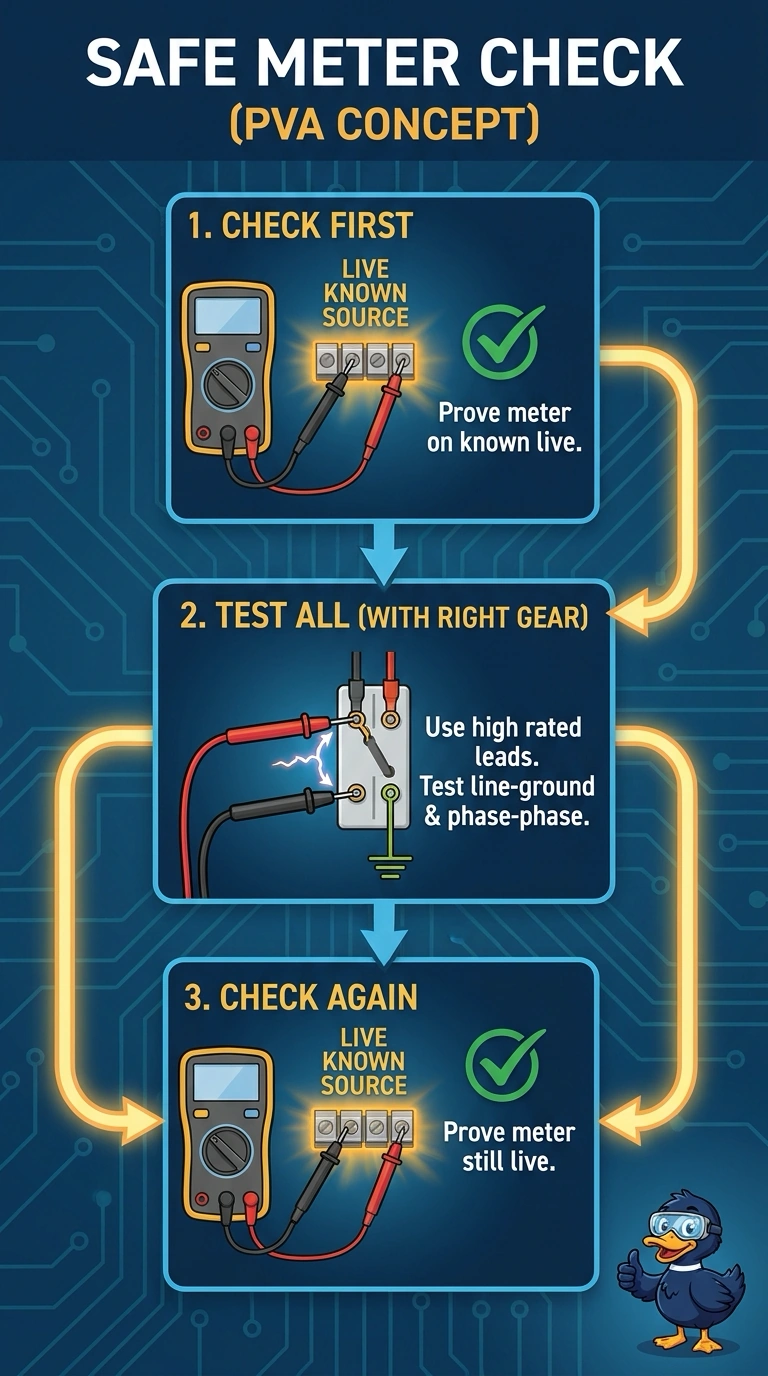
You want confidence that both circuits are de-energized, not just a zero reading. Verification before and after testing helps you confirm the meter is working when it matters.
Full Explanation
To prove absence of voltage, verify the meter on a known source before testing, use leads rated for the voltages involved, and test the relevant conductors both to one another and to ground. Rechecking the meter afterward confirms that it remained functional; otherwise, a zero reading could mean the meter failed rather than that voltage is absent. Testing the AC and DC conductors to one another and ground with rated leads but skipping the post-test function check leaves that uncertainty unresolved. Verifying the meter before and after and checking the AC disconnect phase-to-phase and to ground is not enough if the 600-V DC string is left untested; an AC result cannot establish that the DC circuit is de-energized. Verifying the meter before and after and testing both systems conductor-to-conductor also falls short if each conductor is not checked to ground, since a conductor-to-ground voltage may be missed. Exam caveat: a voltage test confirms the condition only at the time and points measured; it does not replace required isolation, lockout/tagout, or site procedures. Practical check: confirm the meter and leads’ AC/DC ratings and condition, select the correct function and range, and ensure you can read the display in bright rooftop conditions before relying on a zero reading.