
A designer reviews two 400 W datasheets at standard test conditions for a 150 V charge controller limit in cold weather. Both show similar power but different open-circuit voltage and short-circuit current values on the label. Which reading of module specs guides the string sizing choice?
Select an answer to reveal the explanation.
Short Explanation
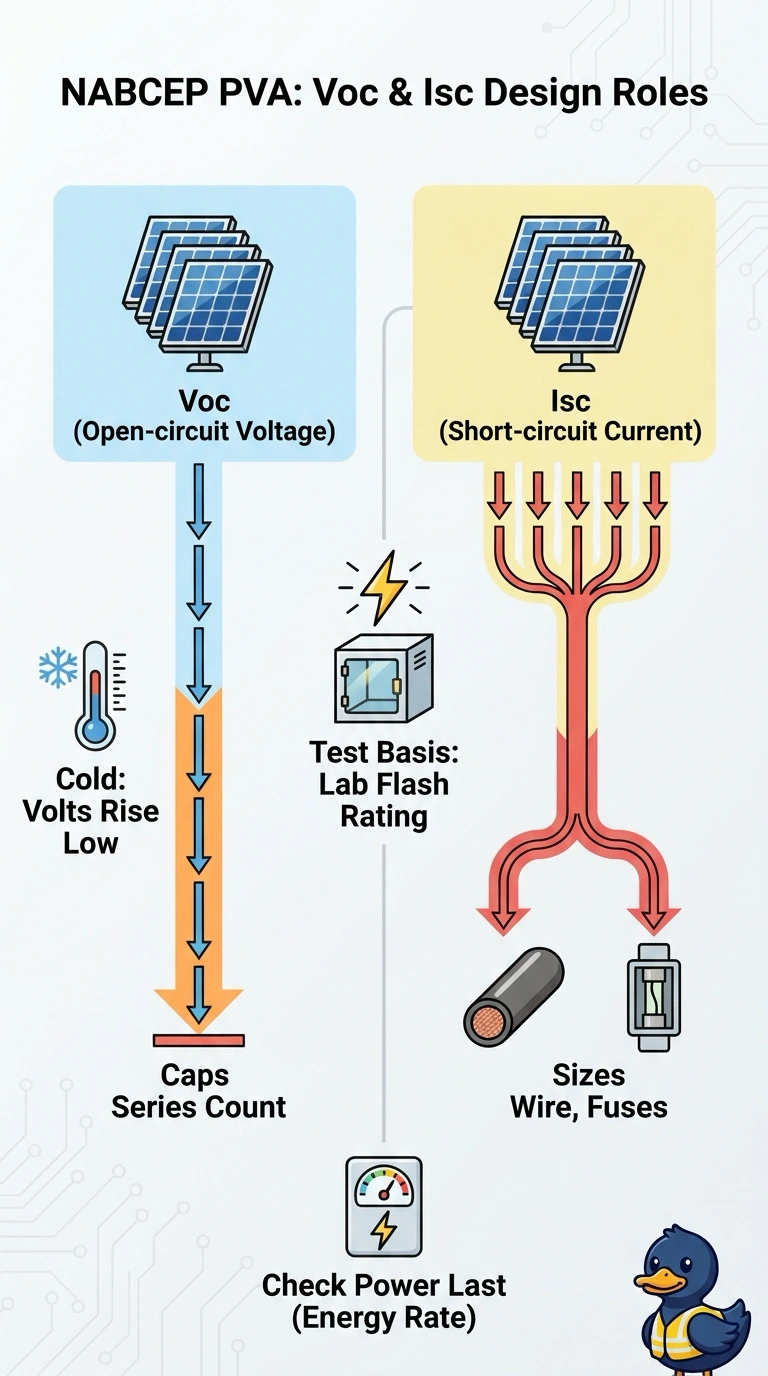
You're playing a fit game with volts and amps here. Voltage stacks in series like blocks, while current needs wider pipes to flow safe.
Full Explanation
The correct reading separates the two ratings by what they govern: open-circuit voltage (Voc) is the module’s highest voltage at a given temperature, so the series string must be checked at the expected coldest cell temperature against the controller’s 150 V maximum. Short-circuit current (Isc) is the relevant module current basis for conductor ampacity and overcurrent-protection sizing, with required code or manufacturer factors applied. Using STC Voc for the series limit is a familiar quick calculation, but it misses the stated cold-weather condition: Voc rises as module temperature falls, so a string that appears below 150 V at STC can exceed the controller limit. Cold-adjusted maximum-power voltage (Vmp) is useful for checking operating range and energy production, but it is not the maximum string voltage; the controller can see Voc when the array is unloaded or not operating at its maximum-power point. Maximum-power current (Imp) describes normal power production, but using it alone for wire and fuse sizing can understate the required current basis because Isc is higher and is used with applicable sizing factors. Exam caveat: distinguish a controller’s absolute maximum input voltage from its MPPT operating-voltage range; they are not interchangeable. Practical check: apply the module’s Voc temperature coefficient to the site’s minimum design temperature, then verify the resulting series voltage and the parallel-array Isc against the controller and wiring limits.