
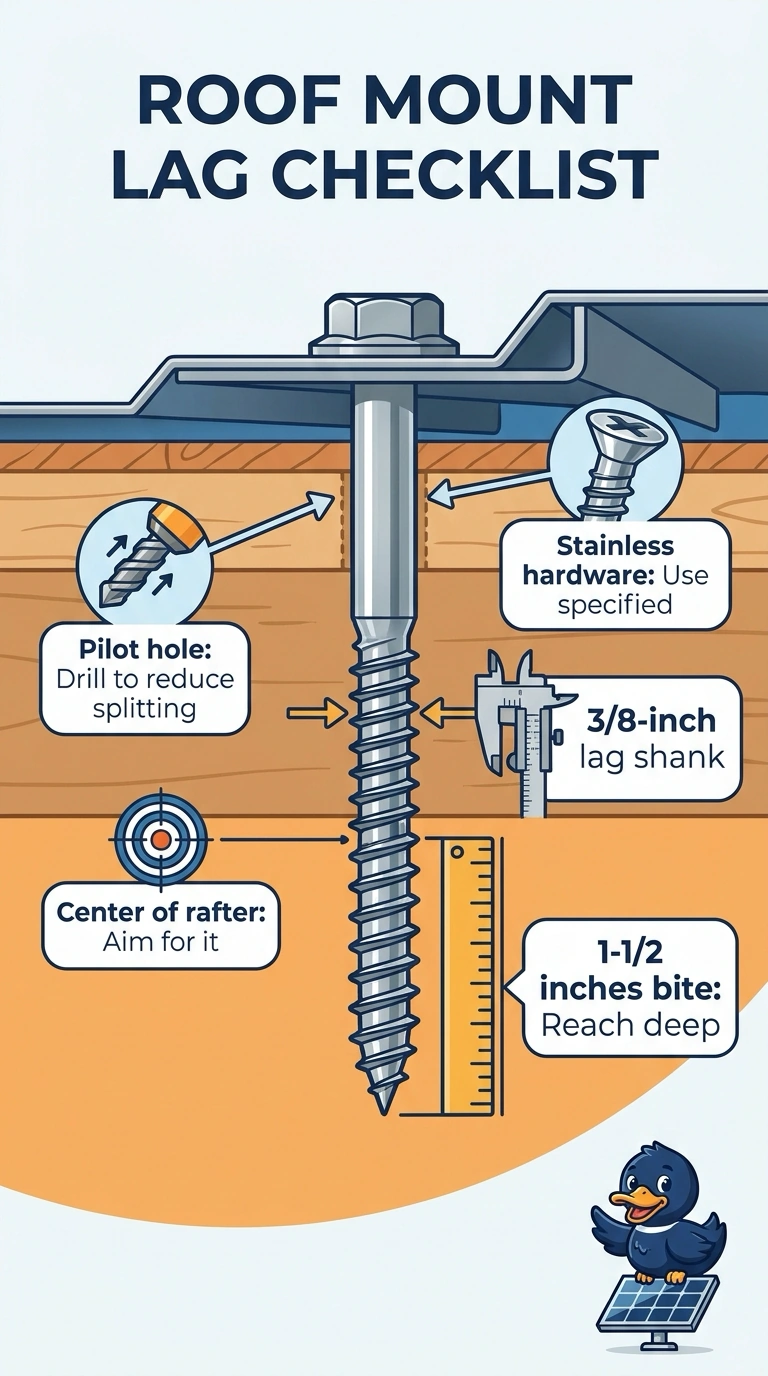
On a residential re-roof, half-inch plywood sheathing is nailed over 2x8 SPF rafters spaced 16 inches apart. The mount plan requires 1-1/2 inches of bite into each rafter, a 3/8-inch shank, stainless hardware to match the aluminum rail assembly, and a pilot hole to prevent splitting. Which fastener should the installer drive at each mount to satisfy all four requirements?
Select an answer to reveal the explanation.
Short Explanation
Your plan has four checks, and only one fastener passes all of them. Choose the 3/8-inch stainless lag installed in a pilot hole, with 1-1/2 inches of bite into the rafter.
Full Explanation
The specified fastener is a 3/8-inch stainless lag screw installed in a pilot hole and providing 1-1/2 inches of bite into the rafter. Its 3/8-inch shank meets the plan’s size requirement, stainless steel matches the aluminum rail assembly as specified, and the required embedment anchors the mount into the structural rafter rather than relying on the plywood sheathing. Drilling the pilot hole follows the installation method and helps reduce the risk of splitting the SPF rafter while the lag is driven. The undersized-fastener approach fails because a 1/4-inch lag does not meet the specified 3/8-inch shank, even if its material, pilot hole, and embedment are correct. The material-substitution approach fails because a galvanized lag is not the specified stainless hardware; matching the stated material requirement matters even when diameter and bite are correct. The no-pilot installation fails because driving the lag flush without the required pilot hole disregards the prescribed method and can increase splitting risk, despite the correct diameter, material, and embedment. Exam caveat: the 1-1/2-inch bite is embedment in the rafter, not total screw length; the sheathing thickness is separate. Practical check: confirm the rafter location and ensure the installed lag achieves the required bite, then verify pilot-hole dimensions and installation details against the mount manufacturer’s instructions.