
A crew is building a ground-mount rack on a sloped, rocky lot. The six posts are already set in concrete, and the rails must sit in one level plane before the modules go on. Which tool set lets them fasten the pressure-treated ledgers and true up the rail plane in one pass?
Select an answer to reveal the explanation.
Short Explanation
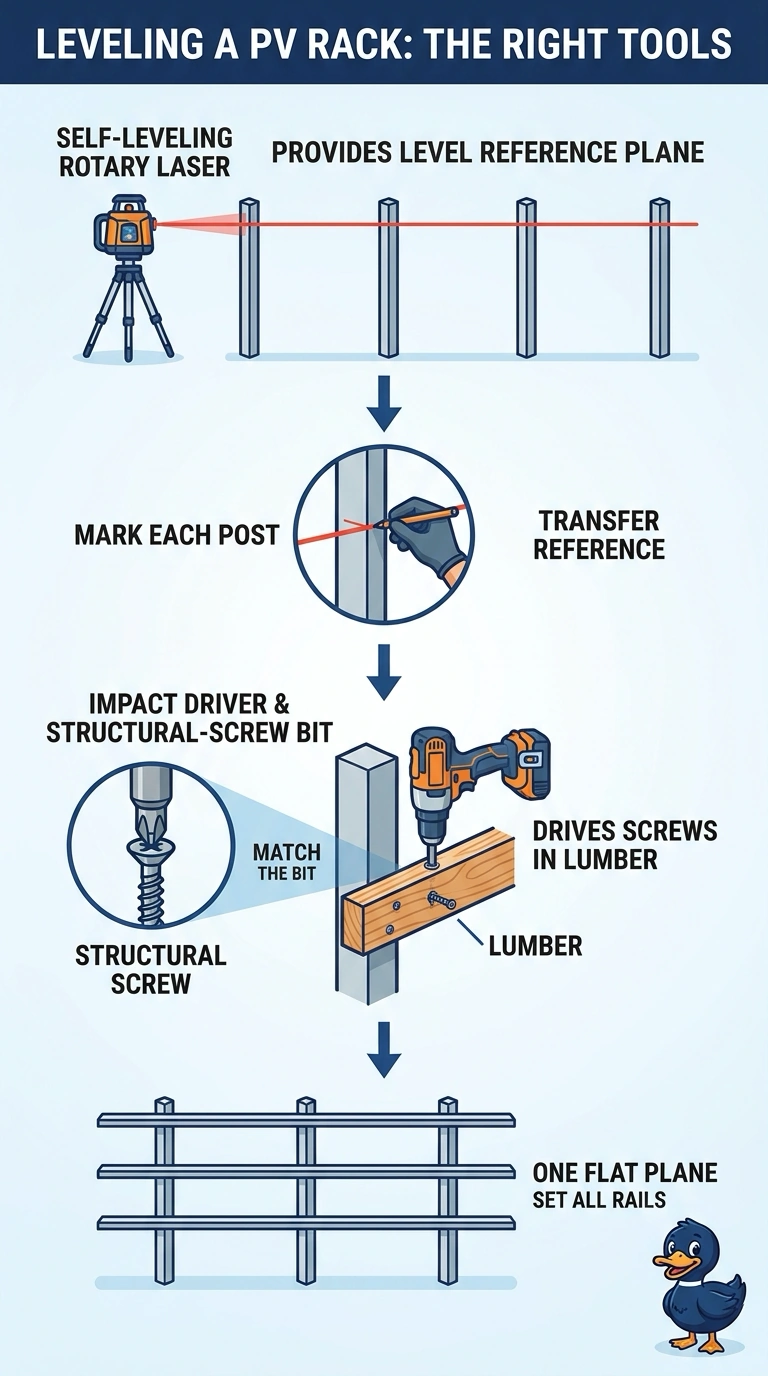
A self-leveling rotary laser gives you one shared reference—like a straightedge across the whole rack—so you can set every rail in the same plane instead of leveling them one by one. Pair it with an impact driver and structural-screw bit to fasten the pressure-treated ledgers, following the screw maker’s instructions.
Full Explanation
Fastening and leveling are separate jobs, and the tool choice affects whether both are done correctly on sloped ground. An impact driver delivers short, high-torque bursts and is commonly used to drive structural screws in lumber; follow the screw manufacturer's instructions for the tool and installation method. A low-clutch drill-driver may stop before a screw is fully seated. Leveling needs a shared reference across all six posts: a self-leveling rotary laser provides a level reference plane, so rail heights can be checked against the same reference even where the ground falls away. A spirit level set on each rail shows whether that individual rail is horizontal, but does not ensure the rails are at the correct heights relative to one another. Hanging each rail the same distance above grade also fails to establish a level plane because grade on a rocky slope is not level. Practical check: once the laser is set, use its receiver to check the rail positions across the whole row before installing modules.