
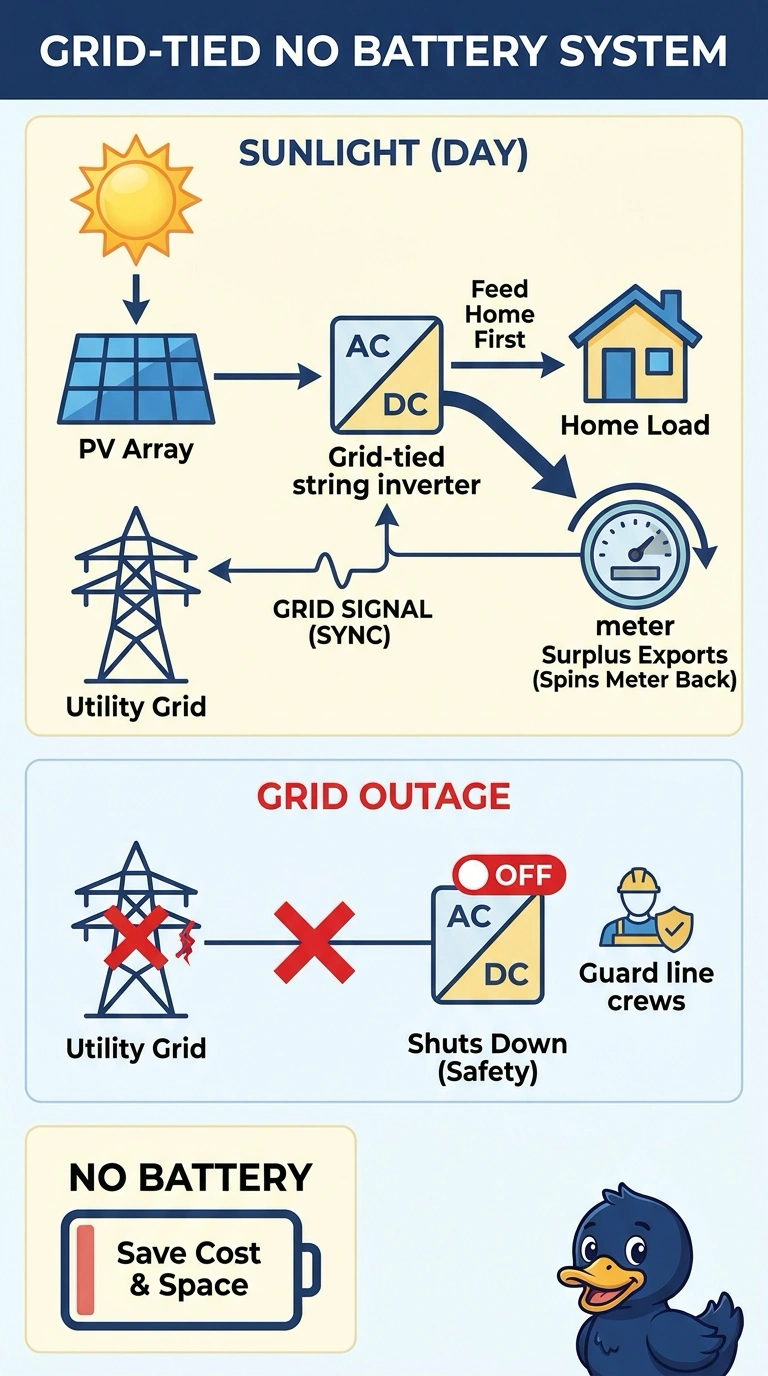
A homeowner has reliable grid power, wants daytime bill savings with net metering, has no batteries, and needs shutdown when the grid fails for lineworker safety. The trainee must label the design file correctly. Which system type label describes this battery-free grid-linked configuration?
Select an answer to reveal the explanation.
Short Explanation
You're still tied to the grid with no backup in the closet. Anti-islanding shutdown is your safety net, like a treadmill that stops when power drops.
Full Explanation
The correct label describes a conventional battery-free grid-tied string-inverter system: it serves daytime loads, exports excess generation through the meter for net-metering credit, and uses anti-islanding protection to stop energizing the utility when grid voltage is lost. The hybrid-inverter choice is a legitimate grid-connected, net-metered design and can also shut down on an outage, but its installed battery conflicts with the stated absence of batteries. The export-control choice is a common way to meet utility rules where export is prohibited; it can reduce daytime purchases, but it deliberately blocks surplus exports, so it does not match the stated net-metering arrangement. The sunlight-backup choice is a battery-free grid-connected design that can isolate the home from the utility and serve selected loads from PV during an outage. That isolation can protect lineworkers, but the PV system continues operating rather than shutting down as required here. Exam caveat: “grid-tied” alone does not determine whether a system exports, has storage, or can operate during an outage; the inverter and controls matter. Practical check: confirm the approved one-line diagram and inverter settings for battery presence, export permission, and listed anti-islanding or transfer-isolation behavior.