
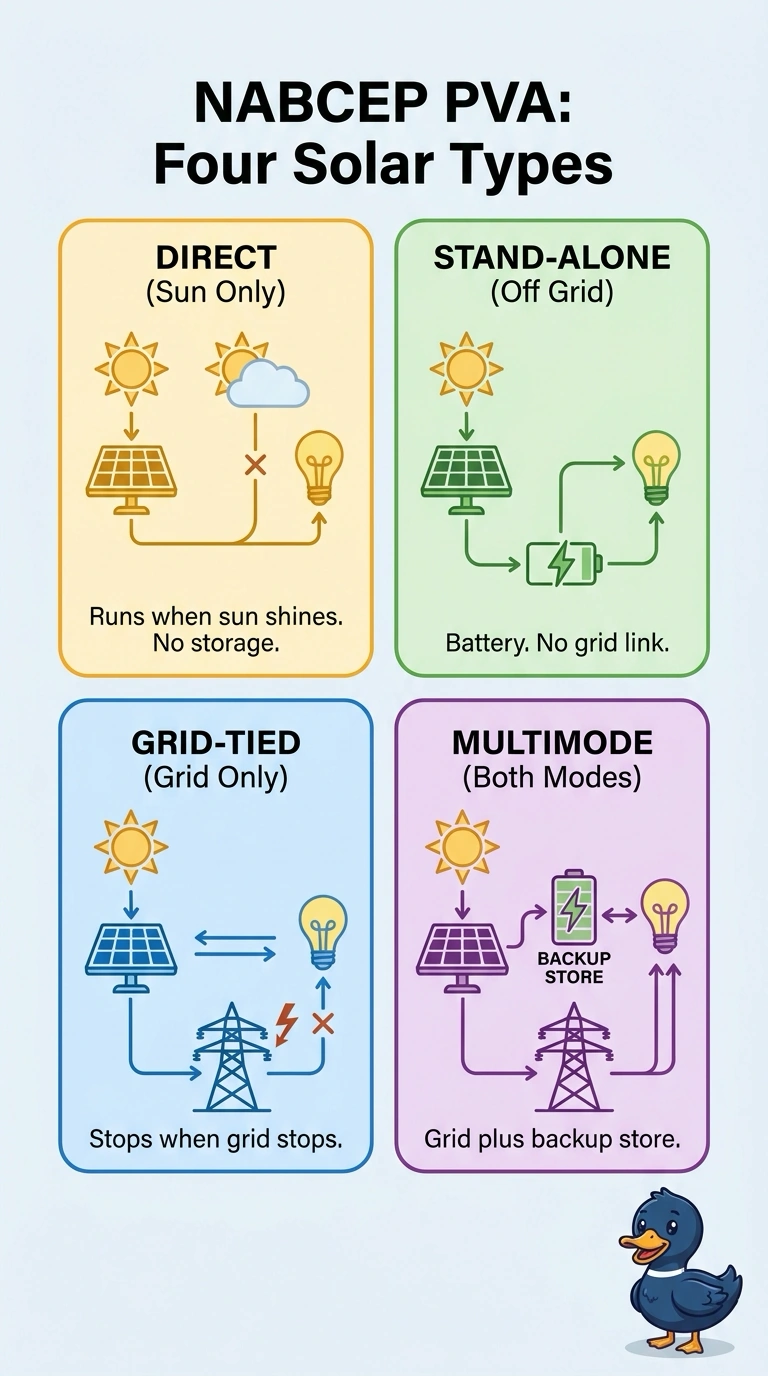
A training lab has four small demo boards: a fan wired straight to a module, a shed light with battery and no grid, a house array that shuts off with the grid, and a house array with battery backup. Which statement correctly distinguishes PV direct, stand-alone, grid-tied, and multimode systems?
Select an answer to reveal the explanation.
Short Explanation
You're sorting four tools by job, not looks. Grouping by grid link and battery use keeps each type clear, like sorting mail by address plus stamp.
Full Explanation
The correct distinction turns on two features: presence of storage and relationship to the grid, so PV direct has neither grid nor storage and runs only when the sun shines, stand-alone has storage but no grid, grid-tied has grid but typically no backup and follows anti-islanding shutdown, and multimode has both grid and storage for backup. Swapping batteries to direct and grid to stand-alone fails by definition because it assigns storage where none exists and grid where the design is intentionally isolated. Assigning grid plus storage to direct and sun-only to stand-alone fails by architecture because direct by nature cannot time-shift energy and stand-alone must time-shift with batteries. Assigning grid dependence to direct and sun-only to grid-tied fails by operation because grid-tied depends on grid voltage while direct depends only on irradiance. Exam caveat: watch for backup power wording that signals multimode rather than simple grid-tied, and practical check is to trace the demo wires for a grid feed and a battery before naming the board.