
A small business wants to sell solar credits that pay by the kilowatt-hour and the utility requires audited production data with tight error limits. The crew installed a standard inverter display and a consumption CT set. Which monitoring choice describes revenue-grade metering for credit payments?
Select an answer to reveal the explanation.
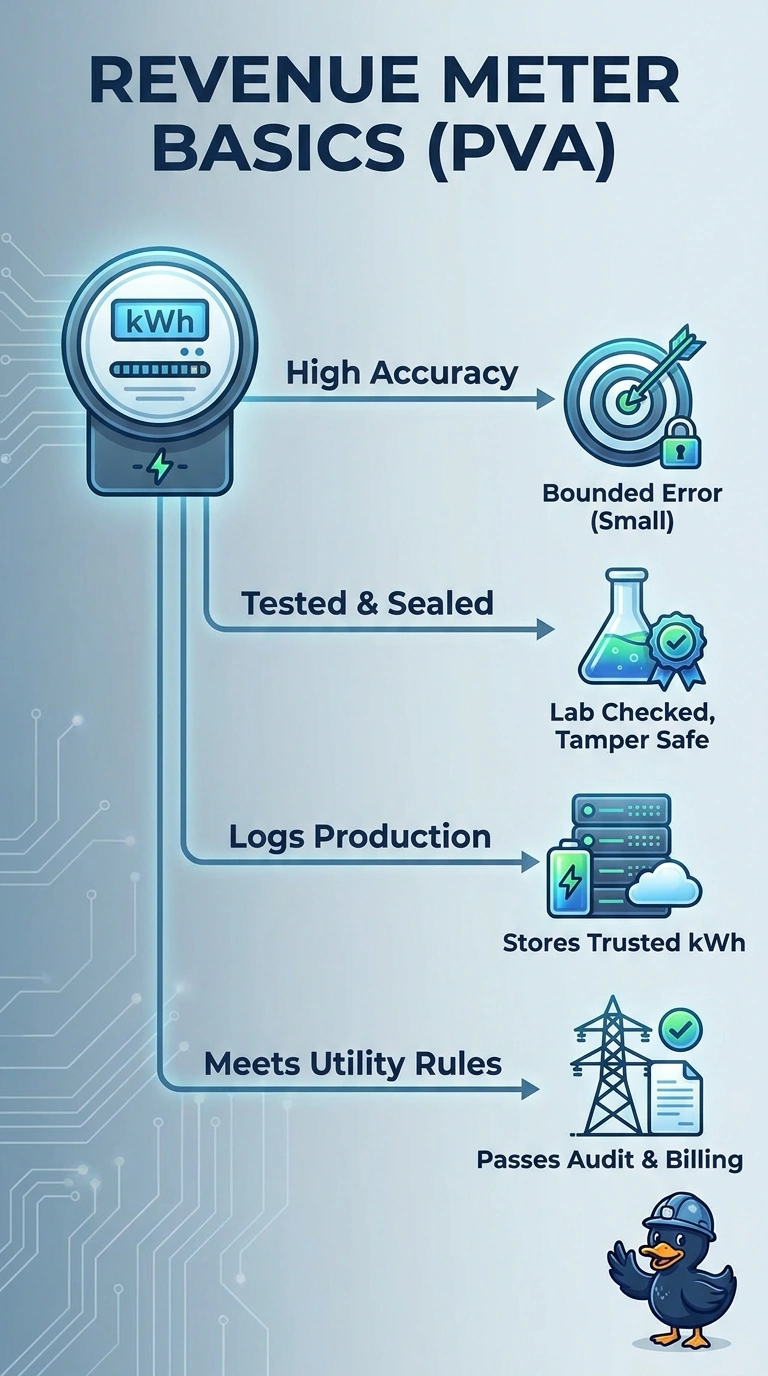
Short Explanation
You're moving from rough guesses to cash-register counts here. A revenue-grade meter acts like a sealed scale at a market, trusted for money because its error is tested.
Full Explanation
Revenue-grade metering is intended to provide production measurements suitable for financial settlement, not merely useful operating data. The correct choice specifies a certified accuracy class and calibration, addressing whether measured kilowatt-hours meet the precision and traceability needed for billing and incentive payments. A bidirectional utility meter can reliably measure energy exported to the grid, but exported energy is not the same as total solar production: on-site consumption may use some generation before it reaches the meter. An inverter’s production counter can report gross generation and is commonly useful for monitoring, but an internal reading alone does not establish independent certification for billing accuracy. A calibrated production submeter may measure gross output within tight tolerances, yet calibration and precision do not by themselves satisfy a utility’s separate audit requirement if the device or its records are not accepted for that purpose. Exam caveat: “revenue-grade” is not a universal accuracy threshold; the applicable utility tariff or incentive program defines acceptable certification, error limits, and documentation. Practical check: confirm the meter’s approved accuracy class, current calibration records, measurement point, and audit-data format with the utility before relying on readings for credit payments.