
A crew must add 40 kW on a two-story office with a flat membrane roof that forbids penetrations, keeps a 10-year warranty, and needs wind-rated hold-down. The owner wants no grading or foundations. Which mounting type matches this flat-roof constraint?
Select an answer to reveal the explanation.
Short Explanation
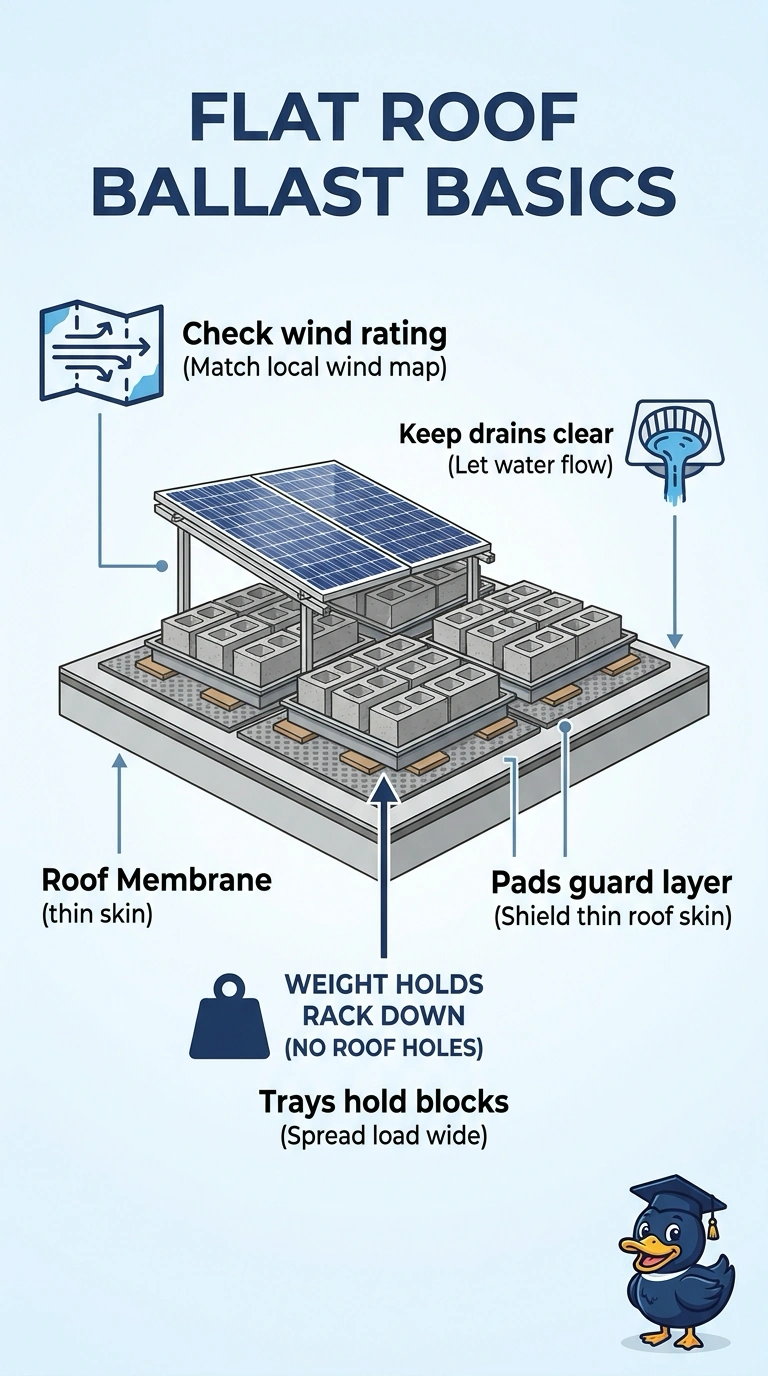
You've got a no-holes flat roof, so weight becomes your anchor. A ballast system holds firm without a drill, much like sandbags hold a tent down.
Full Explanation
Ballasted racking is the best fit because weighted trays rest on protective pads, avoiding membrane penetrations and preserving the roof surface; it also needs no grading or foundations. When designed and tested for the project’s wind loads, the ballast provides the required resistance to uplift while respecting the stated roof constraints. Mechanically anchored rails can be a robust, familiar solution with flashed attachments and engineered wind restraint, and they need no grading or foundations; however, their roof attachments penetrate the membrane, directly violating the no-penetration requirement. Adhesive-bonded low-profile racks can avoid penetrations, grading, and foundations and can be designed for wind loads, but an installation not approved under the membrane warranty fails the requirement to keep that warranty in force. Pad-supported ballast with insufficient tested uplift capacity meets the surface-protection and no-foundation constraints, but cannot provide the required wind resistance at this site. Exam caveat: “ballasted” alone does not guarantee adequate wind performance; allowable ballast and restraint depend on the specific roof and design conditions. Practical check: confirm the roof structure can carry the system’s dead load and that the manufacturer’s tested assembly, including its perimeter and corner zones, meets the site-specific wind design and is accepted by the membrane warranty provider.