
You are sizing a 9.6-kW DC rooftop array of south-facing modules paired with an 7.6-kW string inverter for a home with steady midday loads. The module specs fit the inverter MPPT voltage window and the max input current is not exceeded. Which inverter compatibility check confirms an acceptable DC:AC ratio for this design?
Select an answer to reveal the explanation.
Short Explanation
You've got this — a modest oversize harvests more morning and evening energy without clipping too much. Your ratio sweet spot balances extra DC against inverter limits and orientation.
Full Explanation
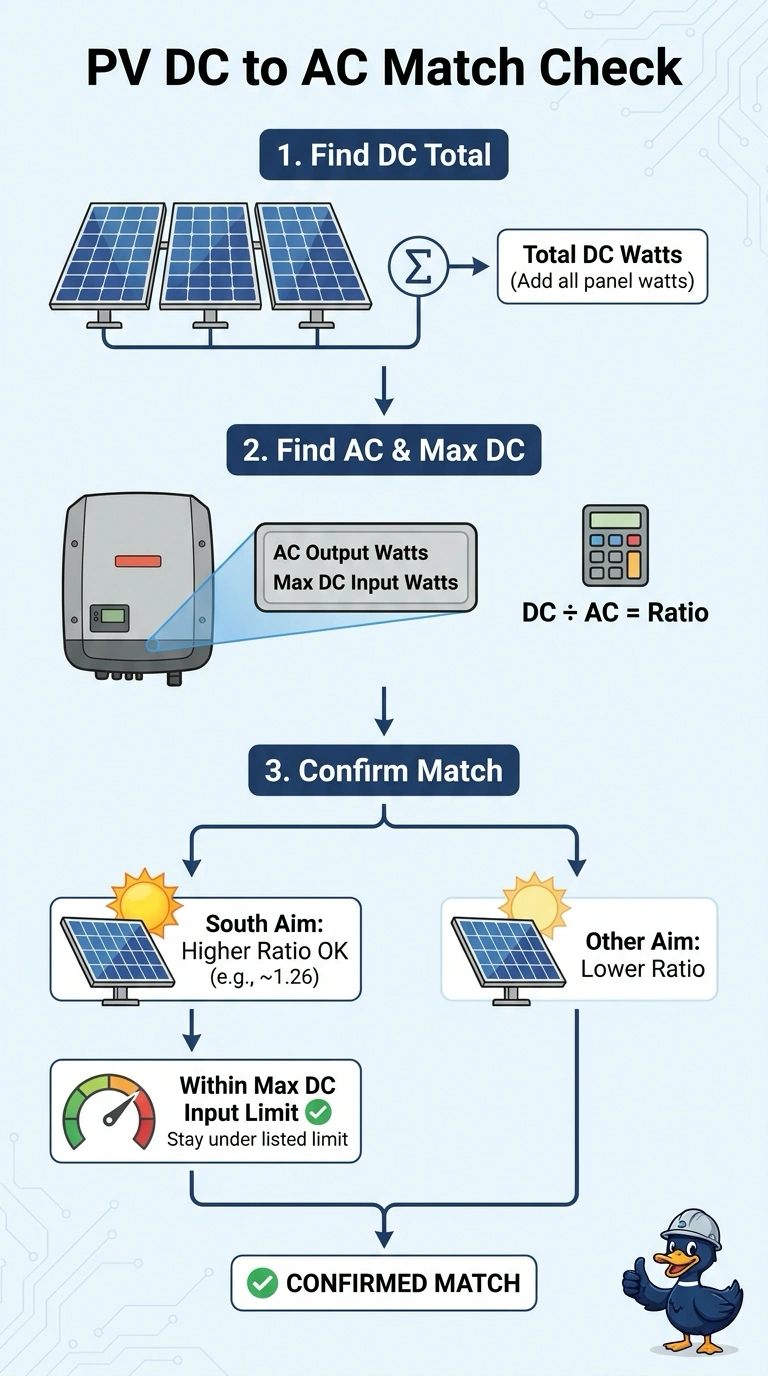
The correct check evaluates the array’s 9.6 kW DC rating against the inverter’s 7.6 kW AC rating: 9.6 ÷ 7.6 is approximately 1.26. That ratio must be appropriate for the south-facing production profile and remain within the inverter’s maximum permitted DC power; the stated MPPT-voltage and input-current checks address different compatibility limits. A manufacturer’s generic sizing range is a useful starting point, but approving the ratio from that range alone can miss the effect of this array’s orientation on production and clipping. Annual-yield modeling can help balance energy harvest and clipping, but it does not establish that the inverter permits the array’s DC nameplate power; exceeding that limit is not made acceptable by favorable modeled yield. Checking cold-weather voltage and input current is also sound electrical practice, but those checks do not assess the DC-to-AC ratio, even when they pass. Exam caveat: allowable ratios and maximum DC power are model-specific, so a commonly quoted industry ratio is not a substitute for the inverter documentation. Practical check: confirm the exact inverter model’s maximum DC power and sizing guidance, then review a site-specific production or clipping estimate using the array orientation and expected operating conditions.