
A technician commissions a ground-mount array on a hot July afternoon and records each string's voltage at the open terminals before the DC disconnect closes. Every string reads several volts below the module datasheet's listed open-circuit voltage, while connections and string counts verify as built. Which factor explains the lower open-circuit voltage readings?
Select an answer to reveal the explanation.
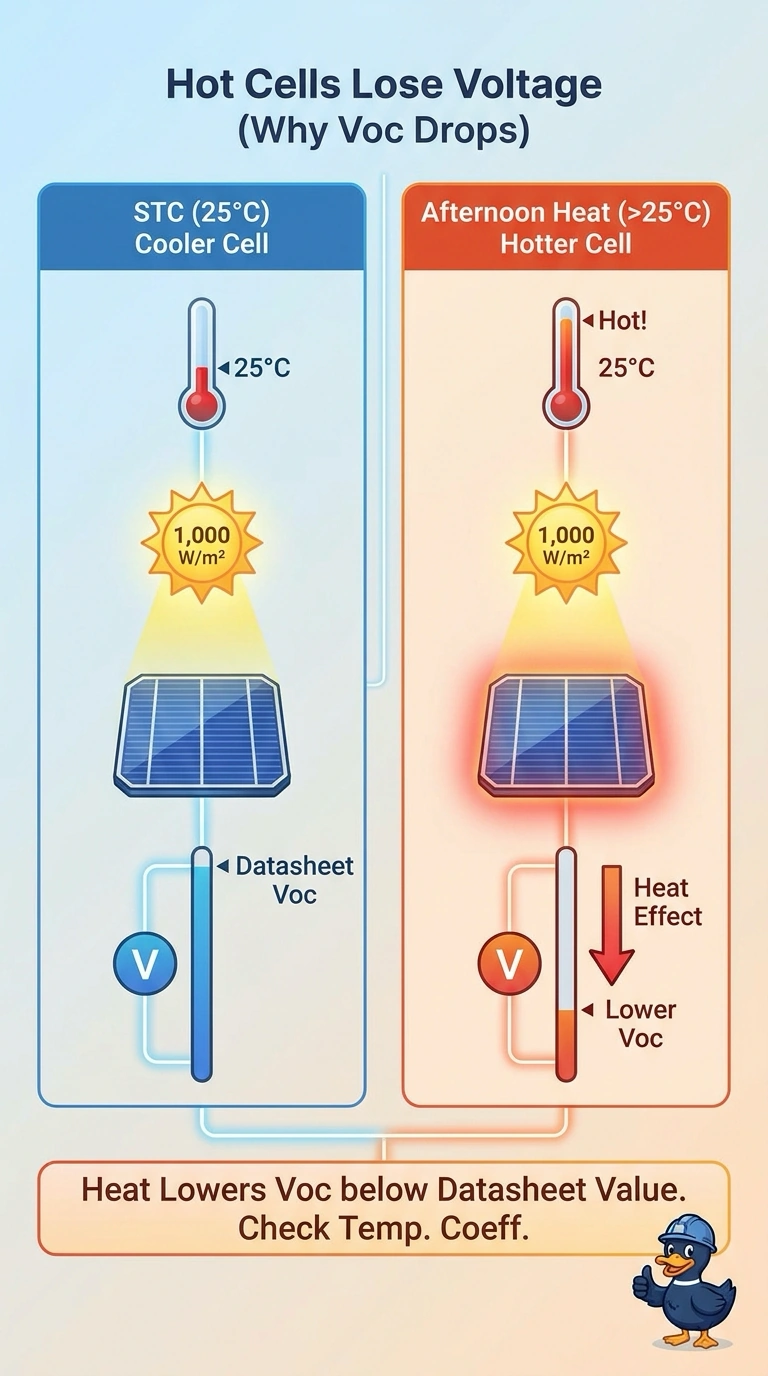
Short Explanation
Your readings can be normal: the datasheet’s open-circuit voltage assumes cell temperature of 25 °C, and hot afternoon cells produce a lower voltage. Like a battery that reads differently as it warms, your array’s voltage shifts with heat—so the difference alone doesn’t mean the wiring is wrong.
Full Explanation
The correct explanation is the module temperature. Datasheet open-circuit voltage is normally specified at standard test conditions, including a cell temperature of 25 °C. In hot afternoon conditions, the cells are typically warmer, and crystalline-silicon module voltage falls as cell temperature rises; the measured string voltage can therefore be several volts below the datasheet figure even when wiring and string counts are correct. A resistive connection is a familiar cause of voltage loss in operating circuits, but an open-circuit measurement draws essentially no current, so the connection has no meaningful current-dependent voltage drop to produce this reading. Lower irradiance can also reduce open-circuit voltage, but it is not established by the scenario and does not replace the specified temperature effect as the explanation. Partial shading can reduce string voltage when it causes a bypass diode to conduct, but bypass diodes generally do not conduct during an ordinary open-circuit voltage test; shading alone is not enough to explain the result as stated. Exam caveat: module datasheet voltage is a reference-condition value, not a fixed field target, and temperature correction should use the Voc temperature coefficient rather than the Vmp coefficient. Practical check: measure module backsheet temperature and plane-of-array irradiance, then compare the measured string voltage with the temperature-adjusted expected Voc.