
A newly hired non-exempt nursing assistant earns the federal minimum wage, and the facility's employee handbook states that the cost of required facility-branded scrubs will be deducted from the employee's first paycheck. How does the federal Fair Labor Standards Act apply to this deduction?
Select an answer to reveal the explanation.
Short Explanation
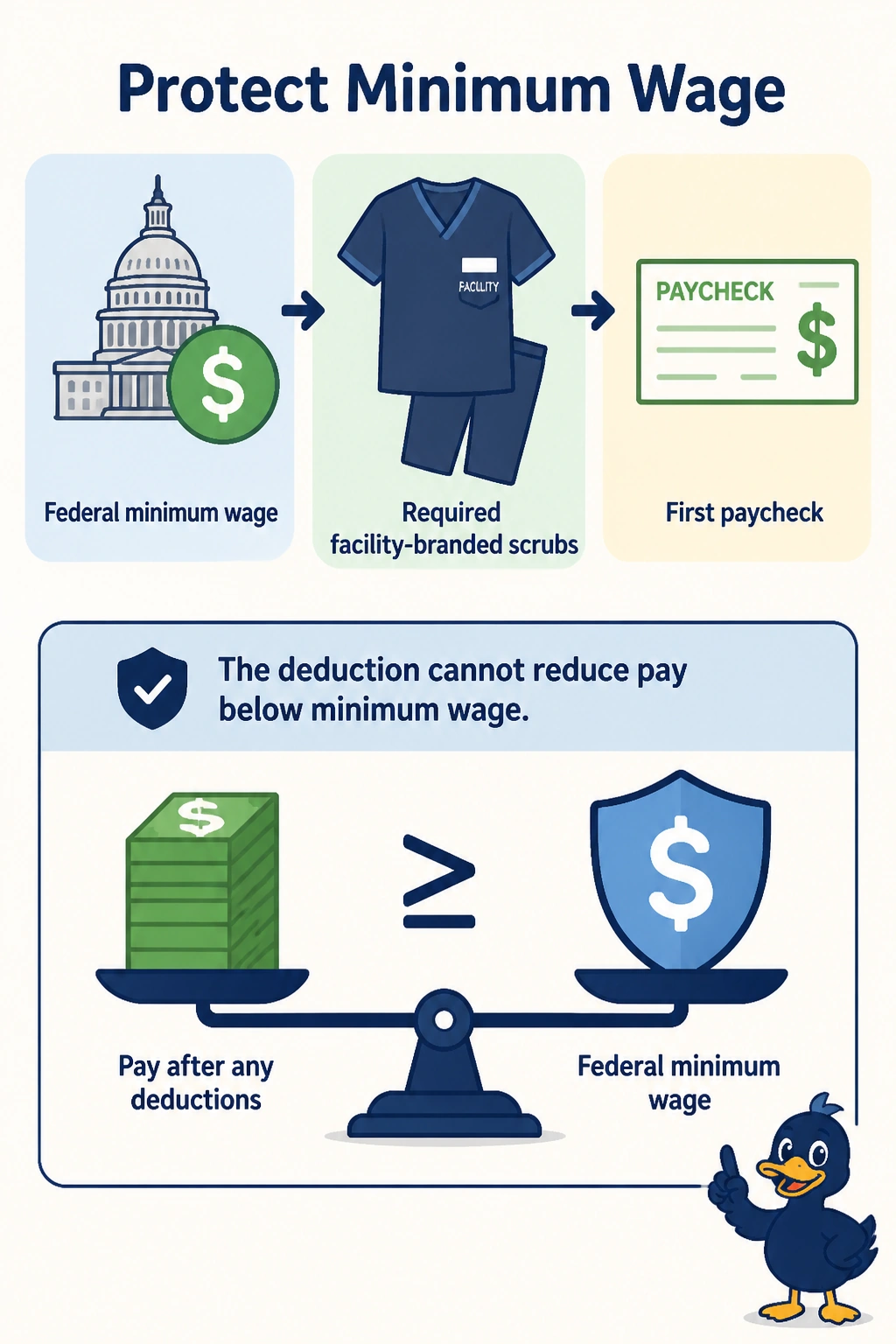
Under federal wage law, the minimum wage is a hard floor, not a starting point you can chip away at with uniform charges. Even with a signed handbook policy, you cannot pass required uniform costs onto a minimum-wage worker if the deduction drops their net pay below the statutory floor.
Full Explanation
Under the Fair Labor Standards Act (FLSA) and 29 CFR 531.35, wages must be paid free and clear, meaning an employer cannot shift required uniform costs onto a non-exempt employee if the deduction cuts into minimum wage or overtime pay. Thus, The facility cannot deduct the uniform cost because doing so would reduce the employee's pay below minimum wage. Claiming The facility may deduct the full uniform cost if the employee signs a written payroll authorization during orientation fails because employees cannot waive FLSA protections by written consent. Claiming The facility may deduct the uniform cost only if the deduction is spread evenly across the first four pay periods also fails because installment deductions still drop affected paychecks below the minimum wage floor. Claiming The facility cannot deduct the uniform cost unless the employee is still within the ninety-day probationary period is wrong because FLSA protections apply from day one. As an exam caveat, state laws may ban uniform deductions even above minimum wage. As an operational check, audit payroll deduction codes before onboarding to ensure no uniform or badge charge reduces any non-exempt worker's effective hourly rate below minimum wage.
Prefer to study offline? Printable PDF study book + test engine ($7.50, unofficial). These questions stay free here.