
A non-exempt employee works 30 hours as a dietary aide at $15 per hour and 20 hours as a housekeeping aide at $18 per hour during the same workweek. Under the federal Fair Labor Standards Act, how must payroll calculate the employee's overtime premium for the 10 overtime hours?
Select an answer to reveal the explanation.
Short Explanation
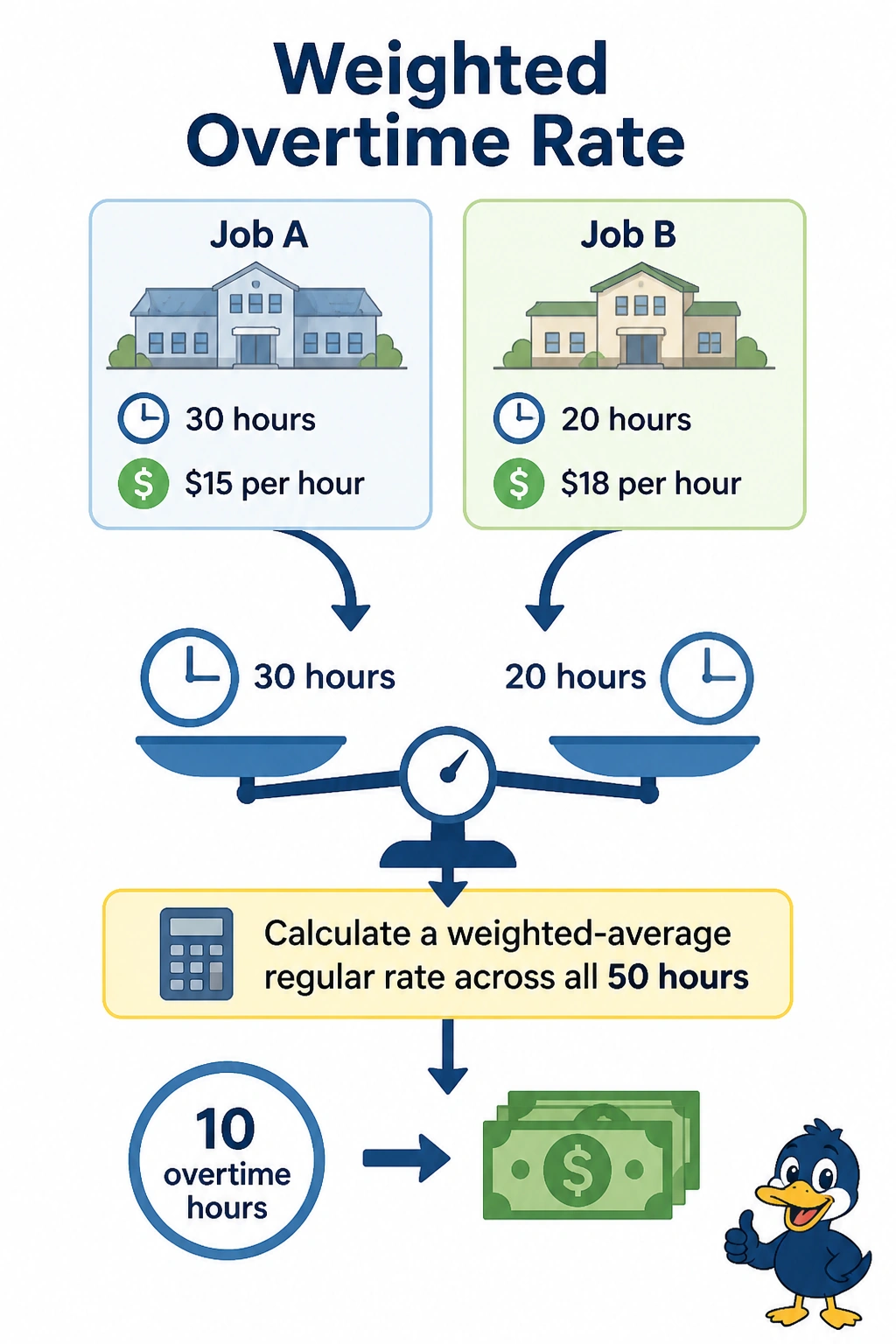
When you work two jobs for the same employer at different rates in one week, payroll combines your hours rather than separating the roles to avoid overtime. Your weighted-average regular rate determines the overtime premium.
Full Explanation
Under the Fair Labor Standards Act (29 CFR 778.115), when you work two or more jobs for the same employer at different hourly rates in one workweek, payroll combines all hours. Your straight-time earnings are $810: $450 for 30 dietary-aide hours at $15 per hour, plus $360 for 20 housekeeping-aide hours at $18 per hour. Dividing $810 by 50 hours gives a weighted-average regular rate of $16.20. Because straight-time pay already covers all 50 hours, payroll adds a half-time premium of $8.10 per hour for the 10 overtime hours. Using only the $15 dietary rate because you worked more hours in that role would understate your regular rate. Treating the departments as separate jobs to keep each role below 40 hours would improperly exclude hours worked for the same employer. Using only the $18 housekeeping rate regardless of your total weekly earnings would not follow the standard weighted-average formula absent a specific prior agreement. Exam caveat: a prior agreement may allow overtime to be paid at the rate for the job performed during overtime hours; the weighted average is the default rule. Practical check: configure payroll software to aggregate multi-department timecards before running biweekly checks.
Prefer to study offline? Printable PDF study book + test engine ($7.50, unofficial). These questions stay free here.