
During a pre-bill Medicare Part A compliance audit, a billing specialist finds that a short-stay resident's initial physician certification was signed on admission, but no physician recertification was completed by day 14 of the covered stay. Why is this a critical compliance issue?
Select an answer to reveal the explanation.
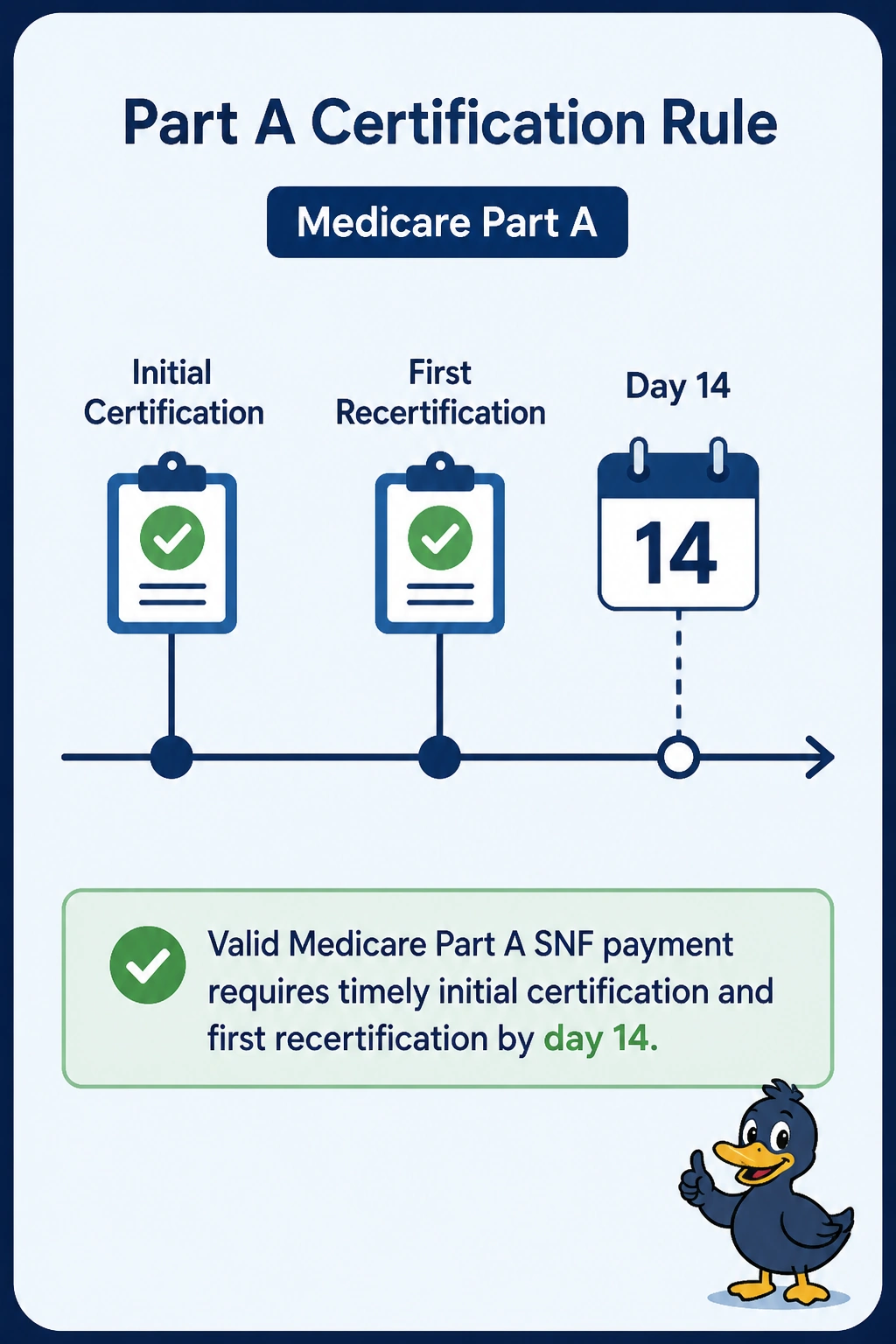
Short Explanation
Medicare Part A pays for skilled care only when the paper trail proves a physician is actively certifying the need on schedule. If your team misses that day-14 recertification checkpoint, the trap is assuming the admission signature covers the whole stay.
Full Explanation
Under 42 CFR 424.20, Medicare Part A skilled nursing facility coverage requires a physician—or a qualified nurse practitioner, clinical nurse specialist, or physician assistant not employed by the facility—to certify and periodically recertify the need for skilled care. Specifically, Valid Medicare Part A SNF payment requires timely initial certification and first recertification by day 14. Subsequent recertifications are required at intervals not exceeding 30 days thereafter, and missing these signatures jeopardizes reimbursement for the affected days. The claim that Medicare Part A requires daily physician recertification signatures for every resident receiving physical therapy is false because daily signatures are not required; the schedule follows admission and the 14-day and 30-day milestones. Saying Only the facility administrator is authorized to sign Medicare Part A recertifications after day 14 is incorrect because administrators are not clinical practitioners and cannot certify medical necessity. Likewise, Missing a day-14 recertification automatically converts the resident's stay to Medicaid without notice is wrong because Medicare billing compliance does not automatically enroll a resident in Medicaid. Caveat: Delayed certification and recertification statements are acceptable when there is a legitimate reason for the delay, and the statement must include an explanation of that reason (42 CFR 424.11(d)(3)); the reason need not be clinical, for example the beneficiary was unaware of entitlement or there was an isolated oversight. Operational check: track certification and recertification due dates on the weekly Medicare utilization review calendar.
Prefer to study offline? Printable PDF study book + test engine ($7.50, unofficial). These questions stay free here.