
A prospective resident's adult son accompanies his mother to sign nursing facility admission paperwork, and the admissions director asks him to sign a personal guarantee making him liable for future unpaid bills. How does federal regulation govern this request?
Select an answer to reveal the explanation.
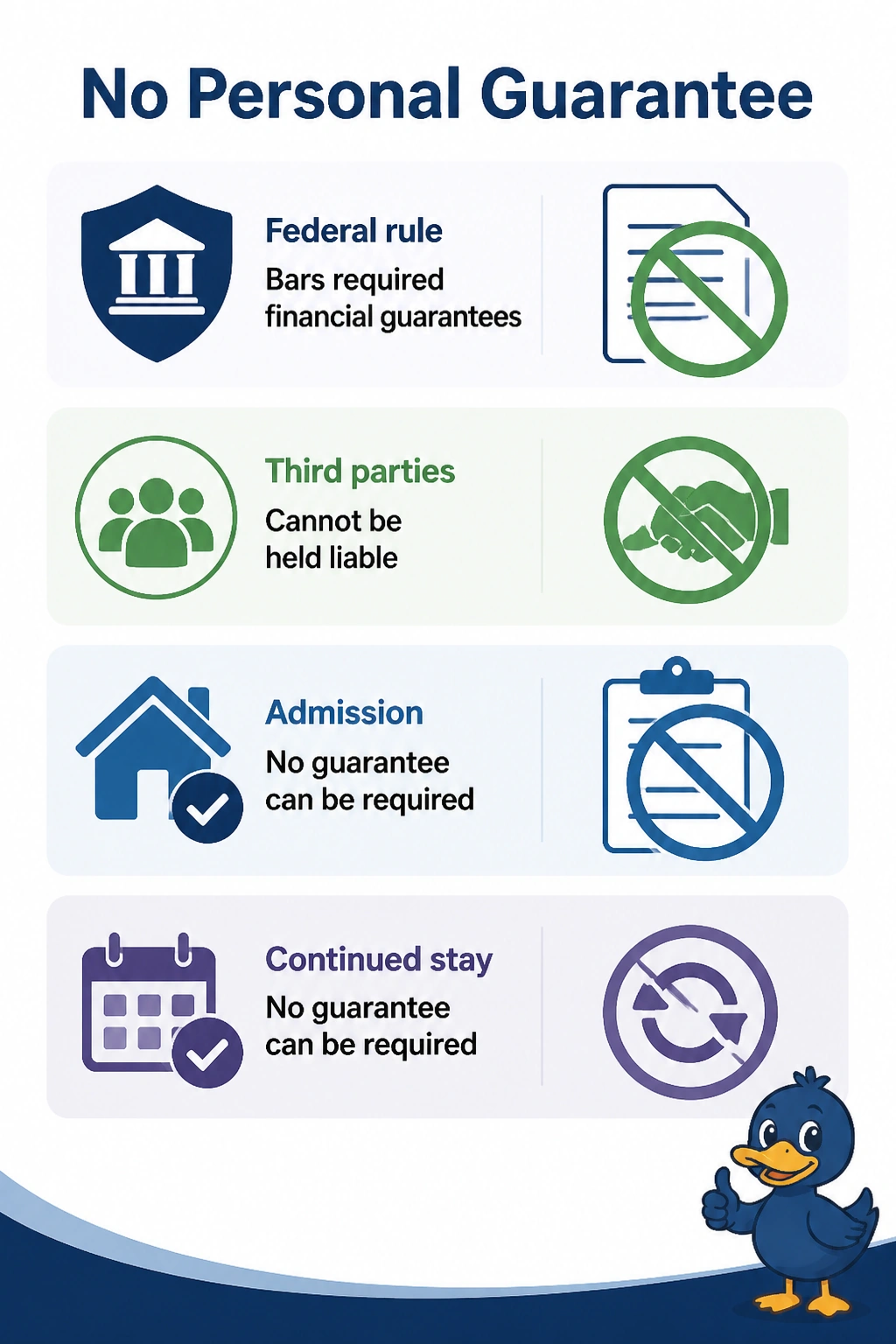
Short Explanation
You may be asked to arrange payment from your mother’s own funds, but federal rules prohibit making you personally responsible as a condition of her admission or stay. Keep the distinction clear: representative access to her funds does not make you a guarantor.
Full Explanation
Under 42 CFR 483.15, a certified nursing facility may not require a third-party financial guarantee as a condition of admission or continued stay. The admissions director therefore cannot make the adult son personally liable for future unpaid bills as a condition of his mother’s admission. A legal representative with access to the resident’s income or resources may agree to arrange payment from those funds, but that does not make the representative personally liable. A guarantee tied to a pending Medicaid application is still prohibited; the ban does not depend on payer source or application status. Choosing a private room does not authorize a family member’s separate personal guarantee: room charges owed by the resident do not create liability for the family. A co-signer cannot be required just because the resident’s income falls below the private rate; the protection does not depend on income level. A caveat is that a third party may voluntarily agree to guarantee payment if the agreement is genuinely uncoerced and not a condition of admission or stay. As a practical check, review admission forms with legal counsel and remove language that makes a family member personally liable or requires a co-signer.
Prefer to study offline? Printable PDF study book + test engine ($7.50, unofficial). These questions stay free here.