
A nursing facility's QAPI committee is investigating a rise in evening medication administration errors and wants a structured visual tool to brainstorm and group potential contributing factors across staffing, equipment, policies, and environment. Which quality-improvement tool best fits this step?
Select an answer to reveal the explanation.
Short Explanation
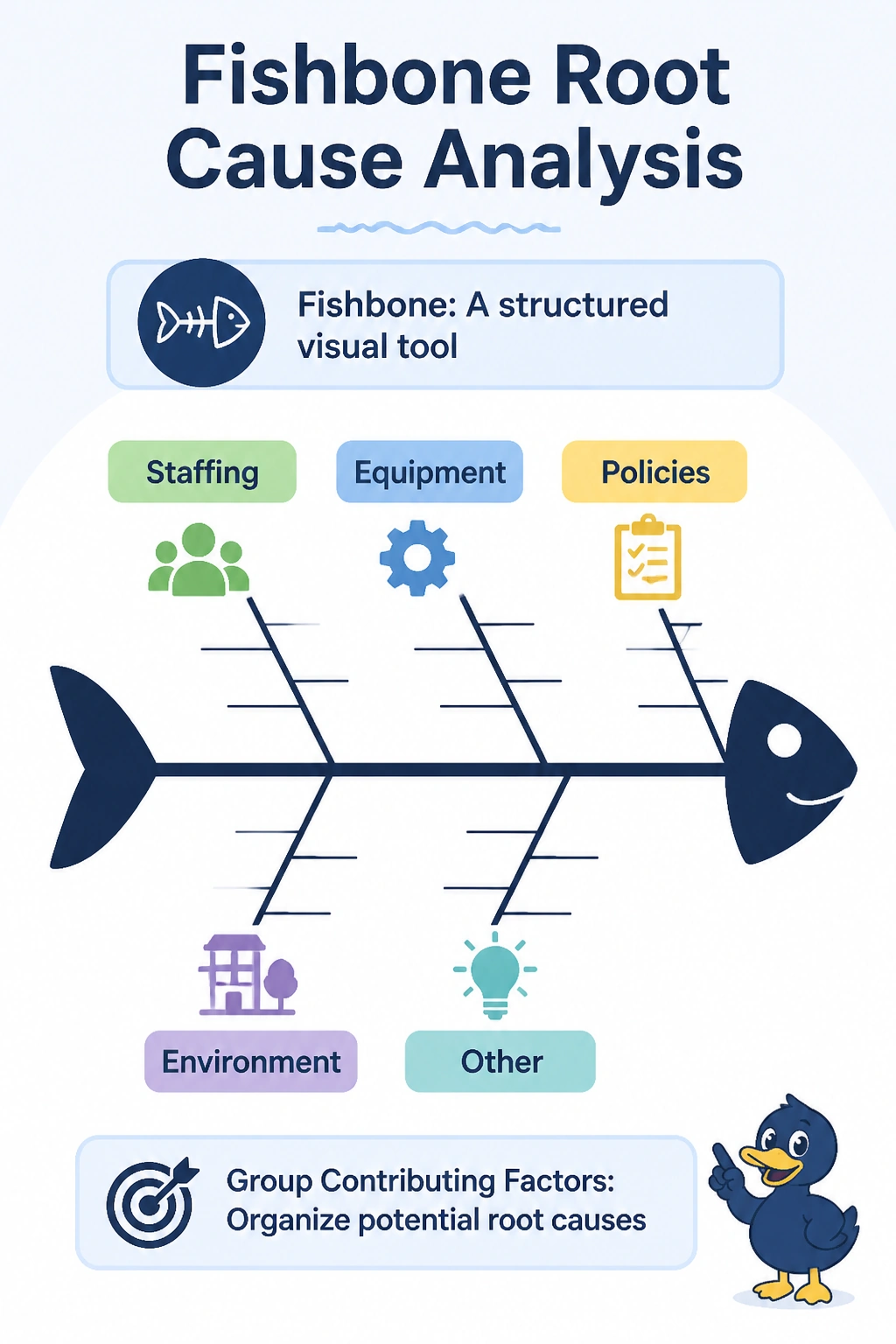
When a quality problem has many possible culprits, you need a map that sorts suspects into neat buckets before jumping to fixes. The trap is grabbing a tally sheet or timeline when your team is still brainstorming why the error happens. A Fishbone diagram lets you visually group causes across people, processes, equipment, and environment.
Full Explanation
A cause-and-effect diagram—commonly called a Fishbone or Ishikawa diagram—is the standard QAPI tool for organizing team brainstorming into structured categories such as staffing, equipment, policies, and physical environment. Using "A Fishbone diagram organizing potential root causes by category" helps the interdisciplinary team see how multiple systemic factors interact to produce evening medication errors before selecting an intervention. Choosing "A Gantt chart tracking project milestones and task completion deadlines" is wrong because Gantt charts manage project schedules rather than diagnose root causes. Selecting "A scatter plot measuring the correlation between two numeric variables" fails because the team is categorizing qualitative workflow drivers, not plotting paired numerical measurements. Picking "A check sheet tallying how often each error type occurs during a single shift" only collects raw frequency counts and does not map underlying system causes. As a caveat, a Fishbone diagram identifies candidate causes rather than proving statistical causation, so teams must verify the primary drivers with chart audits or direct observation. Operationally, facilitate a 30-minute Fishbone session with frontline nurses, pharmacists, and unit aides, then select the top two verified root causes for a small-scale PDSA test.
Prefer to study offline? Printable PDF study book + test engine ($7.50, unofficial). These questions stay free here.