
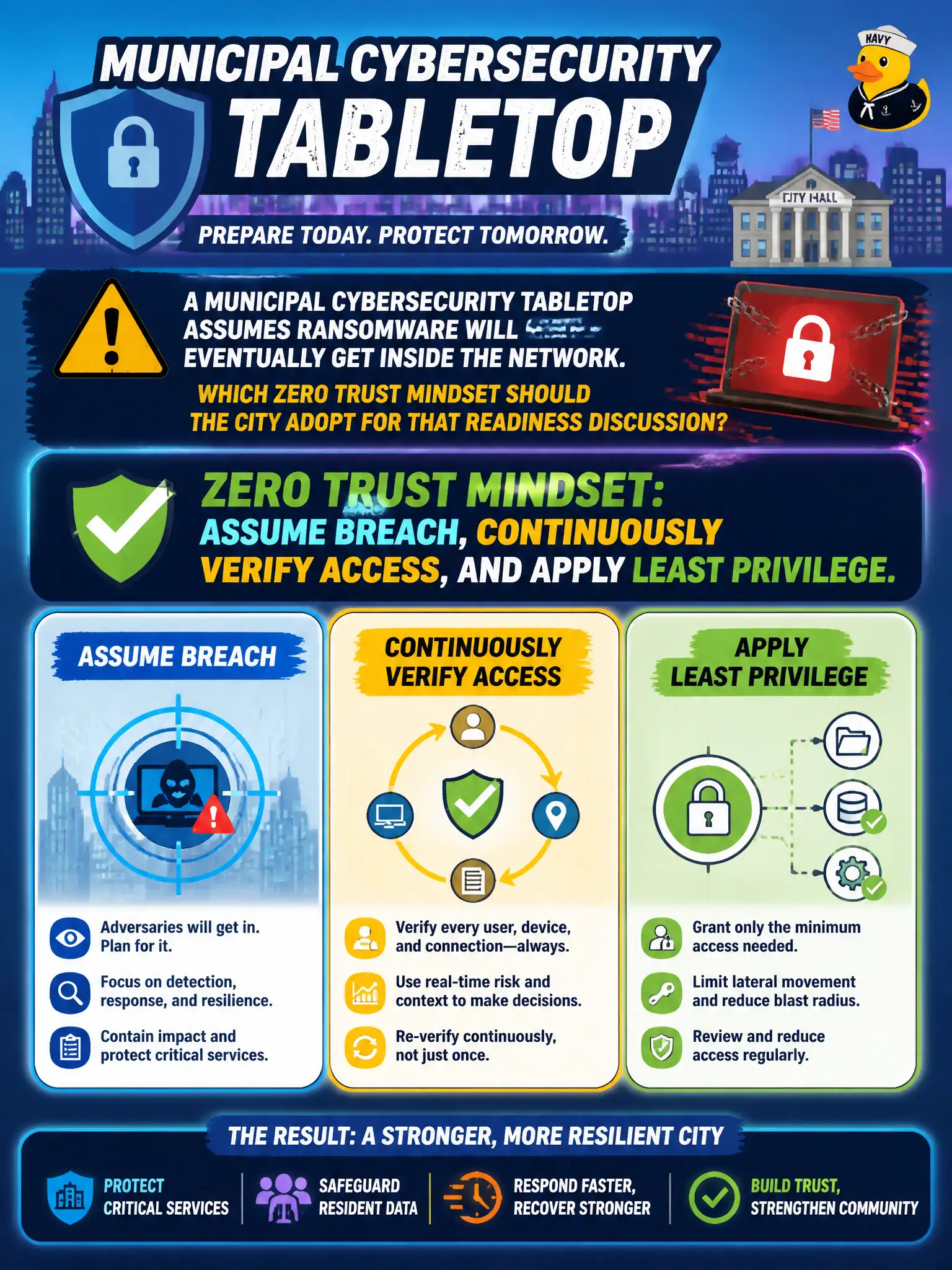
A municipal cybersecurity tabletop assumes ransomware will eventually get inside the network. Which Zero Trust mindset should the city adopt for that readiness discussion?
Select an answer to reveal the explanation.
Short Explanation
Picture the castle walls already cracked—Zero Trust starts there. You keep checking who and what is asking for access, and you only hand out the keys each job actually needs.
Full Explanation
A municipal cybersecurity tabletop that assumes ransomware will eventually get inside should adopt the Zero Trust mindset of assume breach, continuously verify access, and apply least privilege. That framing keeps city defenders from treating the perimeter as infallible and instead focuses on repeated verification of identity, device, and session context with tightly scoped permissions even after initial access occurs.
Trusting every device once it joins city Wi-Fi and skipping further checks is perimeter thinking, not Zero Trust. Treating the perimeter firewall alone as complete protection ignores identity and endpoint compromise paths ransomware commonly uses. Disabling identity verification after the first successful sign-in each day abandons continuous verification.
Exam caveat: assume breach does not mean ignore prevention; it means design detection and least privilege as if prevention will fail. Operational check: during the tabletop, require MFA plus Conditional Access device signals for admin roles, verify privileged accounts use just-in-time elevation where available, and document which blast-radius limits exist if ransomware steals one workstation token. In municipal Microsoft 365 fundamentals scenarios, always map the business need to the named capability, reject distractors that describe a different pillar, and verify the control in the admin portal before telling leadership the risk is closed.