
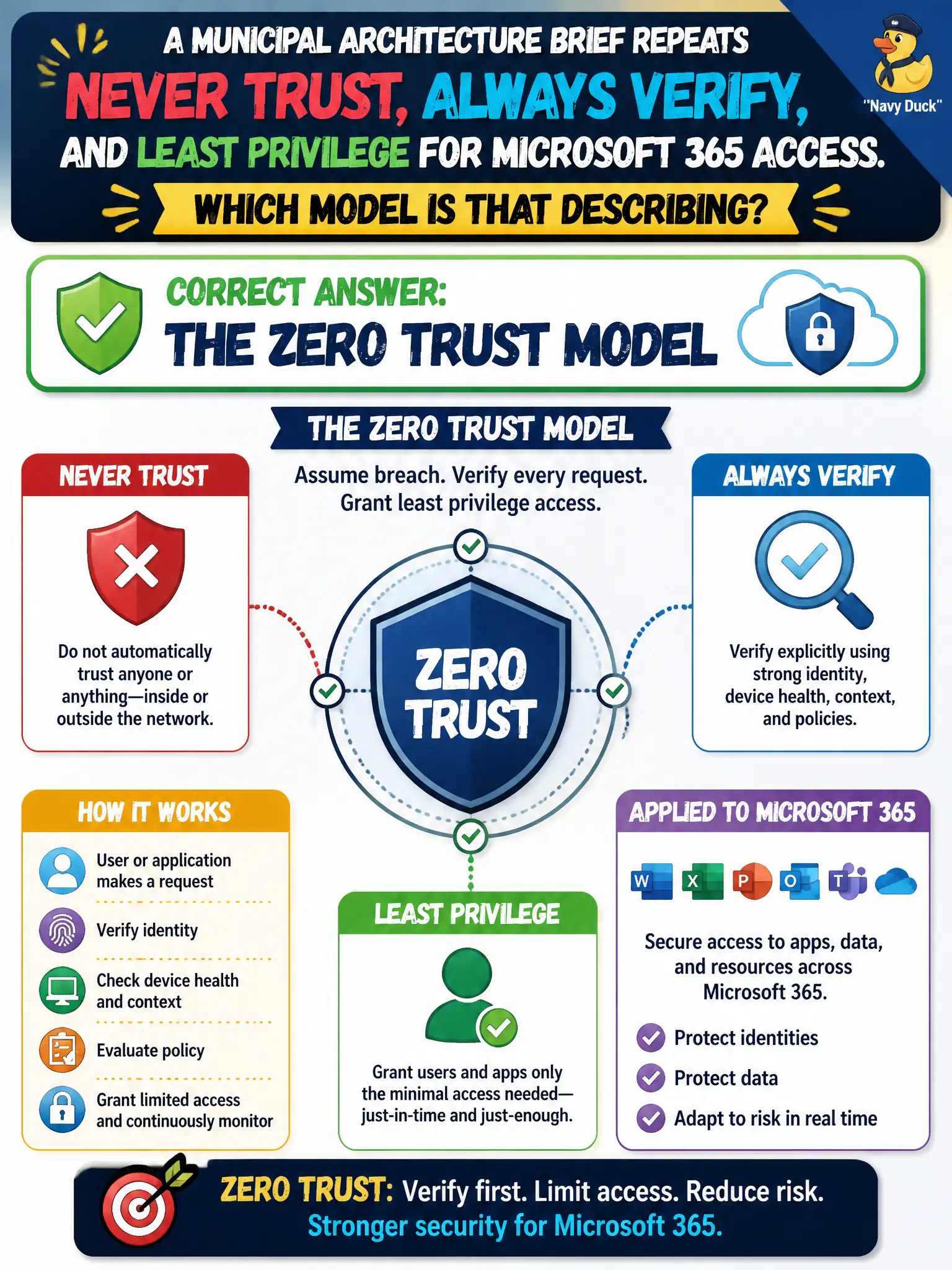
A municipal architecture brief repeats never trust, always verify, and least privilege for Microsoft 365 access. Which model is that describing?
Select an answer to reveal the explanation.
Short Explanation
Never trust, always verify, least privilege—that is Zero Trust in a slogan. Assume breach, check identity and context continuously, and hand out only the access someone needs.
Full Explanation
Never trust, always verify, and least privilege describe the Zero Trust model. For a municipal architecture brief, that means assume breach, continuously validate identity and session context, and grant only the access required for the job—across users, devices, apps, and data—rather than trusting a network location alone because someone is on city Wi-Fi. MS-900 expects candidates to recognize those slogans as Zero Trust principles applied to Microsoft 365 access design, not as purchasing jargon or DNS trivia.
CapEx-only purchasing is a financial model for capital spend, not an access-security architecture. Perpetual on-premises CAL stacking describes legacy licensing patterns, not continuous verification of users and devices. Single-forest DNS scavenging is an Active Directory DNS hygiene task and has nothing to do with Zero Trust access principles for cloud workloads.
Exam caveat: Zero Trust is a strategy spanning multiple products (Entra, Intune, Conditional Access, Purview, Defender, and more)—not a single feature toggle or one-time project. Operational check: map city access policies to Zero Trust pillars—strong authentication, device compliance signals, least-privilege roles, and data protection—and verify Conditional Access requires MFA for municipal admins rather than trusting the office network alone.