
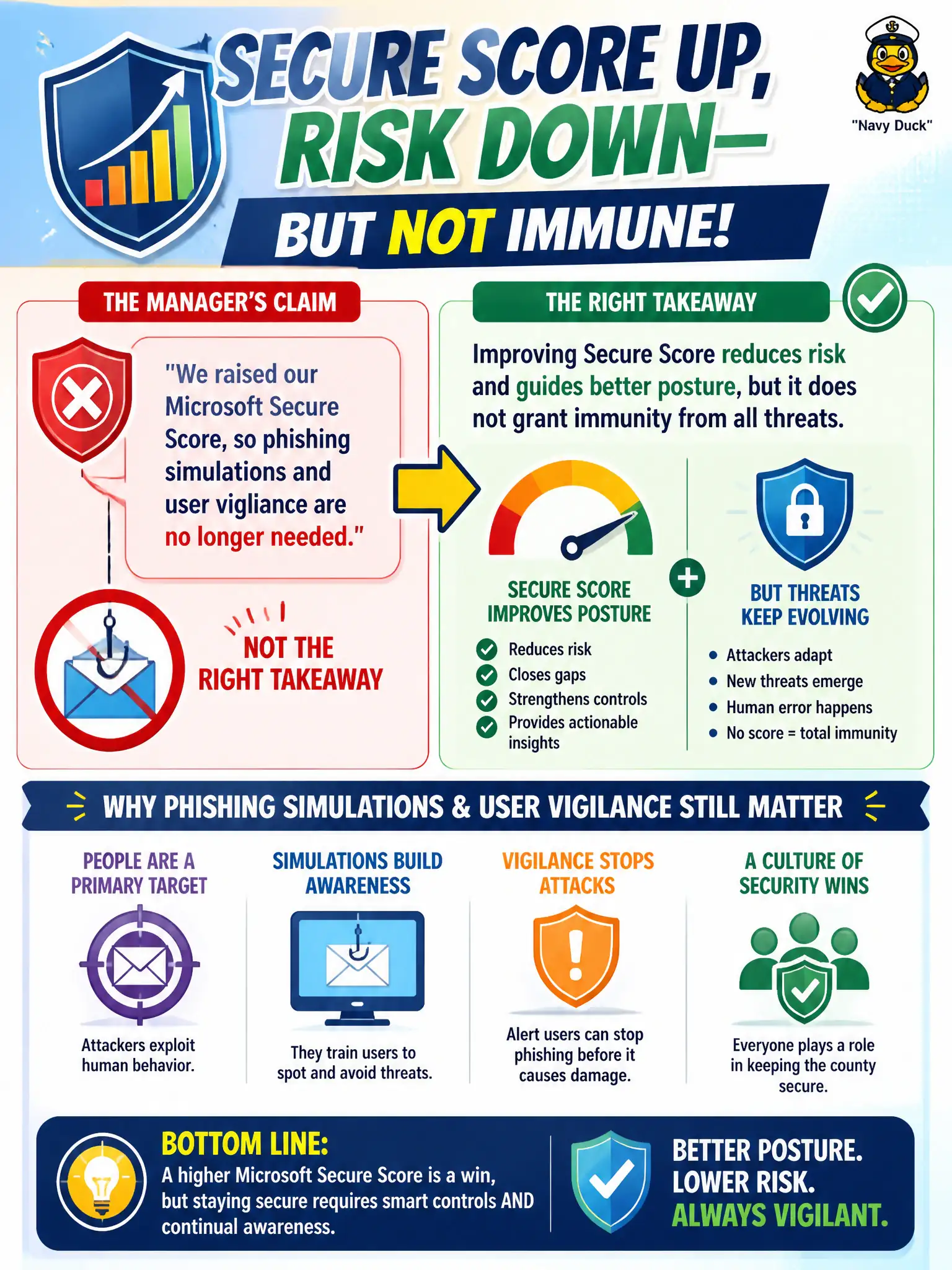
After a county raises its Microsoft Secure Score, a manager claims phishing simulations and user vigilance are no longer needed. What is the right takeaway?
Select an answer to reveal the explanation.
Short Explanation
A higher Secure Score means you tightened a lot of bolts—great. It is not a force field. People can still get phished, so training and simulations still matter.
Full Explanation
Raising Microsoft Secure Score improves recommended security posture and guides municipal IT toward better configurations, but it does not grant immunity from all threats. Phishing simulations and user vigilance remain necessary because attackers still target people, and residual risk always remains. A county manager who treats a higher score as a force field misunderstands Secure Score as a measurement and improvement system, not a complete elimination of human or novel attack risk.
A perfect Secure Score does not mean attackers cannot phish anyone ever again. Secure Score does not disable all email to make phishing impossible. Secure Score does not replace MFA permanently once it rises above an arbitrary threshold such as 50; identity controls remain independent requirements.
Exam caveat: Secure Score recommendations are valuable, but organizations may accept some risks or have compensating controls—score alone is not a compliance certificate. Operational check: after Secure Score improvements, keep a phishing simulation cadence for staff, track click and report rates, and show council both the score trend and ongoing awareness metrics so posture gains are not mistaken for zero residual risk.