
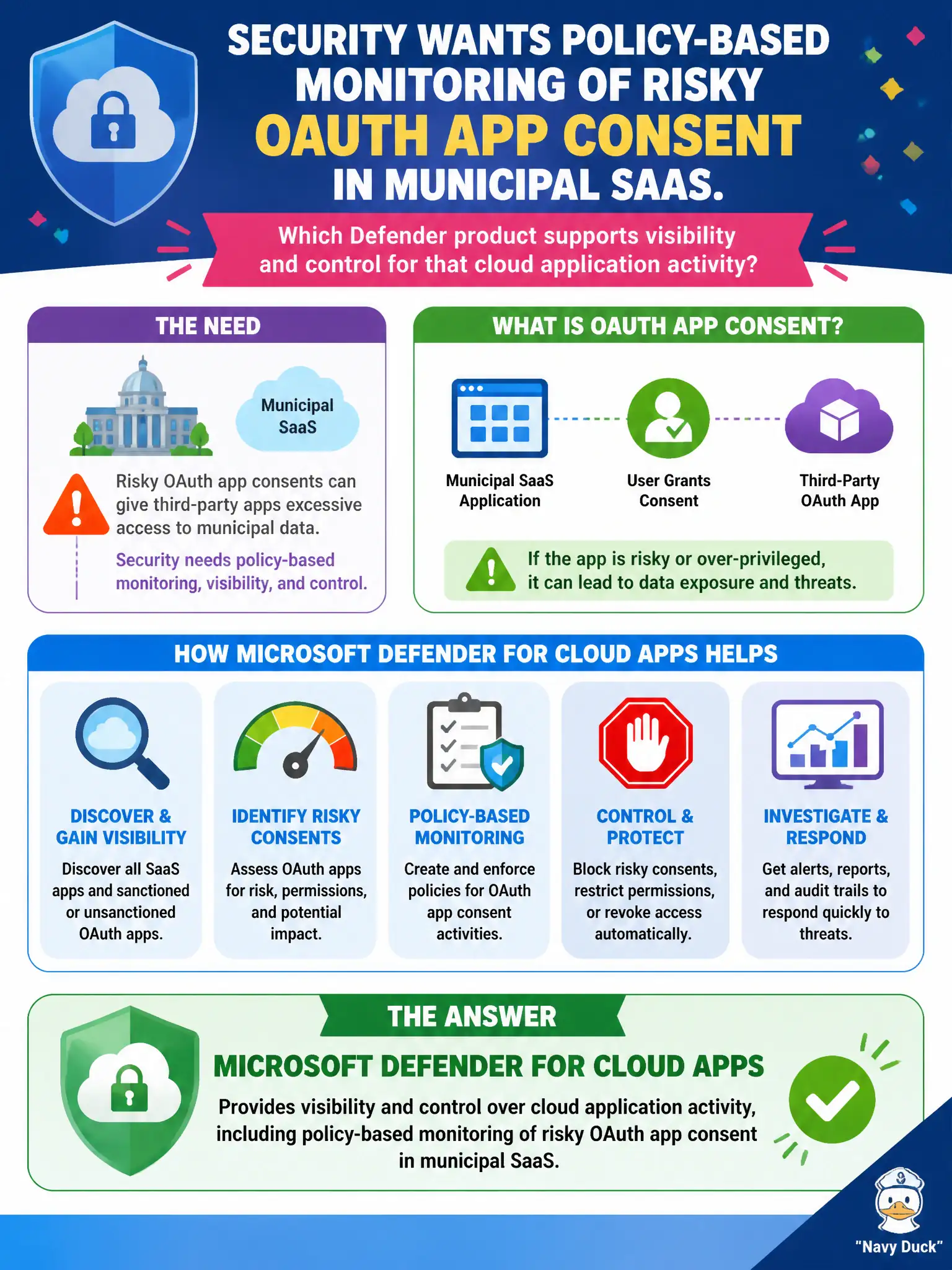
Security wants policy-based monitoring of risky OAuth app consent in municipal SaaS. Which Defender product supports visibility and control for that cloud application activity?
Select an answer to reveal the explanation.
Short Explanation
OAuth consent can hand a third-party app the keys to city SaaS. Defender for Cloud Apps gives visibility and control over that cloud app activity. Clipchamp, signatures, and Word restricted editing are not CASB-style consent monitors.
Full Explanation
Microsoft Defender for Cloud Apps supports visibility and control for risky OAuth app consent and related cloud application activity in municipal SaaS. OAuth consent phishing and over-privileged app grants are a common cloud app risk, so cities need CASB-style monitoring rather than pretending creative or authoring tools broker consent policy. MS-900 maps that cloud application governance need to Defender for Cloud Apps.
Microsoft Clipchamp is a video editor, not the consent broker or CASB control plane. Outlook signatures are email branding, not OAuth policy. Word restricted editing limits document edits and is not a CASB for OAuth app risk.
An exam caveat is that app consent policies in Entra ID and Defender for Cloud Apps controls often work together; fundamentals still point to Defender for Cloud Apps for cloud app activity monitoring and control narratives. Operationally, review OAuth app consents for municipal users, flag high-risk grants, configure governance or blocking policies appropriate to city risk tolerance, and re-check Defender for Cloud Apps after remediation for residual risky consent activity. Publish an approved-app consent standard for municipal staff that explains who may grant tenant-wide permissions and how to request review for new SaaS integrations. Consent hygiene fails when every employee improvises grants under project pressure.