
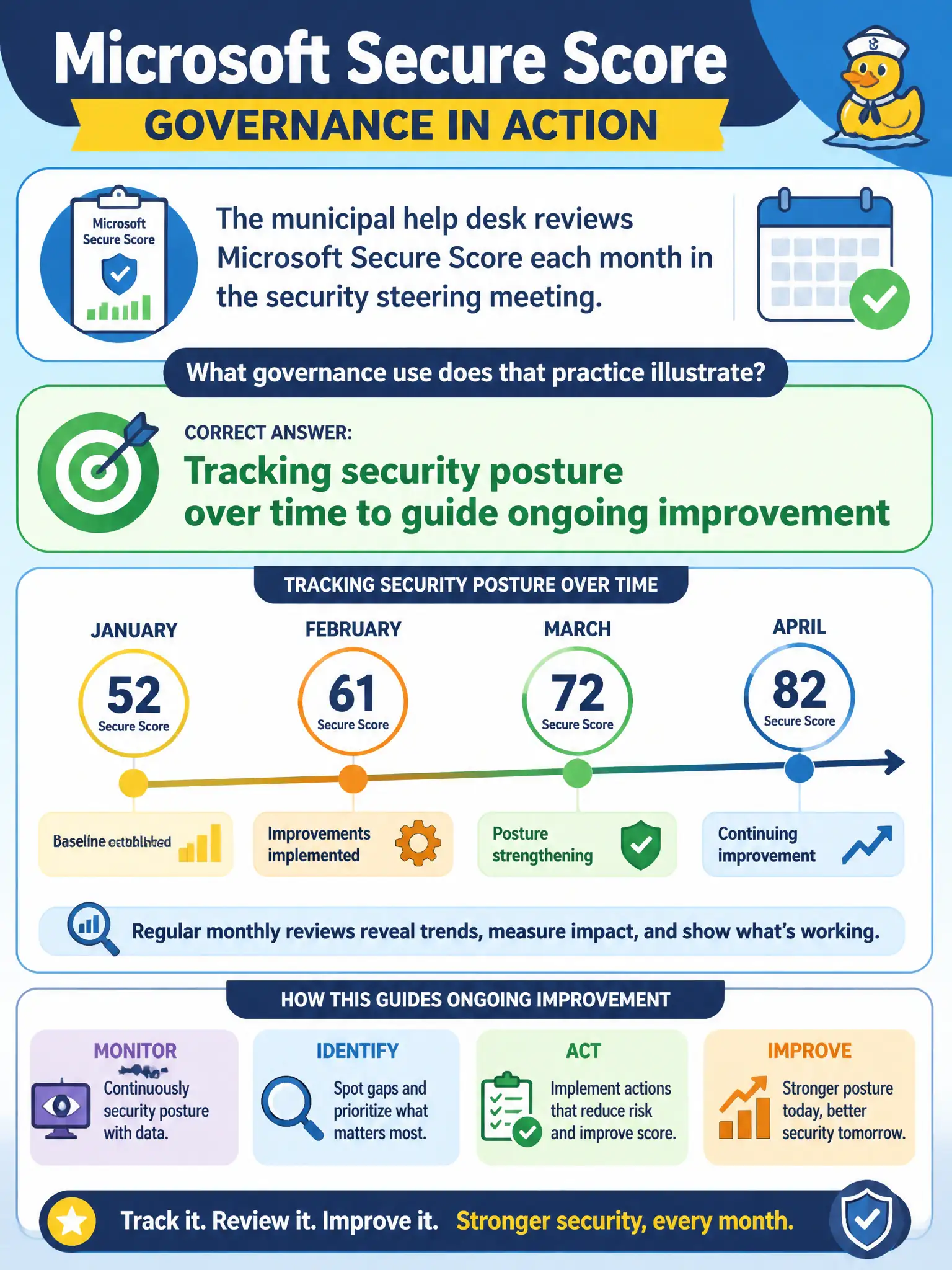
The municipal help desk reviews Microsoft Secure Score each month in the security steering meeting. What governance use does that practice illustrate?
Select an answer to reveal the explanation.
Short Explanation
Monthly Secure Score check-ins are like reviewing the city's safety dashboard — is the posture climbing or slipping? Steering uses the trend and recommendations to prioritize work. It is not a billing engine, a Project license bot, or an SLA substitute.
Full Explanation
Tracking security posture over time to guide ongoing improvement is the governance use illustrated when the municipal help desk or security team reviews Microsoft Secure Score each month in the steering meeting. Regular Secure Score reviews turn posture into a management rhythm instead of a one-time snapshot after an audit scare. MS-900 associates Secure Score with continuous improvement governance for Microsoft 365 security.
Secure Score points are not a mechanism for billing CSP invoices. Secure Score does not assign Microsoft Project licenses automatically. Replacing all SLAs with Secure Score percentages misunderstands both service management and security scoring.
An exam caveat is that score increases should be interpreted with context—some points are easier than others, and operational risk may justify delayed adoption of specific recommendations. Operationally, place Secure Score on the monthly security steering agenda, record the score and top open improvements, assign owners with due dates, and compare trend lines across quarters for city leadership. Keep a simple scorecard archive—month, score, top three open improvements, owners—so turnover in municipal IT does not erase posture history. Over time that archive becomes evidence for auditors that the city manages Microsoft 365 security as a continuous program.