
A council briefing claims XDR is 'just antivirus on each PC.' What correction best describes Microsoft Defender XDR at fundamentals depth?
Select an answer to reveal the explanation.
Short Explanation
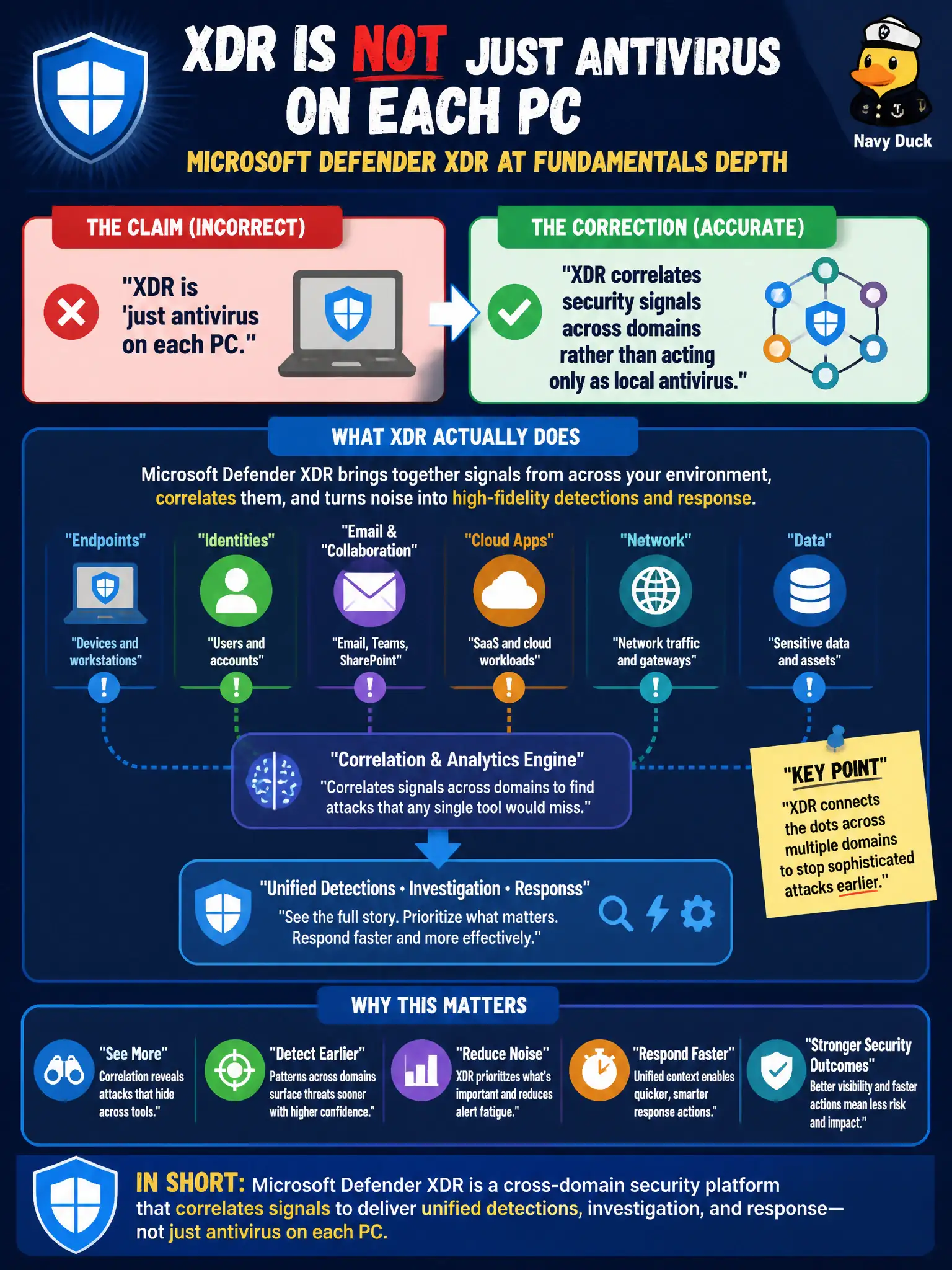
Antivirus on one box is a smoke detector in one room. XDR is the whole-building alarm panel — correlating email, identity, endpoint, and app signals together. It is not Entra ID, a SharePoint template pack, or a network firewall SKU.
Full Explanation
XDR correlates security signals across domains rather than acting only as local antivirus, which is the correction when a council briefing claims Microsoft Defender XDR is just antivirus on each PC. Extended detection and response stitches email, identity, endpoint, and cloud app signals into broader incidents for municipal SOC teams. That cross-domain correlation is the fundamentals definition candidates must defend in stakeholder conversations.
XDR does not replace Microsoft Entra ID as the identity directory. XDR is not only a SharePoint site template gallery. XDR is not solely an Azure Firewall SKU for CAD networks.
An exam caveat is that endpoint antivirus capabilities may still exist within the broader security stack, but calling XDR “just antivirus” understates its correlation purpose and leads to underfunded SOC processes. Operationally, demonstrate an XDR-style incident in the Microsoft Defender portal that links more than one domain’s alerts, brief council staff on that multi-signal view, and update talking points so leadership funding requests match the real XDR value. When funding conversations arise, compare the cost of disconnected product consoles and missed lateral movement against a Defender XDR workflow that already links those alerts for on-call staff. Council briefings improve when leaders see one correlated incident timeline instead of four disconnected screenshots.