
A city moves from treating cloud identity as optional to requiring Microsoft Entra ID for every Microsoft 365 workload. What fundamentals conclusion does that adoption reflect?
Select an answer to reveal the explanation.
Short Explanation
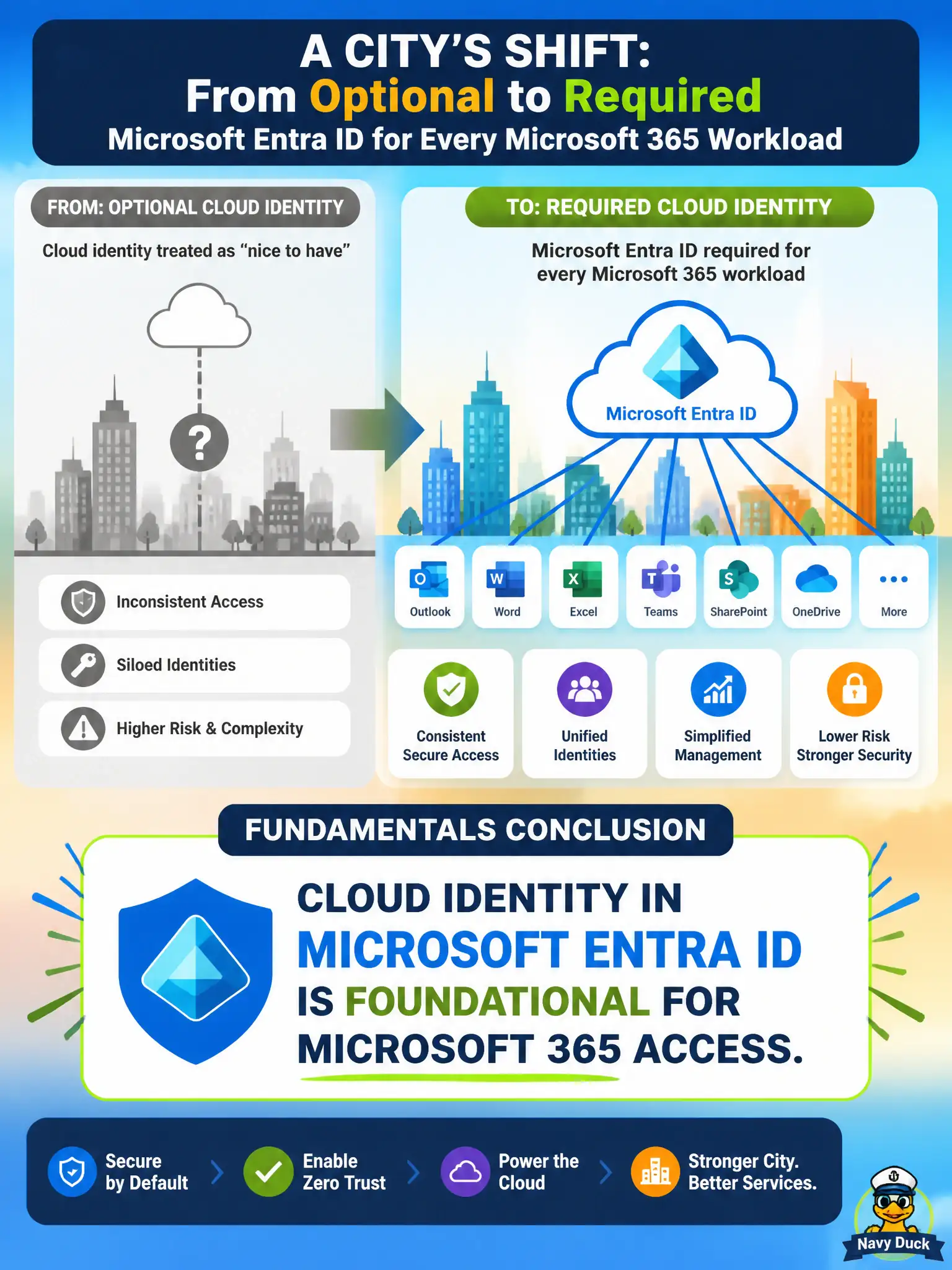
If every M365 workload must use Entra ID, the city finally treated cloud identity as the front door—not a nice-to-have. That is the right fundamentals conclusion. No Entra ID, no proper Microsoft 365 access story.
Full Explanation
Cloud identity in Microsoft Entra ID is foundational for Microsoft 365 access, which is the fundamentals conclusion when a city moves from treating cloud identity as optional to requiring Entra ID for every Microsoft 365 workload. Outlook, Teams, SharePoint, and related services depend on cloud identity integration; treating Entra ID as optional misunderstands the platform. Municipal adoption programs should therefore place Entra ID at the center of Microsoft 365 enablement, not at the edge.
Microsoft 365 cannot fully operate long-term with no identity service of any kind. On-premises DNS alone is not sufficient authentication for Exchange Online and Teams. Cloud identity is needed for core workloads such as Outlook and SharePoint, not only for irrelevant desktop accessories.
An exam caveat is that foundational Entra ID still leaves room for hybrid sync when on-premises directories remain, but the cloud identity dependency does not disappear. Operationally, confirm every Microsoft 365 workload the city uses authenticates against Entra ID identities, remove any outdated “optional cloud identity” language from architecture decks, and require Entra ID accounts in onboarding before provisioning Microsoft 365 apps.