
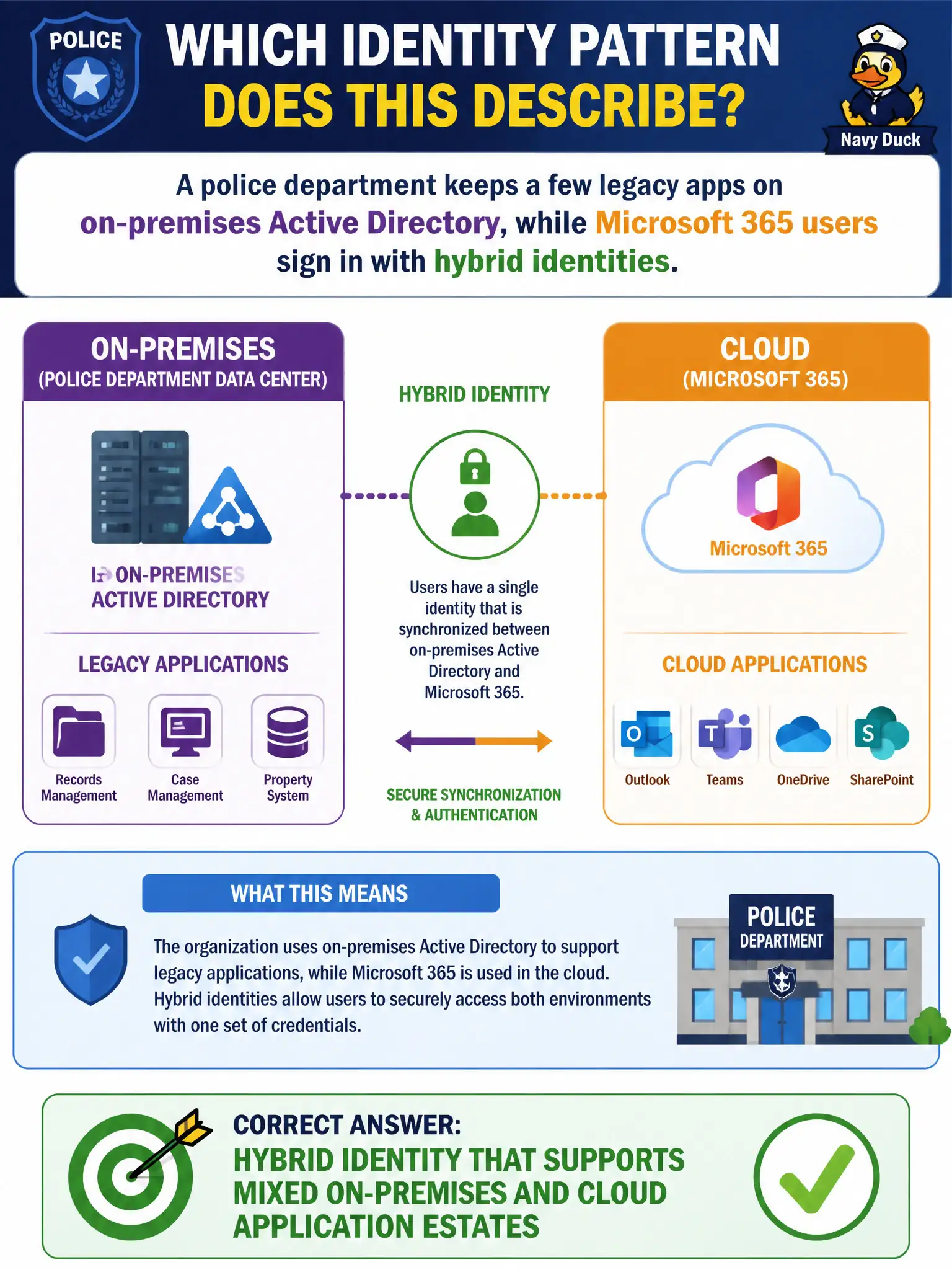
A police department keeps a few legacy apps on on-premises Active Directory while Microsoft 365 users sign in with hybrid identities. Which identity pattern does this describe?
Select an answer to reveal the explanation.
Short Explanation
Think of hybrid identity like a bridge between the old station house and the new cloud HQ. Some apps still lean on on-premises Active Directory, while Microsoft 365 rides Entra ID with synced or federated identities. That mix is the hybrid pattern — not an either-or choice.
Full Explanation
Hybrid identity that supports mixed on-premises and cloud application estates describes a police department that keeps a few legacy apps on on-premises Active Directory while Microsoft 365 users sign in with hybrid identities. Public-safety environments often retain specialized on-premises applications longer than productivity suites, so hybrid identity lets one employee identity span both worlds. MS-900 wants that mixed-estate pattern recognized as hybrid, not as cloud-only or as a desktop-hosting substitute for identity.
Cloud-only Entra ID with no on-premises directory remaining does not match a department that still depends on AD DS for legacy apps. Private cloud hosting that replaces Entra ID entirely is not the Microsoft 365 identity pattern described. Azure Virtual Desktop session hosts deliver desktops; they are not the identity control plane.
An exam caveat is that hybrid identity requires disciplined sync and lifecycle operations, especially for joiner-mover-leaver processes in sworn and civilian staff populations. Operationally, verify legacy police apps still authorize against AD DS, confirm the same users sync to Entra ID for Microsoft 365, and test access to both a legacy app and Exchange Online after a typical account change.