
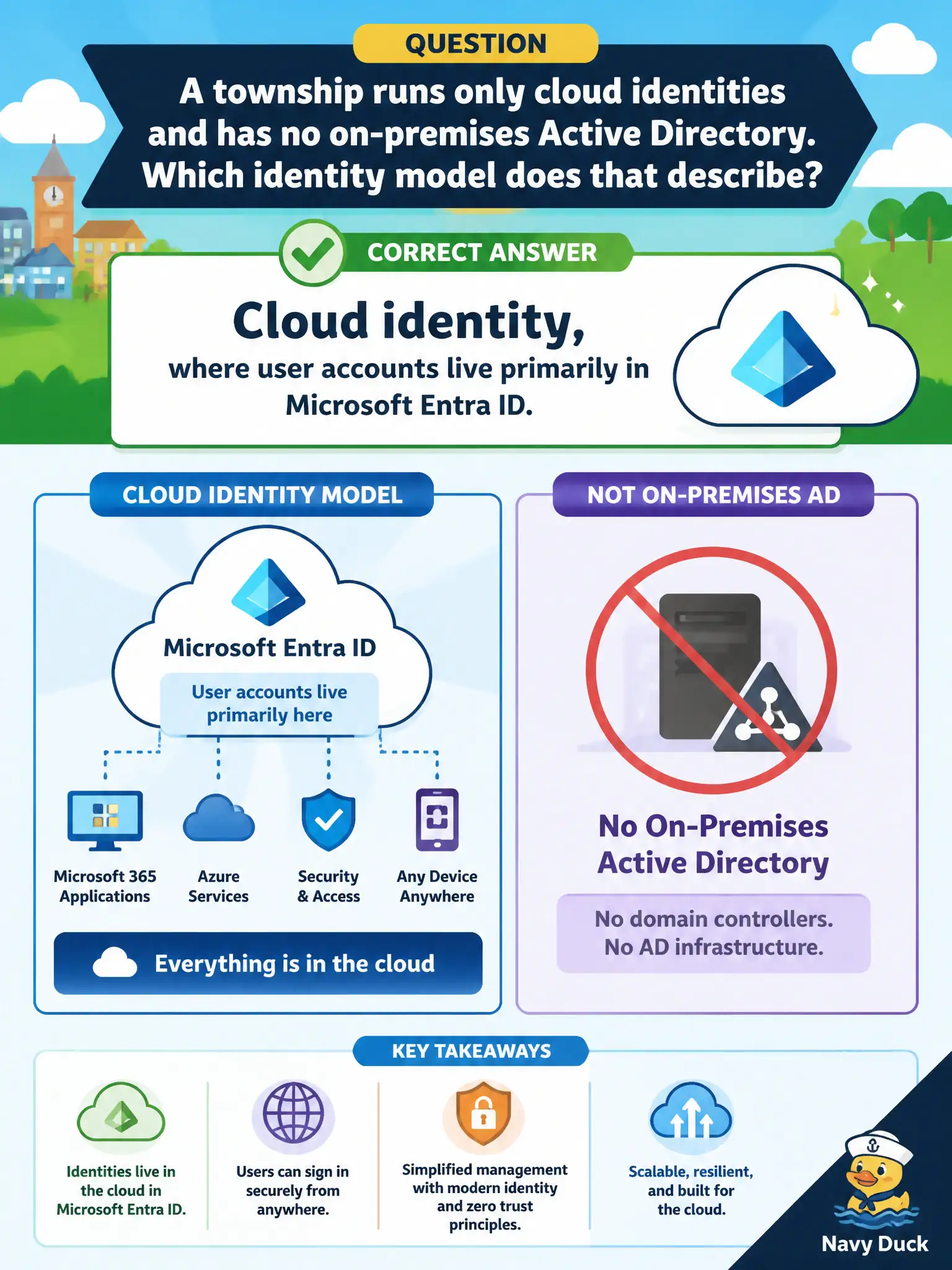
A township runs only cloud identities and has no on-premises Active Directory. Which identity model does that describe?
Select an answer to reveal the explanation.
Short Explanation
If the township never stood up a local domain controller for staff accounts, the directory is living in the cloud. That is cloud identity in Entra ID. No on-prem AD, no hybrid sync story required.
Full Explanation
Cloud identity describes an identity model where user accounts live primarily in Microsoft Entra ID, which fits a township that runs only cloud identities and has no on-premises Active Directory. Many modern municipal startups, small towns, or cloud-first departments choose this model so Microsoft 365 sign-in does not depend on maintaining domain controllers. MS-900 expects candidates to distinguish cloud, on-premises, and hybrid identity models by where accounts primarily live and whether directory sync is required.
Hybrid identity always implies a relationship between on-premises directories and Entra ID, so it is the wrong label when no on-premises Active Directory exists. On-premises identity only would require every account to exist in AD DS and does not match a cloud-only township. Conditional Access is an adaptive access policy feature, not an identity hosting model; it can protect cloud or hybrid identities but does not define where accounts are mastered.
An exam caveat is that cloud identity does not mean Conditional Access or MFA are optional; those controls still matter for protecting Entra ID accounts. Operationally, confirm there is no Entra Connect or cloud sync dependency for the township, verify users are created and managed in Entra ID, and document cloud identity as the official municipal identity model for Microsoft 365 onboarding.