
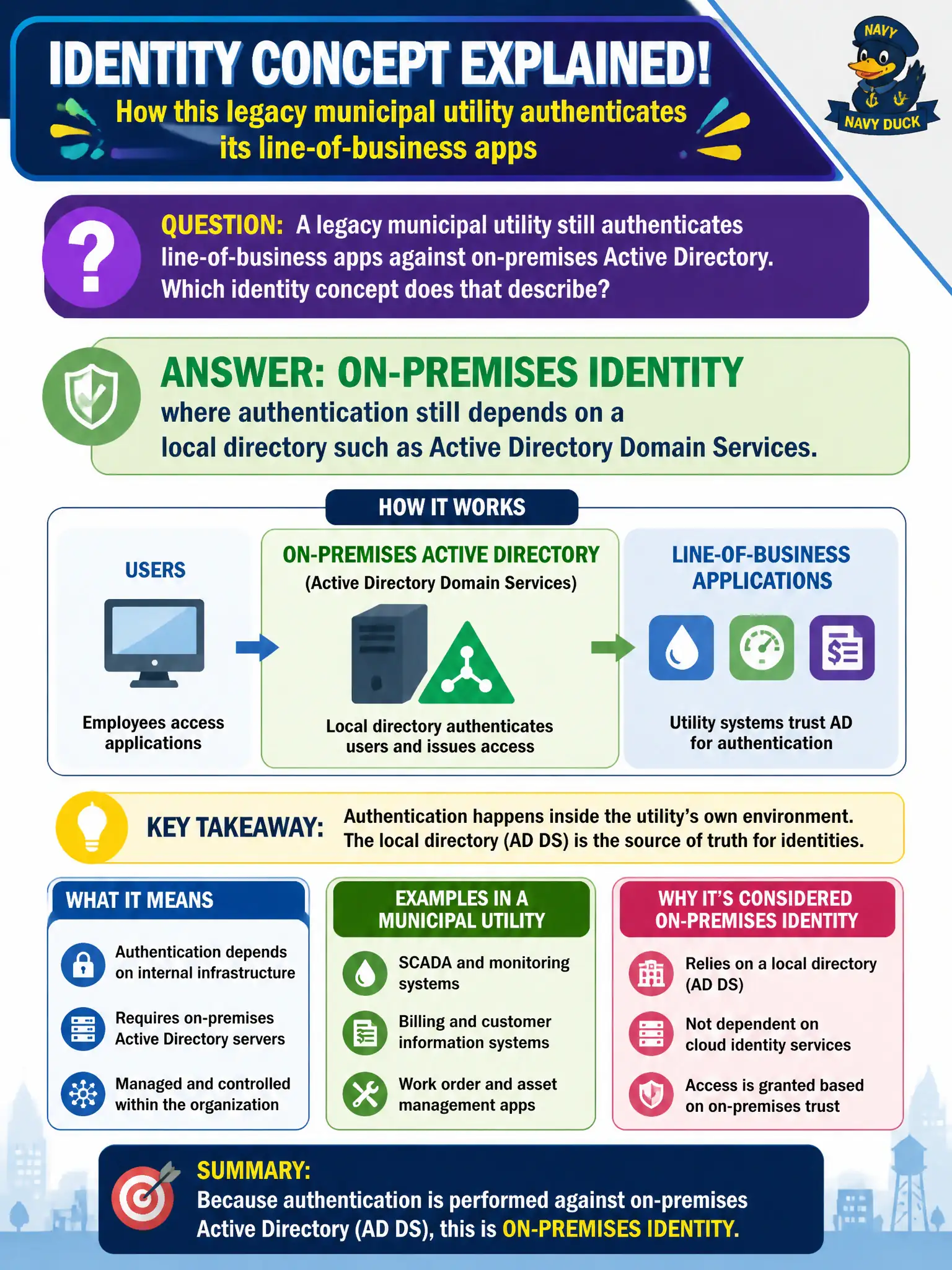
A legacy municipal utility still authenticates line-of-business apps against on-premises Active Directory. Which identity concept does that describe?
Select an answer to reveal the explanation.
Short Explanation
Some city systems still check badges at the old local front desk—Active Directory on-premises. That is on-premises identity for those LOB apps. Cloud Microsoft 365 can sit beside it, but those apps still trust the local directory.
Full Explanation
On-premises identity describes authentication that still depends on a local directory such as Active Directory Domain Services, which matches a legacy municipal utility authenticating line-of-business apps against on-premises AD. Many civic environments keep some LOB apps tied to AD DS even while moving productivity workloads to Microsoft 365, so recognizing on-premises identity as a distinct concept remains exam-relevant. The key idea is where authentication authority lives for those apps.
Cloud-only identity places every account solely in Entra ID with no on-premises directory, which contradicts a utility still authenticating against AD DS. Microsoft Purview data loss prevention protects sensitive content; it does not host user authentication for LOB apps. Microsoft 365 Copilot Chat assists with answers and productivity scenarios; it does not authenticate line-of-business apps against AD DS.
An exam caveat is that organizations often run mixed estates: on-premises identity for some LOB apps and cloud or hybrid identity for Microsoft 365. Operationally, inventory which municipal apps still bind to AD DS, document that on-premises identity dependency for the utility LOB systems, and separate that from Entra ID sign-in paths used for Exchange Online or Teams.