
A county telephony project needs advanced calling features that are not included in the staff's core Microsoft 365 productivity plan. How should the licensing story be framed?
Select an answer to reveal the explanation.
Short Explanation
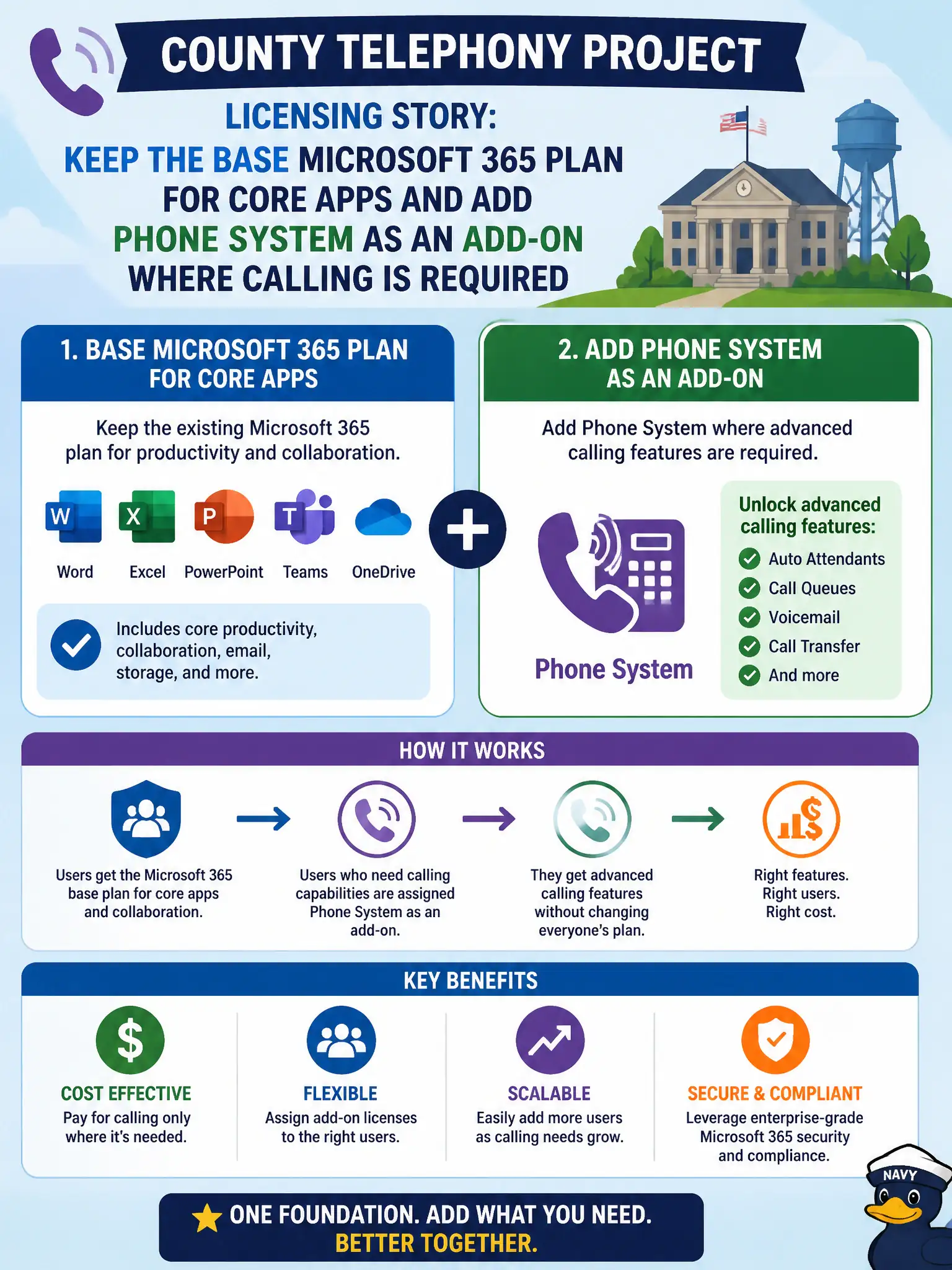
Think of the base plan as the house and Phone System as the optional porch. Keep the house for everyday apps, then bolt on calling only where the county actually needs phones in Teams.
Full Explanation
When some staff need telephony beyond core collaboration, keep the base Microsoft 365 plan for core apps and add Phone System as an add-on where calling is required. That base-plus-add-on pattern is the fundamentals licensing model for advanced calling in municipal organizations.
Replacing every base Microsoft 365 license with a Visio-only SKU for all staff removes core productivity. Buying Phone System alone for every employee and skipping any base productivity license misunderstands add-on prerequisites. Treating Phone System as the only license needed to replace Word, Excel, and Teams is incorrect.
Exam caveat: exact add-on names and eligibility depend on current SKUs—MS-900 cares that telephony is commonly an add-on atop an eligible base. Operational check: identify users who need PSTN calling, confirm they have eligible base licenses, assign Phone System add-ons only to that subset, and validate dial capabilities. In municipal Microsoft 365 fundamentals scenarios, map the business need to the named capability, reject distractors from a different pillar, and verify the control or commercial setting in the admin or billing experience before reporting risk closed to leadership.