
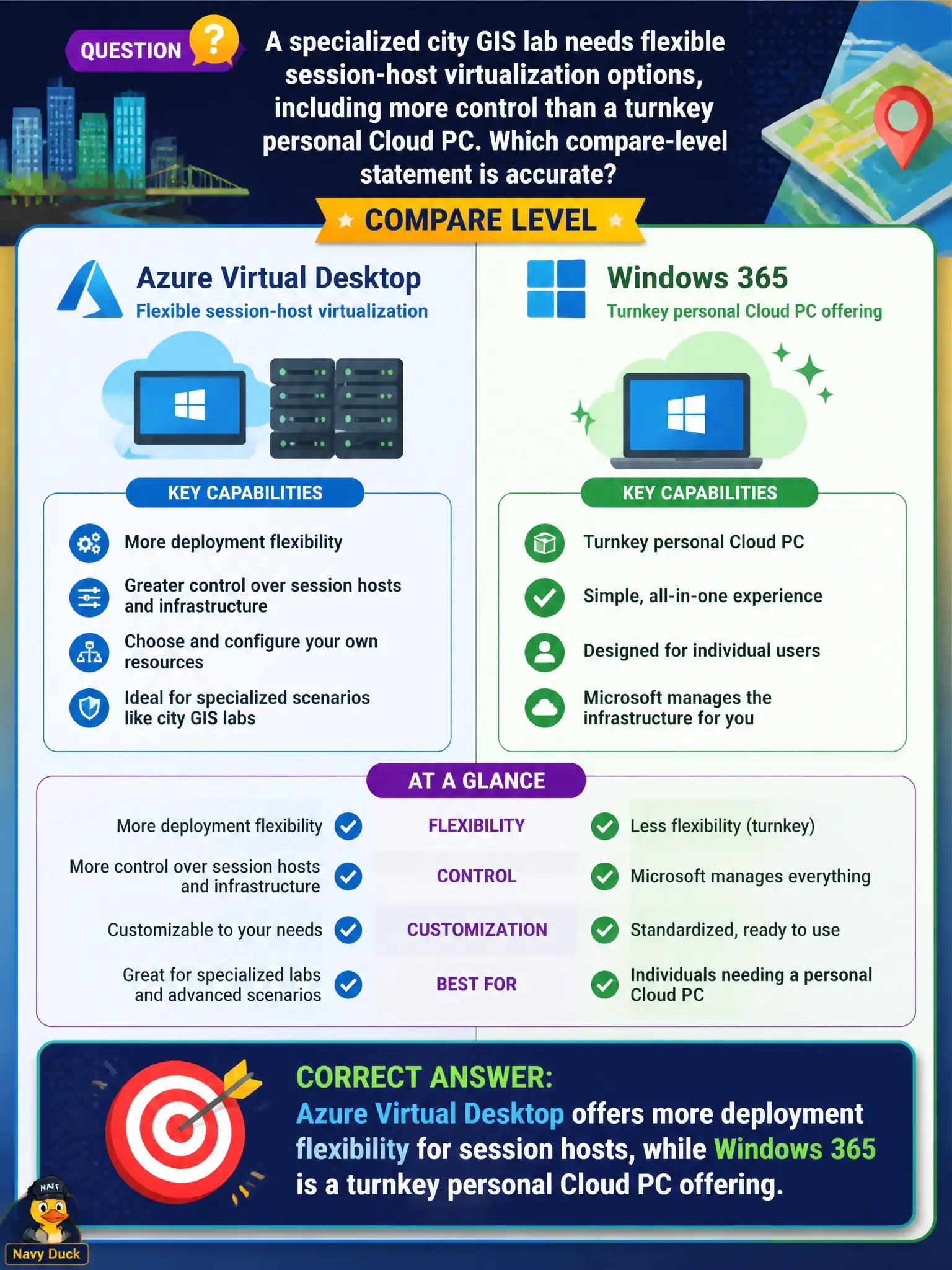
A specialized city GIS lab needs flexible session-host virtualization options, including more control than a turnkey personal Cloud PC. Which compare-level statement is accurate?
Select an answer to reveal the explanation.
Short Explanation
AVD is the customizable workshop; Windows 365 is the ready-to-rent personal studio. Labs that need flexible session hosts usually lean AVD in the compare story.
Full Explanation
A specialized city GIS lab that needs flexible session-host virtualization options—including more control than a turnkey personal Cloud PC—should recognize that Azure Virtual Desktop offers more deployment flexibility for session hosts, while Windows 365 is a turnkey personal Cloud PC offering. Labs that need customized host pools, multi-session density, or deeper virtualization control typically compare toward AVD; simple personal desktops compare toward Windows 365. GIS workloads often need that extra platform flexibility.
Claiming Windows 365 always offers more host-pool flexibility than AVD reverses the flexibility comparison. Claiming AVD and Windows 365 are identical SaaS products with the same deployment model fails the compare objective. Claiming only Microsoft Lists can host GPU-oriented lab desktops for GIS workloads is false—Lists is not a VDI platform.
Exam caveat: AVD = flexible virtualization/platform; Windows 365 = turnkey personal Cloud PC. Match GIS lab flexibility needs to AVD in this stem.
Operational check: prototype AVD host pools for GIS sessions, evaluate GPU/sizing needs as capacity planning, compare against Windows 365 for simpler personas, document the decision criteria, and keep Lists out of the VDI architecture discussion.