
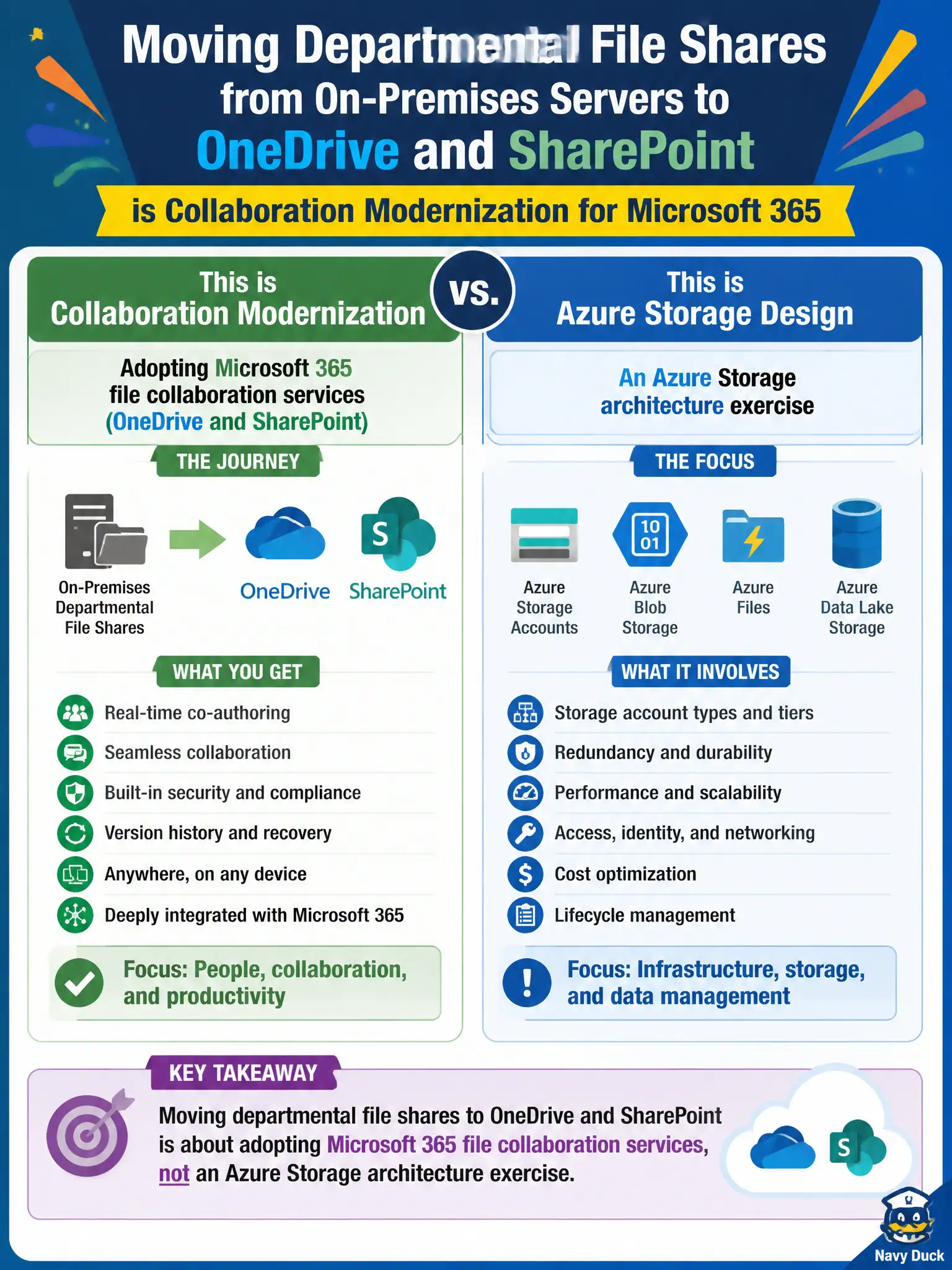
IT explains that moving departmental file shares from on-premises servers to OneDrive and SharePoint is collaboration modernization for Microsoft 365. How should that be framed versus Azure storage design?
Select an answer to reveal the explanation.
Short Explanation
Moving the shared drive into OneDrive and SharePoint is upgrading how people work together on files—not redrawing Azure Blob redundancy maps. MS-900 stays on the collaboration services wall. Leave LRS/GRS deep-dives to AZ-900 territory.
Full Explanation
IT explaining that moving departmental file shares from on-premises servers to OneDrive and SharePoint is collaboration modernization should frame it as adopting Microsoft 365 file collaboration services (OneDrive and SharePoint), not an Azure Storage architecture exercise. The MS-900 point is personal and team file collaboration in Microsoft 365—not redesigning Blob redundancy with LRS/GRS as the core topic.
Framing it as an Azure Blob redundancy redesign using LRS and GRS as the MS-900 core topic fails the exam lane: that is Azure storage architecture, not Microsoft 365 collaboration modernization. Claiming Microsoft 365 cannot store any files and only Azure Disks apply is false. Replacing all identity with local SAM accounts on each file server forever rejects cloud identity and collaboration modernization.
Exam caveat: Azure storage knowledge is valuable elsewhere; on MS-900 file-collaboration questions, prefer OneDrive/SharePoint framing over Blob redundancy trivia.
Operational check: migrate department shares into SharePoint libraries and personal work into OneDrive per boundary guidance, remap permissions thoughtfully, train staff on Files in Teams, and keep LRS/GRS discussions in Azure architecture forums—not as the definition of Microsoft 365 collaboration modernization.