
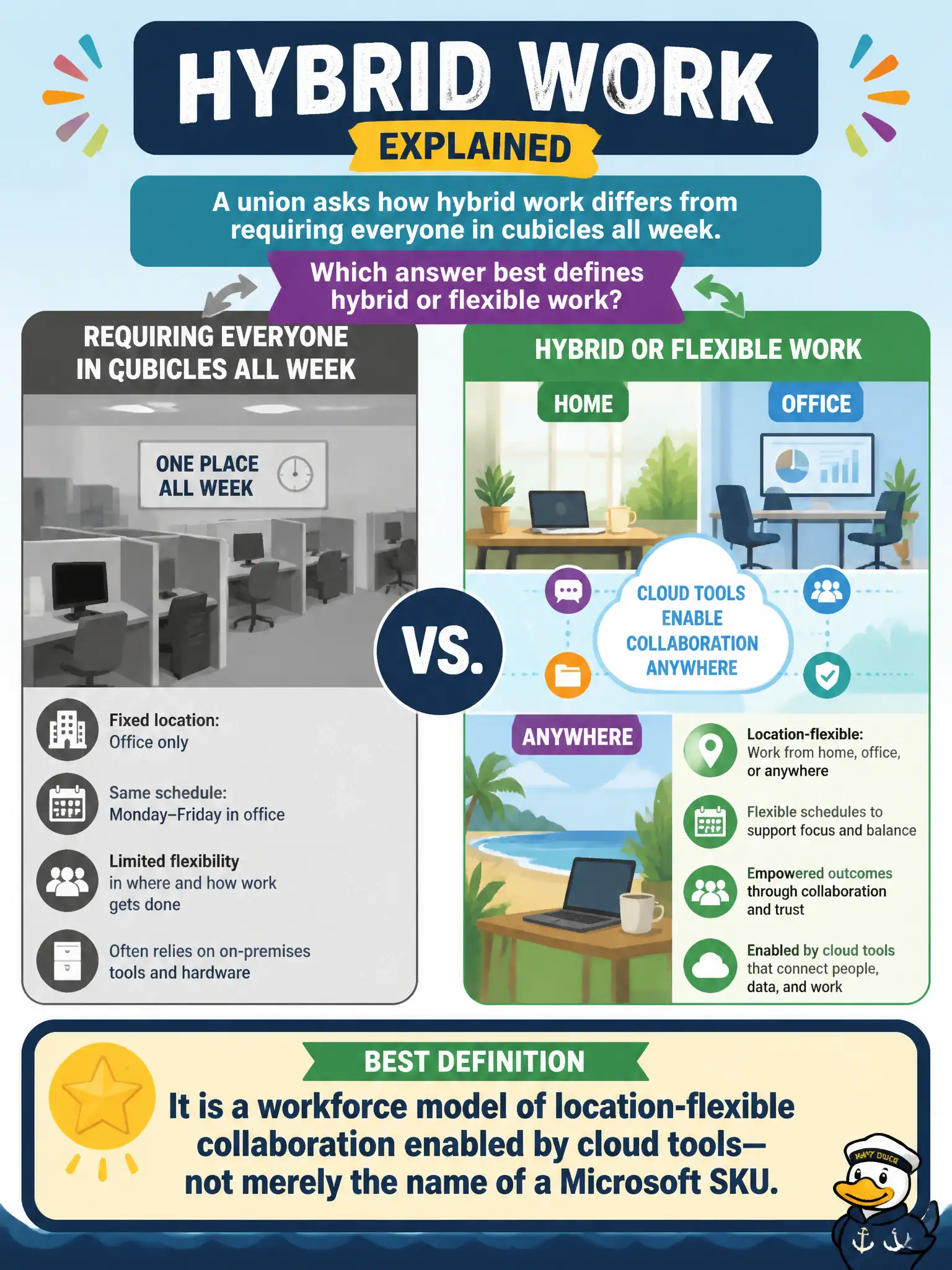
A union asks how hybrid work differs from requiring everyone in cubicles all week. Which answer best defines hybrid or flexible work?
Select an answer to reveal the explanation.
Short Explanation
Hybrid work is a people pattern: some days in the office, some days not—with cloud tools keeping collaboration alive. It is not an update channel name or an Azure region trivia answer.
Full Explanation
Hybrid or flexible work is a workforce model of location-flexible collaboration enabled by cloud tools—not merely the marketing name of a Microsoft SKU. When a union asks how that differs from requiring everyone in cubicles all week, the accurate answer emphasizes people and place patterns supported by Microsoft 365 collaboration, not an update-channel label.
Calling hybrid work only the Semi-Annual Enterprise Channel fails because update channels govern Apps servicing, not where humans work. Saying every employee must permanently abandon office buildings and never use Teams meetings misstates hybrid work, which mixes locations rather than forbidding offices or meetings. Equating hybrid work with Azure availability zones fails conceptually: availability zones are datacenter resilience constructs unrelated to staff location policy.
Exam caveat: workforce flexibility still requires labor-policy alignment, timekeeping rules, and security baselines for remote devices. Operational check: publish a hybrid-work technology checklist (MFA, compliant device, approved storage), train managers on meeting norms, and review whether cubicle-only assumptions remain in outdated SOPs. Record the choice in the municipal service catalog so help-desk scripts stay consistent.