
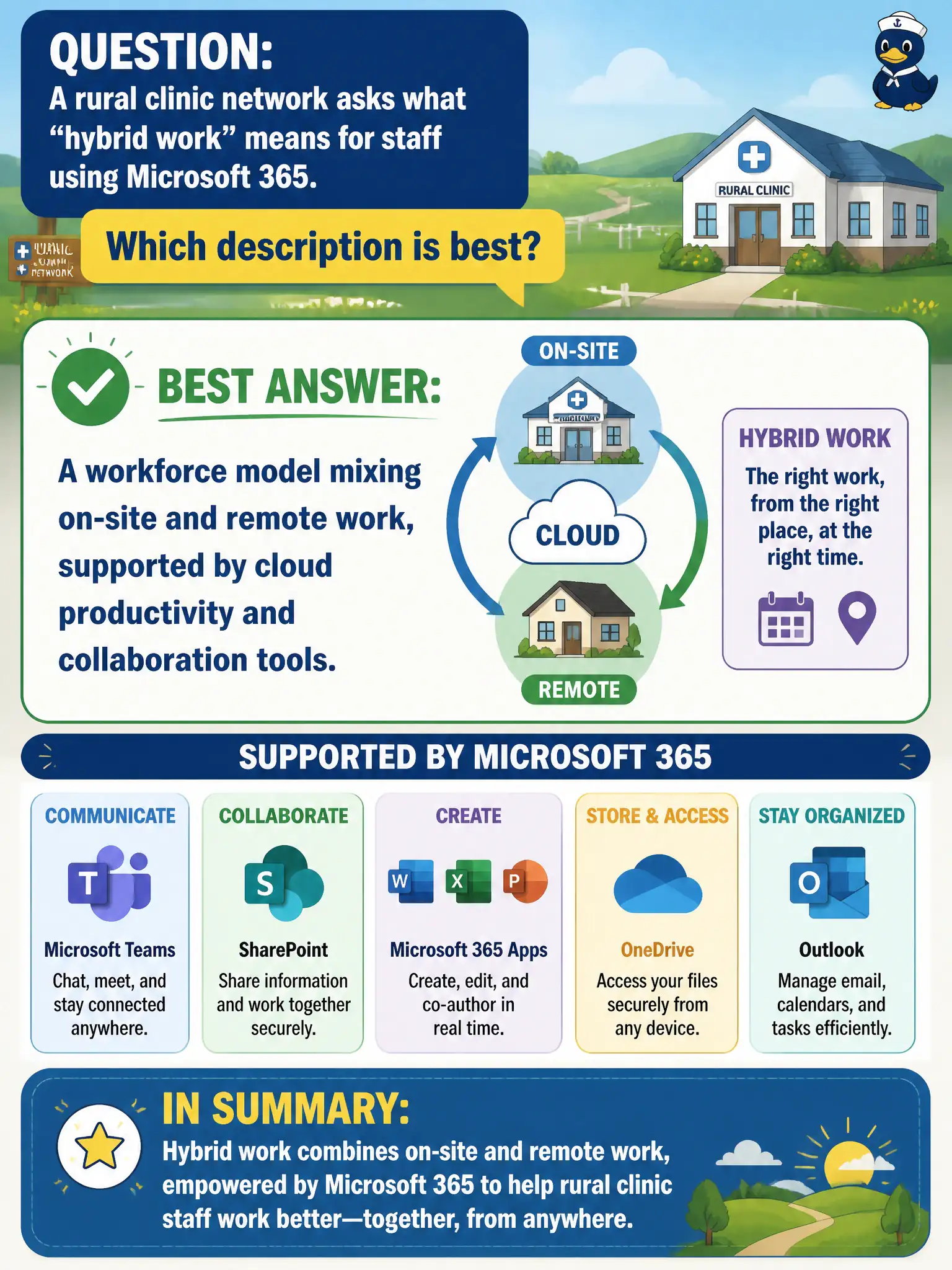
A rural clinic network asks what "hybrid work" means for staff using Microsoft 365. Which description is best?
Select an answer to reveal the explanation.
Short Explanation
Hybrid work is about where people work—office some days, remote or field other days—not a magic SKU name. Microsoft 365 tools like Teams and shared docs are what make that mix practical.
Full Explanation
Hybrid work is a workforce model that mixes on-site and remote work, supported by cloud productivity and collaboration tools such as those in Microsoft 365. For a rural clinic network, that people-and-place definition is the accurate fundamentals meaning: clinicians and staff may split time between facilities and remote locations while still collaborating digitally on care coordination and administration.
Calling hybrid work a Microsoft SKU that replaces Teams, Outlook, and SharePoint with a single on-premises server fails product literacy. Requiring every clinician to work only from a basement cubicle with no remote access contradicts the definition of hybrid or flexible work. Treating hybrid work as an Azure networking topology of VNets and availability zones fails conceptually because those are infrastructure constructs, not workforce location models.
Exam caveat: hybrid work still demands strong identity security, device compliance, and careful handling of clinical or constituent records accessed from remote sites. Operational check: confirm remote clinicians can reach Teams, Outlook, and required documents under Conditional Access and MFA, and align HR telework policy language with the technical controls actually enforced.